
- Solve real problems with our hands-on interface
- Progress from basic puts and calls to advanced strategies
Interactive Options Course
Posted April 16, 2026 at 12:15 pm
The S&P 500 is often treated as the ultimate barometer of the US stock market. When it rises, investors feel confident. When it falls, fear quickly spreads across financial markets worldwide. But while most people focus only on the index itself, a deeper and often more revealing story can be found beneath the surface: in the sectors that make up the S&P 500.
By studying sector rotation and the relative behavior of key sectors, investors can gain valuable clues about the internal health of the market. In some cases, these signals can even help anticipate major market tops before the broader index starts to decline. In other words, rather than simply watching the market’s headline performance, investors can examine its internal structure—almost like giving the market a blood test and an X-ray.
This is where S&P 500 sector analysis becomes especially powerful.
The S&P 500 is not a single entity moving in isolation. It is the sum of multiple sectors, each reflecting a different part of the economy. Financials, Technology, Consumer Discretionary, Consumer Staples, Industrials, Energy, Utilities, Healthcare, Real Estate, Communication Services, and Materials all contribute to the broader picture.
When investors move capital from one sector to another, they are revealing what they believe about the economy, risk appetite, liquidity conditions, and future growth. This process is known as sector rotation, and it can offer early warning signs that are invisible if you only look at the index level.
For example, a market can still be making new highs while economically sensitive sectors begin to weaken. On the surface, everything may look strong. Underneath, however, confidence may already be fading. That disconnect often matters.
This is why analyzing the sectors of the S&P 500 can help investors understand not just where the market is, but where it may be heading next.
Among all sectors, two stand out when trying to identify potential market tops: Consumer Discretionary and Financials.
Consumer Discretionary includes companies tied to non-essential spending. Think of automobiles, luxury goods, entertainment, restaurants, travel, home improvement, and retail categories that consumers typically spend on when they feel confident and financially secure. When this sector performs well, it usually suggests a healthy appetite for risk, strong consumer sentiment, and an economy that is still expanding.
Financials tell a different but equally important story. Banks and financial institutions are deeply linked to liquidity, credit creation, economic confidence, and the overall flow of money through the system. If Financials are losing momentum, it can signal that conditions are becoming less favorable beneath the surface, even before the broader market reacts.
These two sectors act as an internal health check on the market. When the S&P 500 rises but Consumer Discretionary or Financials fail to confirm the move, investors should pay attention.
That kind of non-confirmation can be a warning that the rally is becoming fragile.
One of the most intuitive ways to read the market is to compare Consumer Discretionary with Consumer Staples.
Consumer Staples includes companies that sell essential goods: food, beverages, household products, and personal care items. These are the products consumers continue buying even when the economy slows and financial conditions worsen. As a result, Staples tend to be more defensive.
Consumer Discretionary, on the other hand, depends more heavily on optimism and spending flexibility. People can postpone buying a new car, renovating a house, or taking a vacation. They can reduce spending on entertainment, apparel, and luxury goods. Because of that, this sector often performs better when confidence is strong and risk appetite is healthy.
The relationship between these two sectors can say a lot about the market environment. When Consumer Discretionary outperforms, it often reflects a classic risk-on backdrop. When Consumer Staples starts to outperform, especially while the S&P 500 remains near highs, that can suggest growing caution among investors.
This shift does not always mean a market crash is imminent. But it can indicate that the market is no longer as healthy as the index alone might suggest.
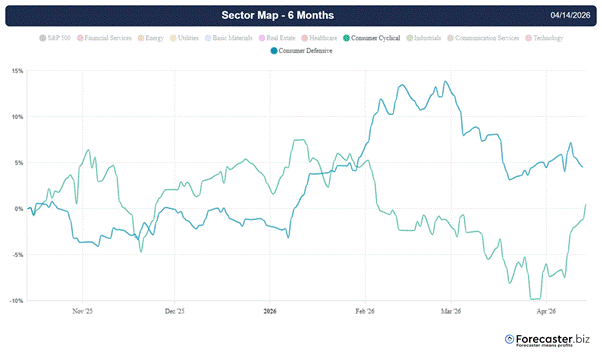
Over the last six months, the Consumer Defensive sector has significantly outperformed Consumer Cyclical stocks. This rotation toward essential goods and away from discretionary spending often signals growing caution among investors, as capital shifts toward safer and more resilient businesses. In short: the market is showing signs of fear rather than confidence. Source: Forecaster Terminal Sector Map
One of the most useful concepts in sector analysis is divergence.
A bearish divergence appears when the S&P 500 makes a new high, but one or more key sectors fail to do the same. In other words, the index is still climbing, but the sectors that should be supporting that move are weakening or lagging behind.
This matters because sustainable bull markets typically require broad participation. When leadership narrows and key sectors stop confirming the advance, the market becomes more vulnerable.
Consumer Discretionary is especially useful here. If the index reaches a new high but discretionary stocks do not confirm that move, it can suggest that consumer enthusiasm is fading. If Financials also fail to confirm, the warning becomes even stronger.
This kind of setup has appeared repeatedly around important market tops. The index may still look strong, but internally the market is already showing cracks.
A rally without confirmation from economically sensitive sectors is often a rally running on thinner ice.

In the highlighted area, the S&P 500 continued to push toward new all-time highs, but the Consumer Cyclical sector failed to confirm the move and instead began making lower highs. This bearish divergence suggested that consumer confidence and discretionary spending were already weakening beneath the surface. In other words, while the index looked strong, the bull market was becoming increasingly fragile. Source: Forecaster Terminal Sector Map.
If Consumer Discretionary reflects confidence and spending behavior, Financials reflect the market’s core plumbing.
Banks and financial institutions are closely tied to lending, credit conditions, liquidity, and economic trust. If these stocks begin to weaken while the S&P 500 is still rising, that can suggest that the market’s internal support structure is deteriorating.
This is why Financials can act as an early warning system. They are not just another sector. They often reflect whether the broader system is functioning smoothly.
A market that continues climbing while Financials lose momentum may be sending a message that conditions are less healthy than they appear. In that sense, sector analysis allows investors to see beyond price and start evaluating the quality of the rally itself.

Just before the COVID market crash, the S&P 500 was still pushing to new highs, but the Financial Services sector had already stopped advancing. This bearish divergence signaled that banks and financial institutions were no longer confirming the rally, revealing growing internal weakness beneath the surface. An early warning that the market’s strength was starting to fade. Source: Forecaster Terminal Sector Map.
Looking at past market peaks, one recurring pattern stands out: before several important declines, either Consumer Discretionary, Financials, or both began to underperform before the S&P 500 itself rolled over.
That does not mean sector analysis can predict every crash with perfect precision. Markets are influenced by macroeconomic data, monetary policy, geopolitics, earnings trends, and unexpected shocks. However, the internal behavior of sectors often reveals deterioration before it becomes obvious in the index.
In practical terms, when investors notice that the S&P 500 is still pushing higher but the sectors most closely tied to confidence and growth are no longer participating, the odds of a correction start to rise.
This is what makes sector analysis so compelling. It does not rely on a single indicator or a rigid formula. Instead, it reads the market as a living system, looking for mismatches between the headline and the underlying structure.
Interestingly, sector analysis tends to work better at spotting fragile highs than clean lows.
Why? Because fear can destroy confidence quickly, but rebuilding confidence takes longer. A market decline can begin as soon as one or two key pillars start to weaken. A durable bottom, by contrast, often needs more evidence.
At lows, it is usually not enough to see one positive signal. Investors often need confirmation from multiple tools: sector rotation, seasonality, sentiment, positioning, volatility, and broader macroeconomic conditions. Sector analysis still helps, but it may not be sufficient on its own.
That makes it especially valuable for identifying when a rally is becoming dangerous rather than for calling the exact start of a new bull market.
Investors do not need to overcomplicate this process. A practical framework can be built around a few simple questions:
These questions can improve market awareness and help investors avoid relying too heavily on index-level strength alone.
Sector analysis should not be used in isolation, but as part of a broader decision-making framework it can be extremely effective. It helps investors distinguish between strong rallies and fragile ones, between genuine participation and weak confirmation, and between healthy optimism and late-cycle complacency.
Predicting stock market crashes with absolute certainty is impossible. But recognizing when the market is becoming internally weaker is a very different task—and one that sector analysis can help with.
By monitoring the relationship between the S&P 500 and its most informative sectors, especially Consumer Discretionary, Consumer Staples, Financials, Technology, and Communication Services, investors can gain a more nuanced understanding of market risk.
The real edge does not come from staring at the index alone. It comes from looking underneath it.
When key sectors stop confirming the market’s strength, the message can be clear: the surface may still look calm, but internal stress is building. And often, that is where the most important signals appear first.
Information posted on IBKR Campus that is provided by third-parties does NOT constitute a recommendation that you should contract for the services of that third party. Third-party participants who contribute to IBKR Campus are independent of Interactive Brokers and Interactive Brokers does not make any representations or warranties concerning the services offered, their past or future performance, or the accuracy of the information provided by the third party. Past performance is no guarantee of future results.
This material is from Forecaster.biz and is being posted with its permission. The views expressed in this material are solely those of the author and/or Forecaster.biz and Interactive Brokers is not endorsing or recommending any investment or trading discussed in the material. This material is not and should not be construed as an offer to buy or sell any security. It should not be construed as research or investment advice or a recommendation to buy, sell or hold any security or commodity. This material does not and is not intended to take into account the particular financial conditions, investment objectives or requirements of individual customers. Before acting on this material, you should consider whether it is suitable for your particular circumstances and, as necessary, seek professional advice.
For specific platform feedback and suggestions, please submit it directly to our team using these instructions.
If you have an account-specific question or concern, please reach out to Client Services.
We encourage you to look through our FAQs before posting. Your question may already be covered!
Related Articles

















Thank you for this information. Very insightful and easy to understand for a novice investor. Appreciate you taking the time to educate us.
Thanks Luca for a well explained info. and data guiding us to understand S&P 500 better!