
- Solve real problems with our hands-on interface
- Progress from basic puts and calls to advanced strategies
Interactive Options Course
Posted March 16, 2026 at 10:48 am
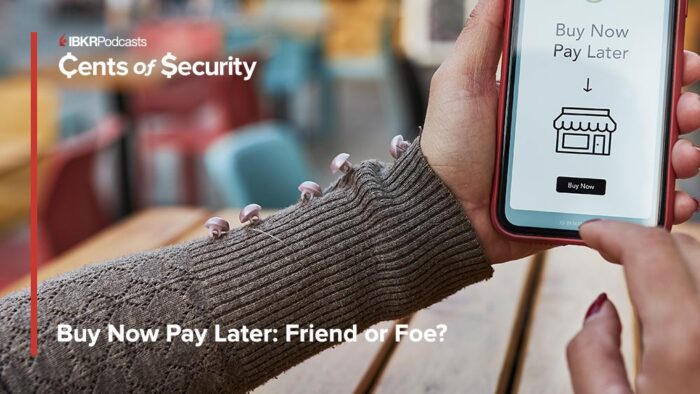
Buy Now, Pay Later (BNPL)—how it works, why it’s exploded with younger consumers, and the psychology that makes spending feel way easier than paying up front.
The following is a summary of a live audio recording and may contain errors in spelling or grammar. Although IBKR has edited for clarity no material changes have been made.
Hello everybody, and welcome to Cents of Security. Today we are talking about “buy now, pay later”, how it works, the spending, psychology, risk, and the big picture. Our guest is Economist, James Yendrey of InvestMentorSM. Welcome back James. How are you?
I am doing great, Mary, how are you?
So, what is buy now pay later? I’m sure most of our listeners know what it is, how is it different from a credit card?
Sure. Buy now, pay later payment method splits purchase into smaller installments. Think typically like four equal payments over a six-to-eight-week period. You get the product immediately, pay 25% up front, and then the remaining 75% is spread out over the six-to-eight-week term, whichever it was.
But a few key differences from the credit cards is buy now, pay later is marketed as 0% interest if you pay on time, whereas credit cards end up charging 15% to 25% APR and balances. Buy now pay later typically has these fixed installment plans that are actually rigid, whereas credit cards, you have a maximum, minimum payments and then by now pay later has a lot looser approval process. They don’t necessarily do hard pulls. They can pre-approve you with a certain set of parameters that they have based off of the purchase history. And sometimes they’ll even do a soft pull, but, if you get a credit card, you got to do a hard pull. And that whole fun process. So those, that’s how they, that’s how they differ.
So, let’s say I’m walking along and there’s this great store and I see this sweater I really like, right? And I have a credit card and I have some cash, but I don’t want to really spend it right now. I think I’ll do buy now, pay later. Do I already have to set up this on some other site and say that’s what I want to do? Or is it something that the store like offers or how does that work? Or is it part of just my whole credit experience? Or is it I have to sign up with something like, I’ve heard Klarna so what? How does that work?
So usually you’ll see a lot on e-commerce rather than walking into the store and it’s on upon the checkout purchase window. And so you have the option to pay with your credit card, apple Pay, or you know what, whatever other means. And it’s usually thrown in there.
So why has it grown so quickly, especially with the younger consumers?
Good question. A lot of that has to deal with a lot of the credit card skepticism that has happened with these younger generations like GenZ and Millennials. They typically saw families struggle with a lot of credit card debt around subprime, so think 2008 crisis and they have an inherent distrust for traditional credit.
There’s that no interest appeal. Because it sounds better than 20% APR on credit cards. They’ve made it inherently frictionless as well. So, it’s baked into the checkout process. So, you go through the entire process and like we just went through it’s right there and you click it once and you’re instantly approved.
So, it’s become extremely frictionless. And it, you really don’t have to worry about any of the background checks or things like that, getting too crazy like you would a traditional credit card or a loan.
So, a couple other things to note regarding that is the psychological framing of it, right? A hundred dollars today. because you have to pay 25% on a $400 purchase feels more manageable. I can pay a hundred dollars, but I really don’t want to pay the $400 or even the total cost. Yeah. It’s okay, I’m going to go ahead and get this item now for what you perceive as a discount on your current budget, and you take the item without having to, for over the full 400.
So then how do you, how does the bill come to you?
How does that work?
So typically, what, when you set up the process you’ll go into signing up. It’ll send you, it’ll set up an email method and cadence and payments, and you know how you want to.
Got it.
Make payments on this. And so you’ll have your pay schedule on it that way. So, you’ll set it up, you’ll be able to get your approved method and then go through it that way.
They do make it easy. Okay. All right. So what’s actually happening behind the scenes when someone clicks Pan in Four?
Okay? Behind the scenes, the buy now pay later companies, they make money from merchant fees and think like 2% to 8% per transaction as well as late fees for consumers. So you have to think of it as a, essentially a short term, but the backend step-by-step process.
Say you’re buying $200 pair of shoes at checkout, you select the Afterpay or Klarna or instead of a credit card it goes through the approval process. If you’re a new user, they basically approve you instantaneously based off transaction size, whether you have a history with them and just a bunch of basic info. Put down 25%, so say on that $200, you put down $50 with a $150 remaining and the scheduled payments across the four to six weeks, and the retailer gets paid up front, so they’re not on the hook for anything. They get paid less the merchant fee. If they have a 3% merchant fee on $200, they’re getting paid $194 up front.
The retailer is completely out of it. So, they leave the transaction unscathed. So now it’s you and your buy now pay later person. So, at that point in time, $50 in two weeks, four weeks, six weeks is auto charged based off of the payment method that you’ve set up. Where a lot of people get hung up on this, and this is like a, taking a rabbit hole is instead of signing it into a bank account or a debit card, they’ll link it to a credit card. So, you’re stacking down debt, which is not a good thing. So that’s what happens behind the scene.
So are there any of these buy now pay later companies that have gone under because there’s so many people who are going bankrupt or it’s buy now and then forget that I have to pay later.
The it gets put on the consumer, right? So, if you want to talk about who’s taking the risk and the risk profile overall. You’re right. The buy now pay later institution is taking most of the risk. Retailer is completely out of it. They got paid up front.
And then you as the consumer, you have to pay the late fee. Your risk is late fees. They have to, they’ll report it to a credit bureau. They can send it to collections. You can get suspended from the account so you’re no longer able to use those types of services. But yeah, they’re effectively the buy now pay later institutions carry the most inherent risks. They’re extending unsecured credit with minimal underwriting. And if, defaults rise, they have to absorb the losses which is why regulators are starting to watch them a little bit more. And providers may be underestimating a lot of risk.
All right. So why does buy now pay later, feel easier to spend than with pain upfront? What’s a little psychology of that? I can guess, right? The immediate dopamine effect of getting what you want, right?
Sure. So loss of urgent is huge, but you also have payment decoupling. So those are two huge ones. So, in behavioral economics you have the classic payment decoupling which is, effectively, separating the consumption from the payment. So, you can think of it like say you’re at an all-inclusive resort and you’ve already paid everything.
So, when you go and eat everything, everything seems free. And oh, I’m just going to go ahead and, eat as much as I can. But the reality is you’ve already paid for it. And so, taking that same example, if you take that shoe example we talked about handing over $200 feels like. Such a bigger loss than it does for payments over $50, but if you budget appropriately, you should be able to pay that without taking on that type of risk. But then you have to think about when we’re talking about psychology of it, you have to think about discounting future payment. So you’re taking that aspect of it and 50 weeks or excuse me, $50 in two weeks. Weeks feels a bit more abstract than, $200 today is more painful. It’s more concrete because you see it leave immediately.
So how is Buy Now pay letter different from interest free credit cards, if you make your payment on time?
James Yendrey: The ugly truth is they can technically both be viewed as interest free provided their managed correctly, right? Credit cards have a bit more of a of a grace period. You, you can pay in full by a due date with no interest paid. Whereas buy now, pay later is a more rigid and fixed schedule.
So, payments have to be paid on time or phase fees. There’s no flexibility in it. The, I guess the real difference is credit cards like that would be the real difference is credit cards offer more flexibility, but they require more discipline to avoid interest. Buy now, pay later, because it is inherently a more rigid schedule with no interest, but you have less flexibility. The trap for buy now pay later is that it? It does feel safe. It feels safer because you have the 0% interest, but you have overlapping installments. Say you make multiple purchases, now you have you’re basically punching holes into your monthly budget, and you have multiple outflows going in, money going out in places that if you’re not able to necessarily track as effectively, really ring out your budget and spread it thin. And unlike credit cards, you don’t really build any credit using buy now, pay later responsibly, which is the point of using things like this not only to spread things out, but to build credit when you’re actually using these tools responsibly.
Yeah, that’s a good point because once again, I learned this in our credit podcast is you have taken a loan with credit, pay it back in installments, and then they notice that they’re like, oh good. You’re paying the installments. And now you know we’re going to, that’s going to reflect in your credit report because you’re being consistent, right?
And so if you think, oh, I’m going to get this credit card and then pay it off every single month. You may find you don’t get a big bounce because you’re always paying off the credit amount, right? And so they haven’t really hit that up yet with buy now, but there they are going to catch up to that fact.
That would mean further regulations on it, more steps in the process because you would take it away from the seamlessness and the frictionless nature of the buy now pay later and how it’s theoretically been and been utilized in the marketplace. You would have to then fill out a form and provide your social and actually do a hard pull. Because now you have to report to the bureaus, these soft pools. Whether or not you don’t necessarily have to do it because it’s not reported. They’re like, okay we’ll take gamble on you. We think that this is $200 purchase. Even if you don’t pay it, I think we can wane this storm.
All right, so let’s spin this a little differently. How can you, as a consumer use buy now, pay later to help you out, to work it into your whole spending plan or spending plan, like the buckets, this I would categorize as discretionary income.
I could spend it or not spend it. It’s not like rent, right? Whatever you’re buying, you can’t pay your condo rent. You can buy now, pay later at all. But I bet you could go to Whole Foods and do it. Could you or go to like your local Publix, or right?
The economic reality is that it is Buy now, pay later is a tool, for disciplined users with a clear budget and cash flow, as long as you are able to cash flow it, say you actually have the cash, you can use it as what’s considered “cash flow smoother”. So, for those struggling financially, for like impulse spending it’s going to enable you to want to buy more.
But if you’re using it as a tool to smooth things out, i.e. you have the cash in hand, you should still use the cash in hand, but you need to buy groceries with that cash, but you also need this thing, whatever it is that you may need, say a winter coat for in the winter, and it’s like $300.
Okay, then at that point becomes a justifiable necessity. And so, you pay your cash. Consumers should never spend groceries or bills using buy now, pay later. That is masking financial distress.
You’re overlapping installments, you’re creating hidden debt load. if you’re going to do it in a way that you use it as a bridge for yourself. If you have a coat, it’s $200 that you absolutely need this coat because it’s winter in the northeast and a blizzard is coming.
Spend the $50 so that way you can keep your lights on by all the necessities. And then when the storm is over, you are able to, at that point in time start to continue to utilize your cash flow for the necessities and then pay these incremental installments on this coat, for example. That’s how you could use it like emergency purchases, unexpected or car repair or medical expenses. It provides short-term liquidity and events like this provided you are able to pay it back.
Once again, folks, this is James’ opinion, right? And it is good practical common-sense advice, right? I guess if you have a blowout on one of your tires and you can’t go to work the next day until this thing is fixed, and you can use this as an option, that’s probably a good option. Or you could say, “Hey, I need to get some Grubhub and DoorDash”, and instead of spending the $20 I in my pocket, I’m going to use buy now pay later. Probably not a good idea, all right? Because then you might go ahead and do that again and again, and then it all adds up. And that’s the thing that worries me, is that “all adds up”. All of a sudden, you realize, wait a minute. I got a couple thousand here that I have to pay at the end of next month, how am I going to do that? And so, you just want to stay focused and keep track of things as best you can. So, are there any, I’m sure there are, some tools out there now that we’re in AI world that are helping with this to manage, this massive spreadsheet of what did I spend here?
Am I still paying for that? Keeping track of all of it, do they, do these backend companies, do they offer applications for that?
I would assume that when they, if you’re using a singular company, say you stick with Klarna versus Afterpay, like you have your favorite in the backend, we will show you your payment schedule, your debt schedule, but it’s still up to you to know when that payment is due so you know where your outflows are,
So it doesn’t matter when you decide that you want to add AI or another tool and you just start layering, making sure that you have this, but it does not matter. Understanding where your outflows go matters more than the tool get to get there. If what you are attempting to do is to be a savvier individual who is on top of their finances, who is able to keep as low of a DTI as possible, so your debt-to-income ratio.
Instead of using buy now pay later tools or credit cards or anything like that, just manage a budget. Make sure that you have any miscellaneous line items covered within that. So, you have your emergency savings, you have anything covered that you can pay for in cash, so you can completely avoid accruing this type of debt.
Good advice, James. Love it. So good, right? Common sense folks. Really good. All right, did you want to add anything else, James, before we wrap up?
I guess my final thought for this would be buy now, pay later is a debt, treat it like a debt, doesn’t matter if it’s installments. The biggest danger is that it doesn’t feel like a debt. But it literally is, it’s a short-term loan, and it should be respected as such because it’ll quietly erode your financial stability, and that’s not good.
Yeah, that is not good. Okay. All right, James, thank you so much for your time your common sense. We really appreciate it. And folks you can find out more about in InvestMentor on the ibkr.com site, you just go to ibkr.com/campus. You can also see market commentary there and Traders Academy courses, other podcasts that you might be interested in and InvestMentor information as well.
Thank you so much and appreciate it.
Thank you, Mary. Talk soon!
IBKR InvestMentor (dba “InvestMentor”) is a service of Interactive Academy LLC, an affiliate of IB LLC and majority-owned by IBG LLC. All content provided by InvestMentor is for informational and educational purposes only and should not be interpreted as implying any sponsorship, partnership, endorsement, recommendation, or approval by IB LLC or its affiliates.
Information posted on IBKR Campus that is provided by third-parties does NOT constitute a recommendation that you should contract for the services of that third party. Third-party participants who contribute to IBKR Campus are independent of Interactive Brokers and Interactive Brokers does not make any representations or warranties concerning the services offered, their past or future performance, or the accuracy of the information provided by the third party. Past performance is no guarantee of future results.
This material is from InvestMentor, an affiliate of Interactive Brokers LLC, and is being posted with its permission. The views expressed in this material are solely those of the author and/or InvestMentor and Interactive Brokers is not endorsing or recommending any investment or trading discussed in the material. This material is not and should not be construed as an offer to buy or sell any security. It should not be construed as research or investment advice or a recommendation to buy, sell or hold any security or commodity. This material does not and is not intended to take into account the particular financial conditions, investment objectives or requirements of individual customers. Before acting on this material, you should consider whether it is suitable for your particular circumstances and, as necessary, seek professional advice.









Join The Conversation
For specific platform feedback and suggestions, please submit it directly to our team using these instructions.
If you have an account-specific question or concern, please reach out to Client Services.
We encourage you to look through our FAQs before posting. Your question may already be covered!