
- Solve real problems with our hands-on interface
- Progress from basic puts and calls to advanced strategies
Interactive Options Course
Posted February 3, 2026 at 10:30 am
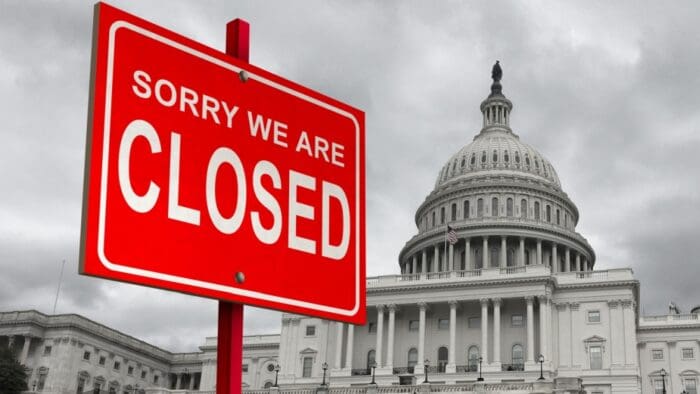
Barely two months after the previous shutdown, a Senate standoff may halt funding for key government agencies.
While the last shutdown saw limited market volatility, previous ones had more, though they tended to resolve quickly with little overall impact.
Don’t let any short-term market volatility from a government shutdown change your long-term investing plan.
The federal government is facing another shutdown. As Democrats and Republicans argue over conditions for funding, many agencies could close their doors Friday evening. The market hasn’t reacted so far. What is a government shutdown, and how will it be resolved? Will the government shutdown affect the stock market? Should investors care?
During past shutdowns, essential government functions tended to continue. This has included, but wasn’t limited to, air-traffic control, border patrol, federal prisons, power grid, mail delivery, disaster relief, food-safety inspections, military, and tax collection. Seniors continued to receive Social Security and Medicare. Veteran benefits, unemployment benefits, and food stamps were administered.
Many non-essential government activities previously ceased though. Examples abound, but here are just a few. The Justice Department suspended many civil cases. NASA paused most projects but continued to support the International Space Station. Certain national parks remained open, but with limited hours and staffing. The National Zoo continued to operate using the previous year’s funds.
A shutdown is no laughing matter for the estimated 3 million federal employees. Non-essential workers could be furloughed. Essential workers may be paid retroactively when Congress funds the government again. In 2025, more than 670,000 non-essential workers were furloughed, and 730,000 essential workers received IOUs.1
Government shutdowns have precedent. This is the 23rd since modern Congressional budgeting began in 1976. The longest — 43 days — lasted from October 1, 2025 to November 12, 2025, during the second Trump administration.2 Most were resolved much more quickly, with an average length of nine days. Five only lasted a day.
Shutdowns typically end when one or both political parties can no longer withstand the public’s ire. During the 2013 government shutdown, Congress’s approval rating fell to a record-low 9%.3 For context, at the time, that was below approval ratings for head lice, root canals, traffic jams, and even colonoscopies. As of December 2025, 17% of Americans approved of Congress, down from a multi-year high of 36% in March 2021.4
The good news is that government shutdowns haven’t really affected the stock market historically. While there have been examples of heightened market volatility, it’s generally been benign. (And so far that’s been true of this shutdown as well.) The S&P 500 Index posted positive returns during 12 of the 22 previous government shutdowns. The average S&P 500 return during those shutdowns was 2.0%.5 (Remember, shutdowns have been resolved, on average, within nine days.
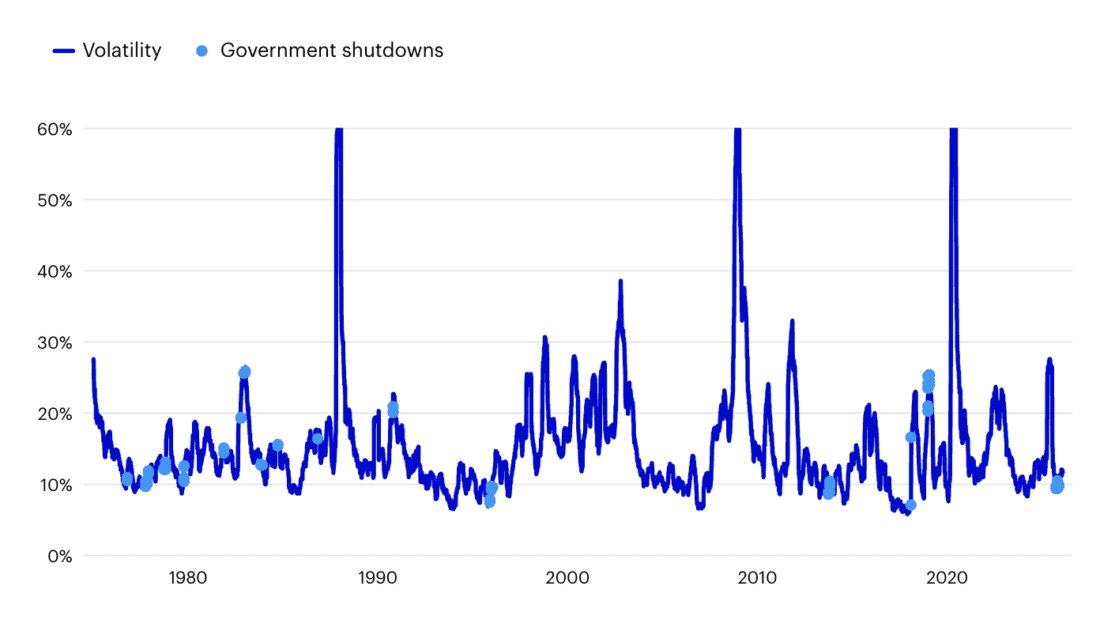
Source: Bloomberg L.P., 1/2/75 – 1/28/26. Volatility is measured by the standard deviation of price moves on returns of the index. Standard deviation measures a range of total returns for a portfolio or index compared to the mean. An investment cannot be made into an index. Past performance does not guarantee future results.
In the 12 months following the December 2018 government shutdown, the S&P 500 Index gained 26.2%. It returned 19.72% in the year following the infamous shutdown of 2013. In fact, since 1980, the average S&P 500 return in the 12 months following the government closing is 16.95%.6
Extending the timeline even further, a $100,000 investment in the S&P 500 Index in 1957 would’ve been worth $14.7 million by the end of 2025.7 That’s despite 22 government shutdowns.
While unnerving, concerns about shutdowns shouldn’t change investors’ long-term investment plans; sticking to the plan may be the best way forward. This isn’t the first government shutdown, and it likely won’t be the last. We expect the spending bill (or bills) to pass eventually and government operations to return to normal.
In the meantime, the political gamesmanship continues. Past shutdowns have generally been short with little noticeable impact for most people. Let’s hope history repeats itself.
—
Originally Posted on January 30, 2026
Government shutdown: Will investors see market volatility? by Invesco US
This does not constitute a recommendation of any investment strategy or product for a particular investor. Investors should consult a financial advisor/financial consultant before making any investment decisions. Invesco does not provide tax advice. The tax information contained herein is general and is not exhaustive by nature. Federal and state tax laws are complex and constantly changing. Investors should always consult their own legal or tax professional for information concerning their individual situation. The opinions expressed are those of the authors, are based on current market conditions and are subject to change without notice. These opinions may differ from those of other Invesco investment professionals.
NOT FDIC INSURED
MAY LOSE VALUE
NO BANK GUARANTEE
All data provided by Invesco unless otherwise noted.
Invesco Distributors, Inc. is the US distributor for Invesco Ltd.’s Retail Products and Collective Trust Funds. Institutional Separate Accounts and Separately Managed Accounts are offered by affiliated investment advisers, which provide investment advisory services and do not sell securities. These firms, like Invesco Distributors, Inc., are indirect, wholly owned subsidiaries of Invesco Ltd.
©2024 Invesco Ltd. All rights reserved.
Information posted on IBKR Campus that is provided by third-parties does NOT constitute a recommendation that you should contract for the services of that third party. Third-party participants who contribute to IBKR Campus are independent of Interactive Brokers and Interactive Brokers does not make any representations or warranties concerning the services offered, their past or future performance, or the accuracy of the information provided by the third party. Past performance is no guarantee of future results.
This material is from Invesco US and is being posted with its permission. The views expressed in this material are solely those of the author and/or Invesco US and Interactive Brokers is not endorsing or recommending any investment or trading discussed in the material. This material is not and should not be construed as an offer to buy or sell any security. It should not be construed as research or investment advice or a recommendation to buy, sell or hold any security or commodity. This material does not and is not intended to take into account the particular financial conditions, investment objectives or requirements of individual customers. Before acting on this material, you should consider whether it is suitable for your particular circumstances and, as necessary, seek professional advice.













Join The Conversation
For specific platform feedback and suggestions, please submit it directly to our team using these instructions.
If you have an account-specific question or concern, please reach out to Client Services.
We encourage you to look through our FAQs before posting. Your question may already be covered!