
- Solve real problems with our hands-on interface
- Progress from basic puts and calls to advanced strategies
Interactive Options Course

Posted January 16, 2026 at 11:03 am
On the surface, the new Taiwan–US trade deal is easy to dismiss as yet another vague investment pledge in exchange for lower tariffs. As the White House renegotiates trade relationships around the world, these deals have become monthly news fodder.
But take a second glance, and this is something much more substantial, involving the world’s biggest chipmaker, TSMC. Taiwan is pledging that its companies will invest at least $250 billion in chip production capacity in the US, with the Taiwanese government guaranteeing credit for the whole sum. In addition to actual chips, the investment pledge also includes AI servers and energy. In return, US tariffs on Taiwanese goods are capped at 15%.
In practice, the $250 billion pledge mainly refers to TSMC — which had already announced US investments of up to $165 billion. And now more is likely to come.
When the company released another round of blockbuster earnings earlier this week, it announced more land purchases in Arizona to expand its so-called gigafab cluster of chip manufacturing.
To understand why a Taiwanese chip company’s investment decisions matter so much, one must fully appreciate the scale of TSMC.
With roughly 90% of the world’s most advanced 3‑nanometer production and around 70% of the broader contract manufacturing market in chips, TSMC is one of the most critical nodes in the global economy.
Chip designers like Nvidia and Apple sketch out the architecture. Dutch toolmaker ASML builds incredibly complex lithography machines that etch circuits onto silicon. And then there’s TSMC, a foundry that turns blueprints into working chips in its fabrication plants or fabs.
A modern fab is a multibillion‑dollar fortress of clean rooms, equipped with top-notch technology, including the machines that ASML builds. Without TSMC’s fabs, Nvidia’s GPUs are just PowerPoint slides.
Despite its dominance, TSMC’s valuation lags behind its biggest customers. Nvidia is worth roughly $4.6 trillion (the No. 1 company by market cap in the world) and Apple around $3.8 trillion. Meanwhile, TSMC sits at $1.8 trillion as of Friday — the most valuable company in Asia, yet still overshadowed.
The reasons are structural and strategic. Nvidia owns the “secret sauce”: the algorithms, software, and architectures that make chips smart. TSMC owns the factories, which are expensive, complex, and difficult to scale without massive capital outlays.
Nvidia enjoys gross margins north of 70%; TSMC’s were high in Q4 at 62% but still lower than those of its top customers.
TSMC is nudging prices higher to capture more value, but it still can’t charge designer‑level markups for a builder’s job — especially when it’s reliant on a few heavy-hitting customers.
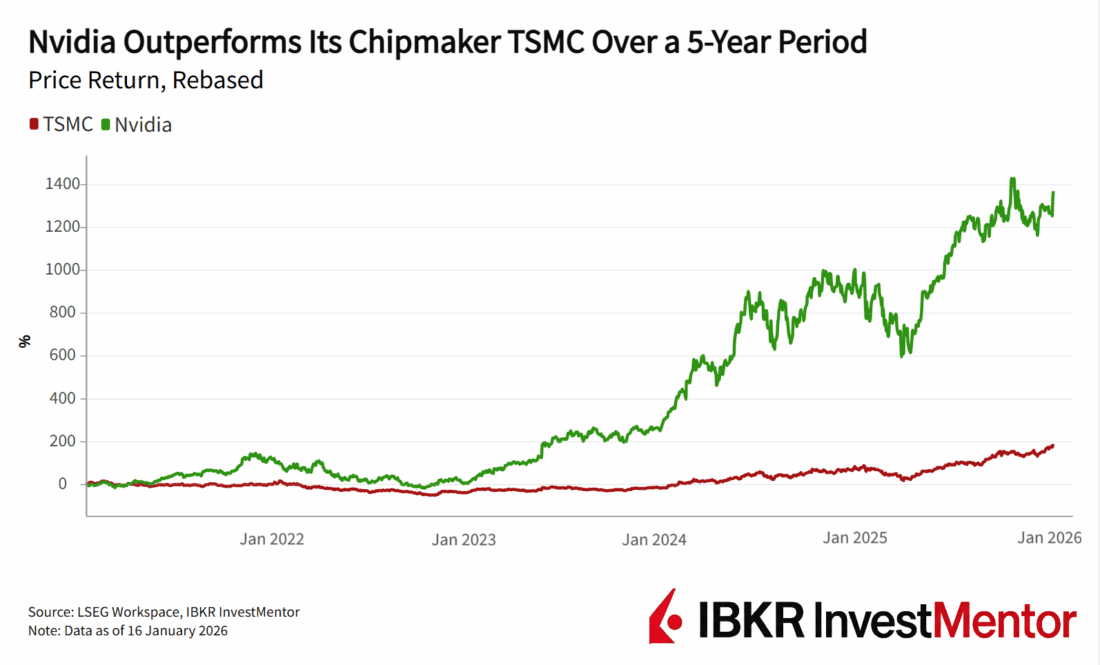
Ultimately, though, geopolitical risks weigh heavily: Nvidia is American, TSMC is Taiwanese. With most of its manufacturing in Taiwan, one of the world’s most sensitive geopolitical flashpoints, TSMC is directly exposed to any conflict that may flare up in the region.
For decades, TSMC’s strength has been its tight geographic concentration: talent, suppliers, and know‑how all clustered on one island. That model worked when the world was stable. It looks less brilliant when every major economy is suddenly obsessed with “friend‑shoring” and “strategic autonomy”, racing to build their homegrown chip industry.
From the investors’ perspective, it may be a good thing for TSMC to expand in the US — geopolitical motives set aside.
This addresses:
Of course, TSMC has to avoid overbuilding, even under political pressure. AI demand is booming now, but fabs are multi-year, multi-billion‑dollar bets. If the cycle turns, under-utilized plants will weigh on returns.
TSMC’s CEO C.C. Wei addressed the risk of an AI bubble candidly during the earnings call earlier this week:
“I am also very nervous about it. You bet, because we have to invest about $52 billion to $56 billion for the capex. If we did not do it carefully, that would be a big disaster to TSMC for sure.”
In other words, TSMC can expand its footprint, but it can’t suspend the laws of supply, demand, and capital discipline.
Yet the company is also trying to make one thing very clear: expanding abroad does not mean abandoning its home base. TSMC says its most advanced technologies will continue to be developed and stabilized in Taiwan before any of them are transferred overseas.
Taiwan’s Ministry of Economic Affairs expects the production split for the most advanced chips to be 80/20 between Taiwan and the US by 2036, even as the White House is pushing to move 40% of the entire Taiwanese chip supply chain to America.
For now, TSMC is maintaining a delicate balance. It is moving aggressively ahead with its American investment plan, but it’s not a dramatic relocation — it’s a strategic expansion: Taiwan as the brain, the US as the muscle. And for investors, that hybrid model may be the most reassuring outcome: TSMC becomes more resilient without diluting the advantages that made it dominant in the first place.
The Taiwan–US tariff deal accelerates this trajectory. It gives TSMC more incentives to build abroad, political cover to diversify, and a clearer runway to meet the AI industry’s insatiable appetite for compute.
Download the free IBKR InvestMentor app to access interactive lessons on stock investing and much more.


Learn more about InvestMentor
Information posted on IBKR Campus that is provided by third-parties does NOT constitute a recommendation that you should contract for the services of that third party. Third-party participants who contribute to IBKR Campus are independent of Interactive Brokers and Interactive Brokers does not make any representations or warranties concerning the services offered, their past or future performance, or the accuracy of the information provided by the third party. Past performance is no guarantee of future results.
This material is from IBKR InvestMentor, an affiliate of Interactive Brokers LLC, and is being posted with its permission. The views expressed in this material are solely those of the author and/or IBKR InvestMentor and Interactive Brokers is not endorsing or recommending any investment or trading discussed in the material. This material is not and should not be construed as an offer to buy or sell any security. It should not be construed as research or investment advice or a recommendation to buy, sell or hold any security or commodity. This material does not and is not intended to take into account the particular financial conditions, investment objectives or requirements of individual customers. Before acting on this material, you should consider whether it is suitable for your particular circumstances and, as necessary, seek professional advice.
Related Articles















Join The Conversation
For specific platform feedback and suggestions, please submit it directly to our team using these instructions.
If you have an account-specific question or concern, please reach out to Client Services.
We encourage you to look through our FAQs before posting. Your question may already be covered!