
- Solve real problems with our hands-on interface
- Progress from basic puts and calls to advanced strategies
Interactive Options Course

Posted March 10, 2026 at 12:13 pm
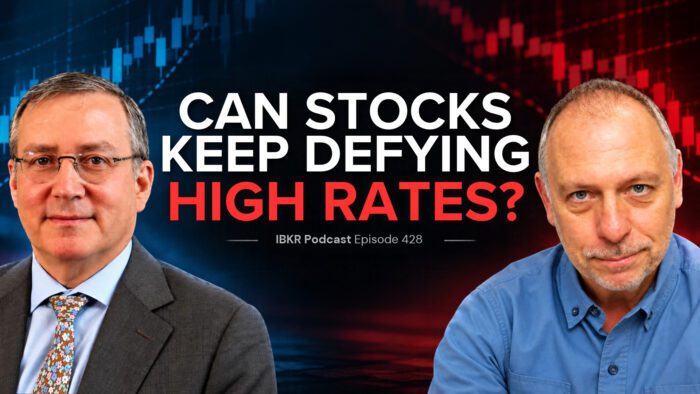
Oil prices have surged amid escalating conflict with Iran, raising concerns about supply disruptions through the critical Strait of Hormuz and the broader impact on global markets. We break down what the latest geopolitical developments could mean for oil prices, inflation and the balance between fear and FOMO driving investor behavior.
The following is a summary of a live audio recording and may contain errors in spelling or grammar. Although IBKR has edited for clarity no material changes have been made.
Welcome to this week’s podcast. Today we examine the investment implications arising from the war in Iran. Steve, I’m sure you’ve been inundated with questions from the media seven days a week since the assault on Iran started, but I wanted to put some time between the start so that we could observe the results.
Over the first two weeks, markets have swung violently, and maybe that’s an understatement in response to events that, rather than heading straight down, which you wouldn’t be blamed for expecting there’s much to talk about. Maybe we can start with some balance. Can you define perhaps the best case and the worst-case scenarios?
Yeah the scenarios that historically, whenever people asked,“What are some of the big black swans that are out there?,” along with like solar flare, nuclear accident, things of that nature, closure of the Straits of Hormuzwas the most likely black swan event that that was in the market’s psyche. It’s been there since the seventies. We got one, and quite frankly, the market reaction, I’m gonna say was rather tepid.
But is that maybe Steve, is that maybe a function of the fact that it all happened in a day? With the price of oil, the impact on the price of oil.
Not really. You did see the price of oil build, from $70 to $80 to $90, and then we have yesterday — we’re taping this Tuesday – yesterday we had that overnight spurt up to $115 and then back down to $85, which is, you put it to me in a Teams message was we managed to have a bull market and a bear market in one day.
The numbers that had always been thrown around were in the $150 to $200 range. And we didn’t get that. In terms of market impacts, yes, there were some huge market impacts in Asia but those were in markets that had been overheating to some extent. The KOSPI which was up, I think, 20% year-to-date gave back half, gave back a good, maybe it was more, I don’t have the number in front of me. It might have actually been more, like almost 40%, it had this huge parabolic silver-like rise, it gave back a big portion of it as parabolic moves often do. That meandered around. You had the Nikkei moving 5%, 6% a day.
But again, Nikkei had been outperforming. The US market yesterday at its worst was down like 2%, 2.2% year-to-date. That is not even, that’s not even a blip,
Yeah, that’s a very important point, whether you said that year-to-date as opposed to just on the day, the intraday movement was minimal.
One of the things that I pointed out on Friday, I believe, if not,the days are all blurring together, was that each of the days, except for Friday, where I think people were a little nervous about going home long over the weekend, every single day, so five out of the six trading days we’ve had through yesterday, we had closes that were significantly higher than the intraday lows.
So that tells me that there was always an underlying bid for stocks. There was always a big undercurrent of dip buying. There was, and more importantly, there was always a big undercurrent of FOMO. As soon as the bounce seemed to hold, as soon as it was a support level that held, the buyers came charging in, not necessarily to crazy levels, but the buyers did not want to miss that bottom.
Nobody wants to miss that bottom. And I know that the F in FOMO stands for fear. “Fear Of Missing Out.” FOMO is really greed, and markets are continually wrestling to find the equilibrium between fear and greed. And it told me that through this whole process, while there was still more fear than we’d had for some time, greed is still probably in control, not fear.
To that point, Steve, I think a lot of people like yourselves last week said, “Yes, oil prices are building, but we’re not near $100,” and then we did that all in one day. Perhaps you’ve really just outlined kind of the best-case scenario. What’s maybe the worst case?
The best-case scenario emerged yesterday afternoon when the markets rallied because the President basically implied that the hostilities are done. Then of course today we learn from Defense Secretary Hegseth that, oh wait, we’re gonna be stepping up our bombing campaign today.
So, the two are somewhat incompatible, but it tells you that’s what the markets want to hear. The markets want to hear that this will be over and done with quickly. That the oil will be transiting through the Straits of Hormuz within days and everything will go back to normal.
The flip side of that scenario is, I think there’s been, since this whole thing started, one ship making it through the Straits of Hormuz. There’s been the talk of backstopping, the insurance – and by the way, without insurance the ships aren’t moving. Backstopping the insurance, it’s not clear that’s gone into effect yet, or how that’s going to work, or the idea of naval escorts through the Straits. It’s not clear how that’s gonna work. You know, let me ask you a question here, which I don’t have the answer to: Is the US going to backstop the insurance for and escort tankers headed for China in this situation?
One would think not, and I’m not sure that Congress would like that, would they?
Yeah, and there’s a lot of unanswered questions here and also there’s also the very strong possibility that Iran is capable of very asymmetric types of disruption. It doesn’t take much more than a couple of drones or a small speedboat to truly send a message that says it’s not safe to go through the Straits. And again, it’s not collectively. They can’t collectively, if all the tankers started going, they’re not gonna sink them.
But if those tankers can’t get insurance to go through, they’re not gonna go through. Or the insurance is gonna be so extraordinarily expensive that it’s going to feed into the price of crude. So, the idea that this is just gonna be neatly wrapped up is I think a bit optimistic, but that’s the scenario that the market has been going on.
It’s basically been that we’re going to be able to tie a bow on this thing very quickly. I think from a conventional military point of view, probably that’s true. I’m certainly I’m not gonna put on, I’m not gonna pretend to be a military analyst. I don’t know. So let me just state for the record that’s probably fair. The problem is what happens if, for better or worse, Iran has shown that they’re good at drones and they’re good at terrorism. And you’ve basically hardened the theocracy at this point. And the idea that we, that let’s say by the end of the week, we’ve heard the last of this very hard to swallow.
Yeah, I would agree with that. I think the issue is the regime change, isn’t it? Which is what really, that’s what this is about from Trump’s perspective, isn’t it?
Is it? The problem is it’s been one of several stated objectives and I don’t know. And the US has… I hope that’s actually not the case, because as much as I detest the regime — and I think most Americans feel that way based on their history — the other inconvenient part of history is that US attempts to institute regime change in that part of the world do not go well.
We got rid of Hussein, Saddam Hussein, and then it took… the US was mired in Iraq for years. We got rid of Qaddafi, and Libya is essentially anarchy. We got rid of the Taliban and got mired in Afghanistan for many years. I’m not saying that this is the outcome.
I don’t, I don’t think that anybody in the US has the stomach for this, but I think the idea of basically saying we’re gonna go in there and change the regime is very difficult. Again, because we’re dealing with a theocracy and you’re not, this is not like, you know, picking Democrats versus Republicans, or Tories versus Labour. This is picking sides in a religious conflict, and that’s not the same thing as pulling a lever for one group or another. Again, I don’t want to go too far down these rabbit holes, but I think the idea is that the market has decided, this is very neat, that there’s a neat outcome at the end of this.
And I’m just saying that while there’s not a catastrophic outcome at the end of this, I think the market is a little too sanguine in thinking how neatly this can be solved. Sure, this can be solved neatly if we just said, “You know what, we’re done. We’re out. We did what we’re gonna do and walk away.” But even then, there’s still ramifications.
Yeah, I think militaristic domination, it is probably the best case for the investor. And the worst case is we’re just kicking the can down the road for problems later, but it could be many years later. Steve, bring it home for us in terms of the impact on the US economy. We did see that massive jump in oil prices over the weekend and into Monday morning hot on the heels of a terrible employment report.
Could you add some color around where the rear-view data intersects with the prospect of a resultant pain at the pump situation for the US consumer?
Again, best case is that number was an outlier, and we could say that even as bad as that number was, we’re talking about, call it a difference of 200,000 jobs in a labor force of 170 million. We focus on these numbers a lot, but essentially, they’re rounding errors.
But it’s the data we have, and change happens at the margin. So, we do need to pay close attention to these numbers. The best-case scenario from this is that, you know what, there’s blips, there’s numbers, we’ll see how it annualizes out, this too shall pass, potentially. At the worst case, it’s telling us there’s problems in the labor market. At the same time, we’ve got the very inconvenient problem of inflation being driven by energy prices. Now, again I think people in many ways think it’s natural to think back to, oh no, this happened in the ‘70s and we got this huge oil spike.
As an economy, we’re less dependent upon oil as an input. It’s just it’s just not as important. But we’re building out data centers like crazy, which do require energy. As a nation, we drive big cars and in many cases trucks. And this will hurt. I saw a statistic today, I believe it was from Bloomberg Economics, that $80 oil essentially negates the tax refund benefits promised by the “One BigBeautiful Bill.” And so, if you’re banking on that stimulus, higher oil prices act as a tax. And the question is how high?
And the other issue you have with prices at the pump is there’s a ratchet effect. This has always been the case. If you’re running a gas station, if you’re running the Mobil station down the street or whatever, you are going to raise your prices as soon as you discover that it’s going to cost you. If it cost you X to fill your tanks last week and it’s gonna cost you X plus 10% to fill your tanks this week,you are not waiting. You’re raising your price by 10%.
If on the other hand, the price comes down, you’ve filled your tanks at X plus 10%, you’re going to charge X plus 10%. And presumably, let’s say, that goes back down, you’re going to move your prices down slowly because at a minimum you have to make a profit on the gasoline that you have in inventory. At a worse case, you’re realizing, “You know what? Nobody else is racing tocut their prices, why should I?”
So, they move up very quickly, but they come down much more slowly. That’s definitely an issue as well. So, you’re going to have this problem. Also, and I’ve published this before, a chart with University of Michigan 1-year inflation expectations versus the price of gasoline, and they’ve historically tracked very well.
The only time they haven’t actually was basically middle of last year, where because of the tariff fears, inflationary expectations jumped dramatically while the price of gasoline stayed relatively steady. They have re-converged in recent months. But now you have to wonder, “What if they persist at higher prices, does that feed into inflation expectations?” So, at the worst, you’re talking aboutstagnation, maybe turning into stagflation. That’s a modest case, but it can get ugly in and of itself. I think the base case here is some very modest, you’ll see the term stagflation. I don’t think that’s really it. If prices go up a little and the economy stagnates a little, is that stagflation? Yeah, I guess so, but that’s not, that’s not really my base case. We’re not talking here about…
Let me also put something in perspective. Yes, we went up from 4.3% to 4.4% on the unemployment rate. And yes, that occurred as the labor force participation rate sank, which actually means the denominator in the unemployment rate was sinking at the same time. So that’s not a very good sign. But historically, 4.4% is fabulous!
Yeah.
So that’s why I don’t wanna… There’s definitely currents, but let’s not overstate this.
I think we’re still in a generally healthy economy. The market’s still only pricing in a rate cut, I think as early as September. About a month ago, it was June. We’re still pricing in, maybe a 50% chance of a second rate cut, whereas we’ve been pricing in two rate cuts and a 50% chance of a third.
Again, 25-basis points here and there is not… If we’re not getting rate cuts‘cause the economy is solid, that’s fine, root for that ’cause that’s good for company earnings. That’s good for all the things that make the economy go. If we’re not getting rate cuts because the Fed is stuck in a bind amidst the slowing labor market and rising prices that’s a problem. But we’re not there yet.
Dr. Sosnick, chief market psychiatrist, thank you for joining me today,
My pleasure.
Pleasure having you on the show.
Thanks so much for having me. This was fun.
Alright, and to the audience, please remember, if you like today’s episode, please subscribe wherever you download your podcasts from. Bye for now.
The analysis in this material is provided for information only and is not and should not be construed as an offer to sell or the solicitation of an offer to buy any security. To the extent that this material discusses general market activity, industry or sector trends or other broad-based economic or political conditions, it should not be construed as research or investment advice. To the extent that it includes references to specific securities, commodities, currencies, or other instruments, those references do not constitute a recommendation by IBKR to buy, sell or hold such investments. This material does not and is not intended to take into account the particular financial conditions, investment objectives or requirements of individual customers. Before acting on this material, you should consider whether it is suitable for your particular circumstances and, as necessary, seek professional advice.
The views and opinions expressed herein are those of the author and do not necessarily reflect the views of Interactive Brokers, its affiliates, or its employees.
Futures are not suitable for all investors. The amount you may lose may be greater than your initial investment. Before trading futures, please read the CFTC Risk Disclosure. A copy and additional information are available at ibkr.com.
There is a substantial risk of loss in foreign exchange trading. The settlement date of foreign exchange trades can vary due to time zone differences and bank holidays. When trading across foreign exchange markets, this may necessitate borrowing funds to settle foreign exchange trades. The interest rate on borrowed funds must be considered when computing the cost of trades across multiple markets.
For specific platform feedback and suggestions, please submit it directly to our team using these instructions.
If you have an account-specific question or concern, please reach out to Client Services.
We encourage you to look through our FAQs before posting. Your question may already be covered!










Insurance or not, Navy escort or not, would you want to be captain or crew of the first tanker through the Straight?