
- Solve real problems with our hands-on interface
- Progress from basic puts and calls to advanced strategies
Interactive Options Course

Posted December 3, 2025 at 1:01 pm
The sharpest job losses in 32 months are heightening rate cut optimism, reigniting investor enthusiasm and extending the recovery in stocks, Treasuries and bitcoin. In glass-half full fashion, no one appears worried about the softening state of the labor market, as bulls pile into reacceleration trades and bears are increasingly motivated to cover shorts. Additionally, strengthening confidence that National Economic Council Director Kevin Hassett, a Trump confidant, will be the next Fed Chair is bolstering cyclically oriented areas in the equity space that benefit disproportionately from monetary policy accommodation. Indeed, the Russell 2000 and the Dow Jones Industrial benchmarks are leading the advances amongst the indices, yields are dropping relatively evenly across the curve as fixed-income watchers raise the probability of augmented easing in 2026, and the commodity complex is bullish on expectations that looser financial conditions will increase the demand for raw materials and propel activity. The greenback is retreating, however, in light of narrowing central bank differentials, while volatility protection instruments experience declining premiums due to risk-on energies on Wall Street. Traders are gravitating to forecast contracts as well to express their views on critical economic, market, political and climate developments, with a particular emphasis on shorter-dated expirations.
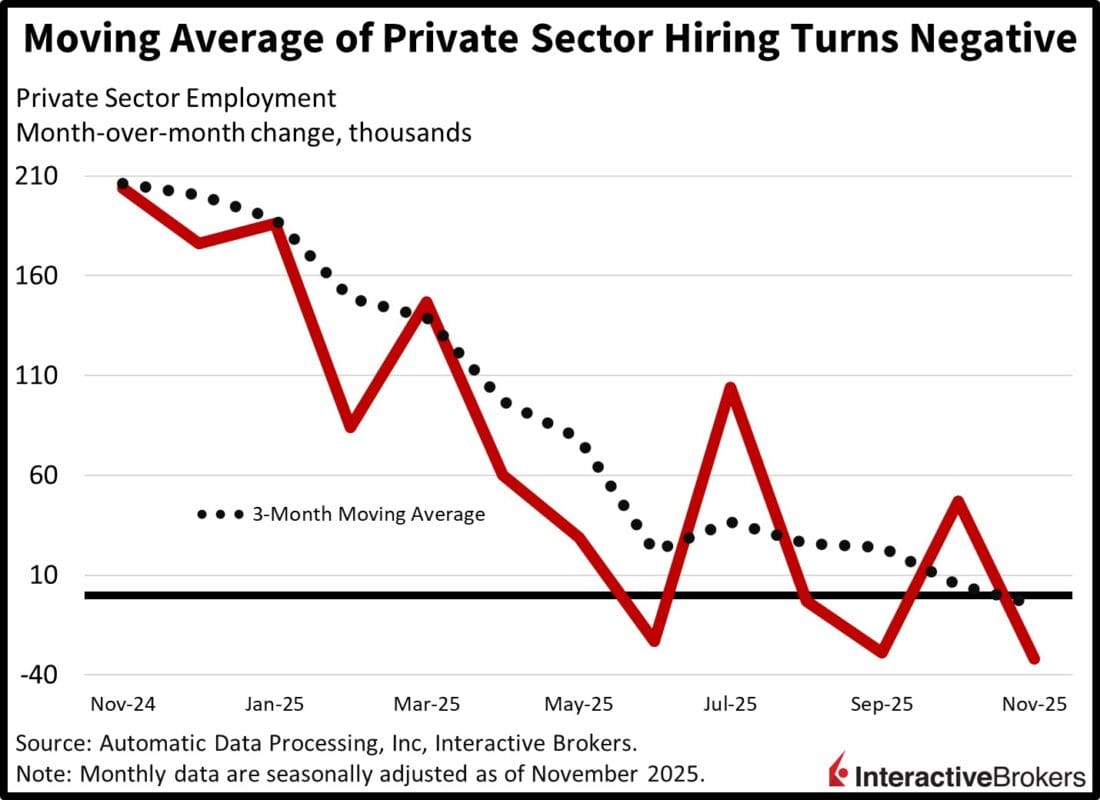
Small business pain drove sharp losses in November’s private sector payrolls, with 6 out of 10 industries reporting staff reductions. ADP’s jobs report depicted an overall decrease of 32k workers, well beneath projections of 10k and October’s 42k gain. It’s the fourth month of the last six with a negative number, dropping the three-month moving average of hiring below zero for the first time since the pandemic. Establishments with less than 50 employees led the weakness, with a roster reduction of 120k, although the contractions were partially offset by medium-sized firms with 50-499 staffers and large companies; they added 51k and 39k, respectively. Sectors that reduced employment and the extent of the changes were as follows:
The impact of those sectors was partially offset by the stated employment gains in the following categories:
In another sign of softening, compensation trends decelerated as the median year-over-year (y/y) change in annual pay slowed from 6.7% and 4.5% for job changers and stayers, respectively, to 6.3% and 4.4%.
The small-cap, cyclically oriented Russell 2000 has the potential to deliver the strongest gains across the major domestic indices in the coming year. Today’s outperformance is driven by beliefs that the economy remains on a robust trajectory despite constant reminders of labor market stress and enthusiasm that the Fed will cut next week as well as two or three times by the end of 2026. It’s precisely the mix of a strong cycle alongside looser financial conditions that can lead to a significant rally in smaller companies that are heavily vulnerable to shifts in activity and restrictive monetary policy. Indeed, an extended expansion helps the index’s constituents bolster top lines, while lighter borrowing yields drive lower debt service costs for an area of the equity space that carries increasingly fragile balance sheets relative to blue-chip counterparts. Furthermore, an economic reacceleration and Fed reductions can swing many of the firms in the gauge that lose money into profit territory. The trade may interest folks that would like to be in stocks but are worried about valuations amongst the magnificent 7, are concerned of the risk-reward dynamics of AI and/or want to position for a broadening of the equity rally in the near future while growing diversification throughout sectors.
China’s services industry continued to expand in November, but the growth was the slowest in five months, according to the RatingDog China General Services Purchasing Managers Index (PMI) from S&P Global. The gauge slipped from 52.6 to 52.1, staying above the contraction-expansion threshold of 50. New orders increased at the slowest pace in five months, but exports reversed from previous declines with reduced uncertainty about global trade helping to shore up demand from abroad. However, unfinished work orders grew, a result of declines in employment staffing. In other areas, higher costs of fuel, raw materials and office supplies caused input expenses to climb. The higher costs were only partially passed on to customers in the form of higher prices. On a positive note, confidence among services companies continued to strengthen. The government issued Services PMI, released this past weekend, also declined, falling six points to 49.5.
Hong Kong experienced its first increase in export sales in 13 months during November, which contributed to the S&P Global Hong Kong SAR PMI climbing from 51.2 to 52.9. It was the fourth consecutive month of increasing results from the index. Overall new orders and output both grew at accelerated paces relative to October. Additionally, input costs climbed at the second fastest rate in nearly two years. Those costs were partially recouped by businesses with output prices climbing at the fastest pace since September 2024. Also last month, pessimism regarding business conditions eased but sentiment was still downbeat, preventing companies from hiring workers.
Singapore business activity grew last month at its fastest pace in more than three years, but higher input costs, lower selling prices and issues with transportation and labor caused the S&P Global Singapore PMI to fall two points to 55.4. A sharp rise in new orders driven by successful marketing and new projects caused businesses to increase their purchasing and hiring, which contributed to the overall increase in activity. Conversely, supply delays, declining selling prices, higher input costs, growing lead times and a labor shortage pushed the headline result down. In a similar manner, sentiment eased to a three-month low but stayed positive with firms remaining hopeful that market conditions and internal growth plans can support future sales.
The Producer Price Index in Europe slipped 0.5% y/y in October, a worse decline than the 0.4% drop expected by a consensus of economists and an acceleration from the 0.2% y/y September descent. On a m/m basis, prices were up only 0.1%, matching the economist consensus after September’s 0.1% decline.
New to Interactive Brokers?
Open AccountInformation posted on IBKR Campus that is provided by third-parties does NOT constitute a recommendation that you should contract for the services of that third party. Third-party participants who contribute to IBKR Campus are independent of Interactive Brokers and Interactive Brokers does not make any representations or warranties concerning the services offered, their past or future performance, or the accuracy of the information provided by the third party. Past performance is no guarantee of future results.
This material is from IBKR Macroeconomics, an affiliate of Interactive Brokers LLC, and is being posted with its permission. The views expressed in this material are solely those of the author and/or IBKR Macroeconomics and Interactive Brokers is not endorsing or recommending any investment or trading discussed in the material. This material is not and should not be construed as an offer to buy or sell any security. It should not be construed as research or investment advice or a recommendation to buy, sell or hold any security or commodity. This material does not and is not intended to take into account the particular financial conditions, investment objectives or requirements of individual customers. Before acting on this material, you should consider whether it is suitable for your particular circumstances and, as necessary, seek professional advice.
Trading in digital assets, including cryptocurrencies, is especially risky and is only for individuals with a high risk tolerance and the financial ability to sustain losses. Eligibility to trade in digital asset products may vary based on jurisdiction.
Related Articles

















Join The Conversation
For specific platform feedback and suggestions, please submit it directly to our team using these instructions.
If you have an account-specific question or concern, please reach out to Client Services.
We encourage you to look through our FAQs before posting. Your question may already be covered!