
- Solve real problems with our hands-on interface
- Progress from basic puts and calls to advanced strategies
Interactive Options Course

Posted November 26, 2025 at 12:00 pm
Durable goods orders offer one of the earliest reads on manufacturing health and business confidence. This monthly report tracks new orders placed with US manufacturers for goods designed to last at least three years like aircraft, machinery, computers, appliances, and vehicles. Because businesses typically order these big-ticket items when they’re confident about future demand, durable goods orders serve as a forward-looking indicator: a surge in orders today often translates to production, employment, and growth months down the road.
The biggest challenge with durable goods data is extreme month-to-month swings, particularly from transportation:
For anyone tracking the business cycle, core capital goods orders matter most. They’re a leading indicator of business confidence and future GDP growth. Sustained increases suggest companies are investing in expansion; persistent declines can signal an approaching slowdown.
New orders for manufactured durable goods in September rose 0.5% to $313.7 billion, marking the second consecutive monthly increase. This followed a strong 3.0% August gain. Beneath the headline, the details reveal a more nuanced picture:
Key movements:
What stands out is that while headline orders look steady, the strength was concentrated in transportation. Strip that out and the gain was similar at 0.6%, suggesting modest but broad-based momentum. The real concern emerges in the capital goods details.
The breakdown between defense and nondefense capital goods tells different stories:
Nondefense capital goods orders: -0.9% to $94.0 billion
Defense capital goods orders: +23.0% to $19.7 billion (a massive surge)
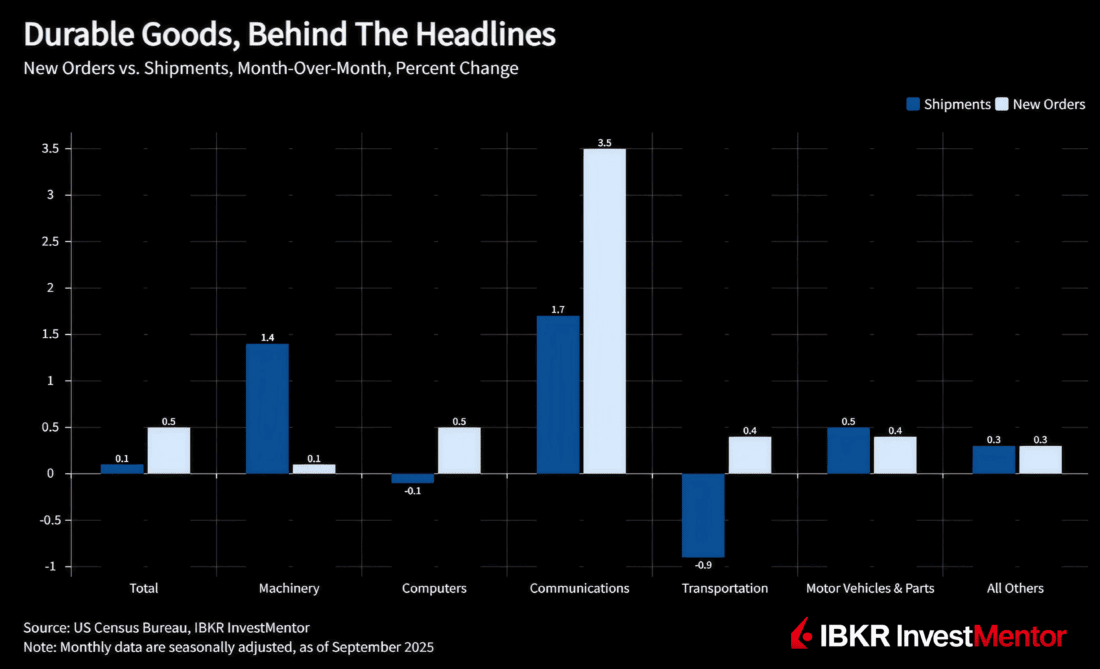
This split matters significantly. Nondefense orders reflect private sector business investment decisions such as companies buying equipment because they expect demand. That 0.9% decline suggests businesses may be pulling back on expansion plans. Meanwhile, the 23.0% defense surge reflects government procurement, which follows different drivers like geopolitical priorities rather than organic economic momentum.
Beyond new orders, two other metrics deserve attention:
September’s durable goods report shows headline strength masking underlying weakness in business investment. Total orders rose 0.5%, but the core signal, nondefense capital goods excluding aircraft, declined 0.9%, suggesting private sector companies are hesitating on expansion spending. The massive 23.0% jump in defense orders propped up the overall numbers but doesn’t reflect broader economic confidence.
The growing backlog of unfilled orders (up 0.7%) and declining inventories provide some optimism that manufacturers have sustained work ahead, particularly in transportation. But for those tracking business cycle signals, the pullback in nondefense capital goods is noteworthy. Business investment in productive equipment tends to lead economic activity, and when companies stop buying machinery and computers, it often signals caution about future demand.
To learn more about how Durable Goods impact you download IBKR InvestMentor.
IBKR InvestMentor (dba “InvestMentor”) is a service of Interactive Academy LLC, an affiliate of IB LLC and majority-owned by IBG LLC. All content provided by InvestMentor is for informational and educational purposes only and should not be interpreted as implying any sponsorship, partnership, endorsement, recommendation, or approval by IB LLC or its affiliates.
Information posted on IBKR Campus that is provided by third-parties does NOT constitute a recommendation that you should contract for the services of that third party. Third-party participants who contribute to IBKR Campus are independent of Interactive Brokers and Interactive Brokers does not make any representations or warranties concerning the services offered, their past or future performance, or the accuracy of the information provided by the third party. Past performance is no guarantee of future results.
This material is from InvestMentor, an affiliate of Interactive Brokers LLC, and is being posted with its permission. The views expressed in this material are solely those of the author and/or InvestMentor and Interactive Brokers is not endorsing or recommending any investment or trading discussed in the material. This material is not and should not be construed as an offer to buy or sell any security. It should not be construed as research or investment advice or a recommendation to buy, sell or hold any security or commodity. This material does not and is not intended to take into account the particular financial conditions, investment objectives or requirements of individual customers. Before acting on this material, you should consider whether it is suitable for your particular circumstances and, as necessary, seek professional advice.
Related Articles
















Join The Conversation
For specific platform feedback and suggestions, please submit it directly to our team using these instructions.
If you have an account-specific question or concern, please reach out to Client Services.
We encourage you to look through our FAQs before posting. Your question may already be covered!