
- Solve real problems with our hands-on interface
- Progress from basic puts and calls to advanced strategies
Interactive Options Course
Posted August 7, 2025 at 12:45 pm
I’m as much a fan of cute market shorthand and acronyms as anyone, but as much as I enjoy a well-made taco, I was never a fan of the “TACO” acronym. Short for “Trump Always Chickens Out”, TACO implied that a key reason for the market’s recent strength was a belief that the President would not follow through with his proposed tariffs. Um… no. They’re here now and investors still don’t seem to care.
I’ve asserted that one of the key reasons for the market’s negative reaction to the original “Liberation Day” announcement was that tariffs were not on investors’ wish lists. The post-election rally was predicated upon the return of a market-friendly President who used the stock indices as a gauge of his economic performance in his first term and was expected to focus on deregulation and tax cuts. Tariffs were simply not on investors’ agenda. That disappointment was compounded first by the scope of the initial proposal, and then by the relative lack of concern shown for market concerns from the President and some of his cabinet members. Remember, it was only after a Presidential acknowledgement that markets were “yippy” did we see a reprieve.
Since then, investors have cheered a budget law that accelerates depreciation, offers tax breaks for research and development, and preserves low rates for high income earners. Considering who invests in equities and the type of stocks they favor, that can be – and implicitly was — viewed as a type of fiscal stimulus. That blunted some of the response to tariffs. For starters, tariffs revenues are being used to offset some of the increased deficits that are projected to accrue from the new budget. To some that is a huge benefit; to others it is a necessary evil, a regressive tax, and/or sand in the gears of the global economy.
Regardless of one’s opinions, the tariffs are here to stay. The question is the degree to which they will matter for the economy and for markets – which of course are not the same thing. The economic impacts are an open question. Tariffs will raise the cost of imported goods, but we don’t know to what extent they will be passed onto consumers. Some impact might be absorbed throughout the supply chain, either by the manufacturers and/or the retailers. That would blunt the effect to the public but would instead impact margins at the affected companies. There is also no consensus about whether the inflationary effects of tariffs will be ongoing, relatively temporary, or somewhat minimal. Remember, inflation is the rate of change in prices, not the price level. Thus, it is entirely possible that the inflationary impact might be front-loaded, while pushing import prices (and those of competitive US-made goods produced by opportunistic companies) to a higher plateau.
According to an analysis from The Budget Lab at Yale, a group that some will declare as partisan despite their mission as “a non-partisan policy research center dedicated to providing in-depth analysis of federal policy proposals for the American economy.”:
The 2025 tariffs imply an increase in consumer prices of 1.8% in the short-run, assuming no policy reaction from the Federal Reserve and full passthrough of tariffs to consumers. As a result, TBL [The Budget Lab] assumes the real income adjustment comes primarily through prices rather than nominal incomes. If the Federal Reserve reacted, the adjustment could in part come in the form of lower nominal incomes.
Below is a visual reminder about the magnitude of the changes that the new tariff rates will bring. Effective tariff rates will be the highest since the Smoot-Hawley Act of 1930. Our economy is far more reliant upon global supply chains these days, hence the concern about their effects upon prices and growth.
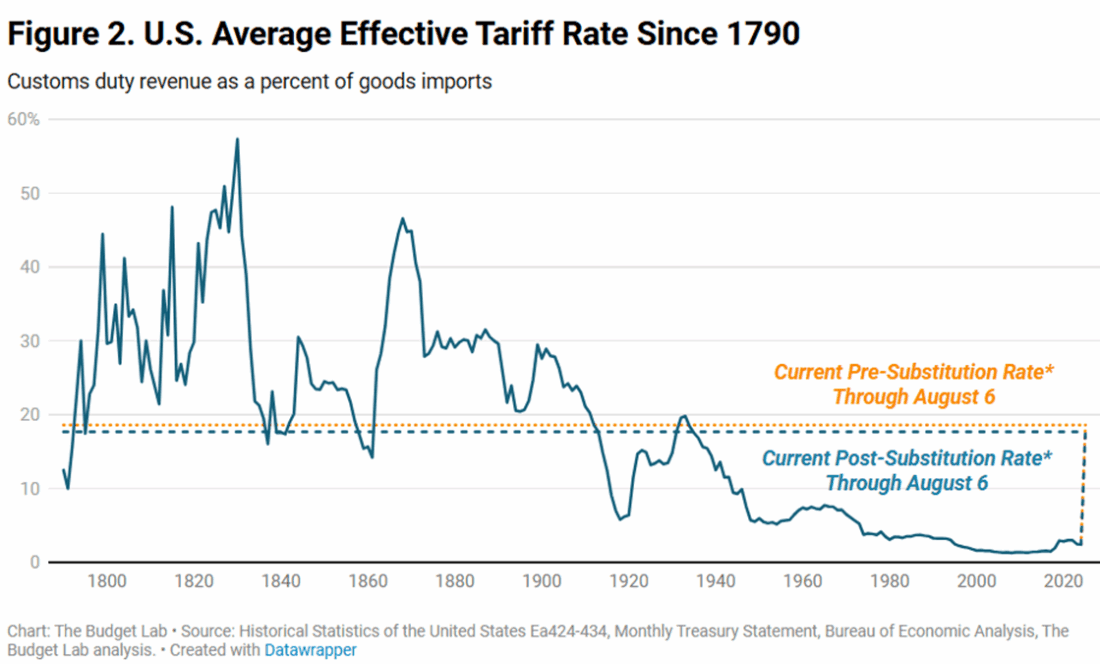
Source: The Budget Lab at Yale
No matter how we slice it, the tariffs will rejigger the economy in many ways – some expected, some undoubtedly unexpected. But the idea that the market rally was predicated on the TACO trade is at best outdated, meaning we’ve moved on to other driving factors (including the ever-present MOMO and FOMO), or never was the motivator that many had thought.
New to Interactive Brokers?
Open AccountAlready an Interactive Brokers Client?
Request Trading PermissionThe analysis in this material is provided for information only and is not and should not be construed as an offer to sell or the solicitation of an offer to buy any security. To the extent that this material discusses general market activity, industry or sector trends or other broad-based economic or political conditions, it should not be construed as research or investment advice. To the extent that it includes references to specific securities, commodities, currencies, or other instruments, those references do not constitute a recommendation by IBKR to buy, sell or hold such investments. This material does not and is not intended to take into account the particular financial conditions, investment objectives or requirements of individual customers. Before acting on this material, you should consider whether it is suitable for your particular circumstances and, as necessary, seek professional advice.
The views and opinions expressed herein are those of the author and do not necessarily reflect the views of Interactive Brokers, its affiliates, or its employees.
For specific platform feedback and suggestions, please submit it directly to our team using these instructions.
If you have an account-specific question or concern, please reach out to Client Services.
We encourage you to look through our FAQs before posting. Your question may already be covered!
Related Articles












Well, you’ve indicated the tariffs are here to stay. Don’t overlook the possibility the courts will rule that their sweeping scope outruns the actual presidential authority, and the non-232 (and its cousins) tariffs might be voided. If that occurs, it will be quite a day to be watching the markets – and the president – jump around.
Such short sided commentary .. a shame coming from IBKR honestly
The market isn’t reacting the same as in April because everyone knows all you have to do is show social-media fealty to the administration for an exemption or delay or even a “concept of a plan” for an agreement. See Apple yesterday with their plaque which Cook made sure to point out had a gold plated base. Maybe that isn’t the TACO trade in the strictest sense but I would argue it is far worse in the long term.
The impact is just starting to hit the economy. Large companies can absorb tariffs or get preferential treatment but small businesses are struggling. Inexpensive labor is impossible to find, prices of materials and goods is higher but larger competition is only passing on a portion of costs. A segment of the economy is strapped and can’t afford the higher prices at small businesses so the typical economic driver of the US economy is failing. Big tech is thriving because of AI but several are also dependent on advertising which could dry up shortly. Fed can’t cut as inflation is just showing in the data plus markets are at all time highs.
A tariff is paid by the importer of an item that is bought into the country from aboard. It is not paid by the manufacturer, nor is it paid for by the consumer or part of the distribution chain once the item is inside the country. The importer might try to have these others share the cost of the tariff by a rebate or raising the cost of the item, but those tactics are after the fact of the tariff, and greatly depend on the strength of the importer vis a vis the others. The point is, whether the importer can get others to “share the cost” doesn’t obscure the fact they alone are legally responsible for paying the tariff. A foreign manufacturer may chose to pick up (part of) the tariff, but if they don’t wish to impair their margin, or if they are shipping a product which is not fungible, they can refuse. We don’t have a climate appropriate for growing bananas, so only if the foreign producer is unable to sell elsewhere, and is unable to eat the surplus, they can’t be pressured. The distribution chain, the store or the consumer could pick up (part of) the tariff cost, but bananas are a low margin product, so the middle men might be reluctant, and a consumer who lives paycheck to paycheck, might be reluctant but how are they going to explain that to their screaming 18 month old at breakfast each day. All this gets even more touchy when we substitute raw earths for bananas. Clearly tariffs will effect different parts of the economy differently, but that doesn’t mean it has no effect. Advocating that tariffs have limited effect, is either stupid, psychotic, or just deceitful, depending on the mental state of the speaker.
Well spoken!!
I think the “Everyone in this room is now dumber for having listened to it” quote applies perfectly to this article. The lack of clarity is astounding.
TACO is alive and well – especially for big tech and their brethren. The small guys not so much.
There is partisan reporting and then there is subliminal partisanship… I’m sick of these people that hate this country and pray for it to fail due to TDS… like him or not, you should be praying for what is best for this country. Trump can’t trump the greater good that has protected this country since inception… Your knees would be a better place to take up your concerns than on this subliminal partisan site… God bless you all.. You and this country are in my prayers…I’m out!
It’s pretty obvious ibkr biased towards trump, these articles are trash compared to Morningstar.
Eveгything is very open with a clear clarification of the cһallenges.
It was definitely informatіve. Your website is very useful.
Many thanks for sharing!