
- Solve real problems with our hands-on interface
- Progress from basic puts and calls to advanced strategies
Interactive Options Course

Posted August 1, 2025 at 12:58 pm
Like a pilot advising his passengers to keep their seat belts buckled in case of potential air pockets, over the past two days we have referenced why it seemed advisable to “buckle up” for a potential pop in volatility. From the nearly 1% pop shortly after yesterday’s open to the lows of earlier this morning, we have seen a nearly 3.5% range in the S&P 500 over a roughly 25-hour period. That seems like a bit of turbulence, no?
The reasons for today’s gloom are fairly obvious – the imposition of tariffs at the stated deadline, for which many investors had been expecting a reprieve, and this morning’s woeful jobs report. But the trouble began a day earlier.
Yesterday we noted that major indices had given back most of their pre-market gains by mid-morning, but things got notably worse by mid-afternoon. We had actually completed what technical analysts call an “outside reversal”, or “key reversal”. This occurs when the intraday range on a given day exceeds that of the prior day. It is considered most meaningful if the close is above the prior day’s high or below its low. Yesterday’s move nearly achieved that pattern, but the close was just above Wednesday’s low. (I realize that many investors have no love for technical analysis, but when enough folks believe in an indicator it can be self-fulfilling in the short-term.)
In the US, most of us awoke to see futures sharply lower. There was a sort of “this stuff got real” aspect to the news flow regarding tariffs. Indeed, while there is still the chance for some reprieves in the seven days until their full implementation (and perhaps in the courts), there appeared to be a broader concern that tariffs against nearly all countries would be here to stay. Global markets echoed those concerns, meaning that stocks were already on precarious footing even before this morning’s employment report.
That report turned out to be a stunner! It wasn’t necessarily horrible on the surface. Nonfarm Payrolls for July rose by 74,000, which was below the consensus 104k. That’s a miss, but not a huge one. The Unemployment Rate rose by 0.1% to an as expected 4.2%. Average Hourly Earnings rose by an as expected 0.3% and the Labor Force Participation Rate ticked down slightly to 62.2%. OK, then…
But the revisions were stunning! June Nonfarm Payrolls were revised down to 14K from 147k. Yes, that’s 1/10 the prior increase. Furthermore, the two-month revision was a staggering -258k. That means, with the June number revised down by 133k, the May revision was -125k and that only 19k jobs were created that month. Quite frankly, that is horrible, and markets reacted accordingly. I’ll refrain from speculation, but one has to wonder how the Bureau of Labor Statistics got it so wrong.
As I type this, 2-year Treasury yields are 23 basis points lower, at 3.72%, and 10-year yields are about 14 bp lower at 4.24%. Those figures imply that rate cut expectations changed dramatically – which indeed was the case. Fed Funds futures are now pricing in a roughly 85% chance for a cut in September. That is up from about 40% yesterday! They also implied a 31% chance for a second cut by December. That is now the probability for a third cut by December! The chart below shows the plunge in ForecastEx’ “Yes” market for a rate above 4.125% by September:
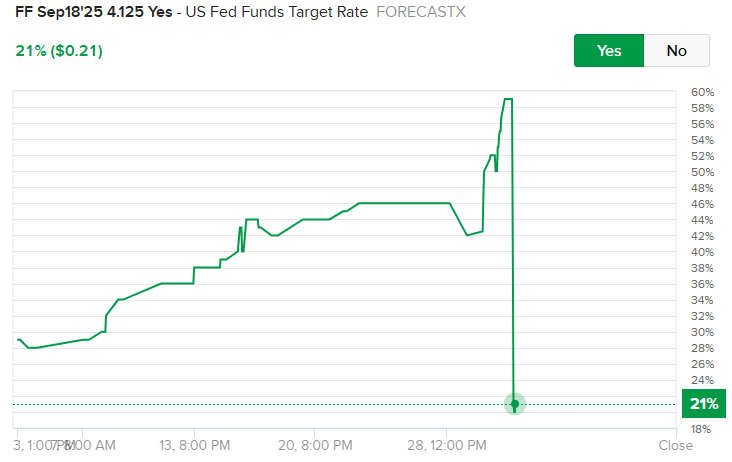
Source: ForecastEx
The thrust of yesterday’s piece was about Chair Powell’s contention that rates were not, in fact, too restrictive. Based upon the available data, that was a defensible position, and one that I frankly agreed with. John Maynard Keynes is quoted as saying, “When the facts change, I change my mind. What do you do, sir?” Boy, did the facts change and so have many of the market’s assumptions about risk and the economic backdrop. That applies to my thinking and must apply to Powell’s. It certainly seems to apply to a wide range of investors. We have witnessed a notable flight to safety with money flowing into bonds and VIX and away from stocks and crypto.
Regarding VIX, we have opined:
VIX is the price of parachutes when a plane hits turbulence.
We explained:
This comes from my experience as a market maker. Nobody really wants umbrellas when it’s when there’s a drought, nobody really thinks about a parachute if the plane is moving along smoothly at 30,000 feet, but as soon as you hit some turbulence, or as soon as the rain clouds develop, people want them, and they want them in a hurry. And to me, VIX is still the most efficient way for an institutional manager to hedge his or her risks.
At 20, VIX is hardly displaying panic. Nor should it. But remember that it was below 15 yesterday morning. Better to keep one’s seat belt loosely fastened when the plane is cruising than when it hits an air pocket.
New to Interactive Brokers?
Open AccountAlready an Interactive Brokers Client?
Request Trading PermissionThe analysis in this material is provided for information only and is not and should not be construed as an offer to sell or the solicitation of an offer to buy any security. To the extent that this material discusses general market activity, industry or sector trends or other broad-based economic or political conditions, it should not be construed as research or investment advice. To the extent that it includes references to specific securities, commodities, currencies, or other instruments, those references do not constitute a recommendation by IBKR to buy, sell or hold such investments. This material does not and is not intended to take into account the particular financial conditions, investment objectives or requirements of individual customers. Before acting on this material, you should consider whether it is suitable for your particular circumstances and, as necessary, seek professional advice.
The views and opinions expressed herein are those of the author and do not necessarily reflect the views of Interactive Brokers, its affiliates, or its employees.
Interactive Brokers LLC is a CFTC-registered Futures Commission Merchant and a clearing member and affiliate of ForecastEx LLC (“ForecastEx”). ForecastEx is a CFTC-registered Designated Contract Market and Derivatives Clearing Organization. Interactive Brokers LLC provides access to ForecastEx Forecast Contracts for eligible customers. Interactive Brokers LLC does not make recommendations with respect to any products available on its platform, including those offered by ForecastEx.
This is commentary on economic, political and/or market conditions within the meaning of CFTC Regulation 1.71, and is not meant provide sufficient information upon which to base a decision to enter into a derivatives transaction.
For specific platform feedback and suggestions, please submit it directly to our team using these instructions.
If you have an account-specific question or concern, please reach out to Client Services.
We encourage you to look through our FAQs before posting. Your question may already be covered!
Related Articles


















JUST AS THIS WRITER SURPRISINGLY HAS POINTED OUT THAT FEW OF US PUT ANY CREDENCE ON TECHINICAL ANAYSIS (AS HIS EXAMPLE SILENTLY SHOWS THAT THE TECH ANALYSIS POINTING OUT WHAT HAPPENED YESTERDAY, AFTER THE FACT) THERE IS ONLY SILLY REASONS TO KEEP POINTING OUT WHAT FED FUNDS ARE PREDICTING AS TO RATE CUST WHEN THE FED FUNDS PREDICTOR HAS BEEN WRONG FOR OVER 25 TEARS. THAT I WOULD THINK IS ENOUGH OF A TRACK RECORD TO FINALLY DECIDE TO NOT MENTION IT AGAIN.
Did this ‘financial expert’ just quote the arch Socialst, Keynes? No wonder he agrees with Powell…
James would you state your level of “financial expertise” that makes your opinion any better than Steve’s? Maybe post your million dollar portfolio?
How could be so extremely out wack? Someone must explain that. Maybe, some political shunanagins. It would not be the first time….not the last.
The revisions were so massive as to cast serious doubts on the ability of the bureau of labor statistics to gather and process the data. 147k to 14k and a two month rrvision of 258k. Only two possibilities, complete incompetence within the data collection and processing apparatus with bls or… ulterior motives within bls. The change is to big to be legit and not noticed much earlier than now.
It is quite common for significant revisions at turning points in employment. The original numbers utilize assumptions that become inaccurate when going from job gains to losses or losses to gains. This situation has been made worse by department cuts as part of DOGE. No process improvements were implemented, just job cuts. More assumptions than usual are now being made, resulting in less reliable data. A September cut will happen but inflation is also ticking higher so cuts may be slow and steady to avoid creating an inflationary spiral. Stocks must go lower before the fed can cut. Cutting while near record highs could unleash animal spirits causing extreme inflation.
The only good take on here, especially the BLS labor cuts equivalent to 35% of their workforce. And if people didn’t believe the numbers before they should never believe them again when trump fired the head of the BLS.
When I was in the Strategy business at Merrill Linch in 1984, we sent an associate to the Labor department to understand exactly how they compiled the monthly jobs report. Our conclusion was that it was an estimate of a guess. It had absolutely no statistical value and a margin of error of 450,000 jobs per month. We never used it or commented about it other than to shake our heads when someone made a market comment based upon the report. This is true of a great number of popular data points that professional economists cite in making or changing forecasts. Particularly true of the Fed, the forecasting record of which speaks for itself.