- Solve real problems with our hands-on interface
- Progress from basic puts and calls to advanced strategies
Interactive Options Course

Posted October 28, 2024 at 12:29 pm
Read about the evolution of trading systems started and the basic life cycle in an automated trading system in Part I and Part II.
Beginner traders can learn to build their own automated trading system with the algorithms to trade in the markets. For building your own automated trading system, you will need to code the strategy in a programming language, backtest the strategy on historical data to find out its performance, paper trade and then live trade.
Let us see these steps in detail below that can serve as a rough guideline for building an algorithmic trading strategy:
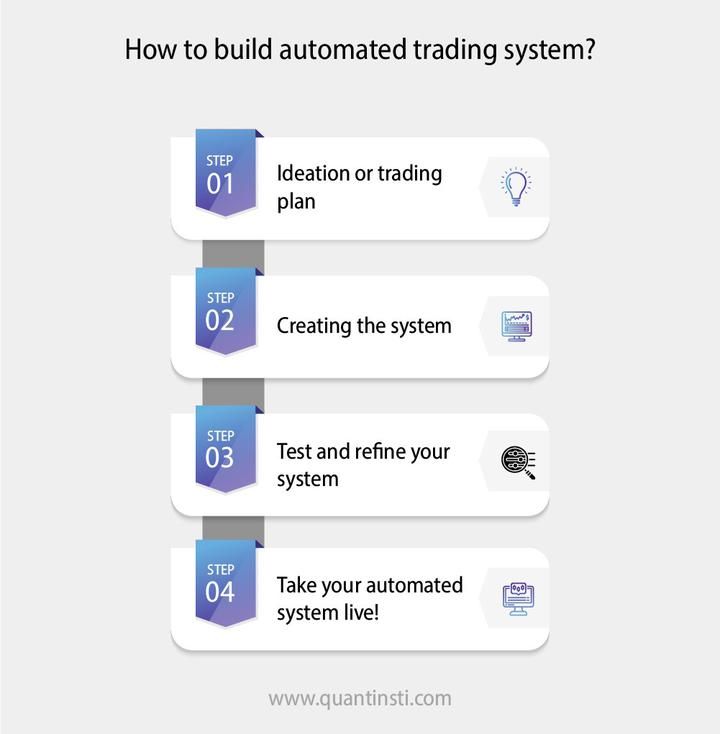
Come up with a trading idea or a strategy for trading in live markets. This ideated strategy can be based on your market observations or can be borrowed from trading books, research papers, trading blogs, trading forums or any other source.
This step requires you to create an automated system to identify the trading opportunities in the market in accordance with your preferred financial instruments. Also, you will need to feed the automated trading system with the information regarding how to perform once it finds the opportunities.
In addition, you will also need to give the inputs regarding risk management by entering the parameters such as stop loss, limit order etc.
This entire process of creating the automated system will require you to have the knowledge of a programming language such as Python, C, etc. With this programming language, you will be able to code the system with all the necessary abovementioned preferences.
The next step is to test and refine the automated trading system so as to improvise the system in case of any malfunctions. After making any necessary changes or improvements, you can be sure that the system is set for taking your trades to the live market.
Once you’re sure of your automated system, you can take your trade live with your trading idea or strategy.
Now that you have successfully built an automated trading system, here is a tutorial to help you through the process of downloading historical stock data using Python. If you are interested in automated trading system and want to analyse historical stock data for developing your trading strategies, this video can serve the purpose. Visit QuantInsti to watch the video: https://blog.quantinsti.com/automated-trading-system/
Moving forward, we will discuss the advantages of automated trading systems.
The advantages of using automated trading systems are as follows:
Ahead, we will discuss some disadvantages of using automated trading systems.
The following are the disadvantages.
This was a detailed post on automated trading system architecture to give you an in-depth and insightful knowledge of the components involved. Also, there are various challenges that the architecture developers need to handle or overcome in order to build a robust automated trading system. So what are you waiting for? Go Algo!!
If you want to learn various aspects of algorithmic trading and automated trading systems, then check out our course on “Algorithmic Trading for Beginners!”. This course builds a foundation in algorithmic trading and is perfect for those who want to get a complete picture of the domain. It includes the what, how and why of algorithmic trading. Different algorithmic trading strategies and regulations for setting up an algorithmic trading business are also included.
Originally posted on QuantInsti blog.
Information posted on IBKR Campus that is provided by third-parties does NOT constitute a recommendation that you should contract for the services of that third party. Third-party participants who contribute to IBKR Campus are independent of Interactive Brokers and Interactive Brokers does not make any representations or warranties concerning the services offered, their past or future performance, or the accuracy of the information provided by the third party. Past performance is no guarantee of future results.
This material is from QuantInsti and is being posted with its permission. The views expressed in this material are solely those of the author and/or QuantInsti and Interactive Brokers is not endorsing or recommending any investment or trading discussed in the material. This material is not and should not be construed as an offer to buy or sell any security. It should not be construed as research or investment advice or a recommendation to buy, sell or hold any security or commodity. This material does not and is not intended to take into account the particular financial conditions, investment objectives or requirements of individual customers. Before acting on this material, you should consider whether it is suitable for your particular circumstances and, as necessary, seek professional advice.











Join The Conversation
For specific platform feedback and suggestions, please submit it directly to our team using these instructions.
If you have an account-specific question or concern, please reach out to Client Services.
We encourage you to look through our FAQs before posting. Your question may already be covered!