- Solve real problems with our hands-on interface
- Progress from basic puts and calls to advanced strategies
Interactive Options Course
Posted May 6, 2024 at 10:44 am
Bob Farrell Told Me
Investopedia is partnering with CMT Association on this newsletter. The contents of this newsletter are for informational and educational purposes only, however, and do not constitute investing advice. The guest authors, which may sell research to investors, and may trade or hold positions in securities mentioned herein do not represent the views of CMT Association or Investopedia. Please consult a financial advisor for investment recommendations and services.
I had the privilege of speaking with the legendary Robert Farrell at the CMT Association’s Midwinter Retreat in Tampa. He recommended I read a book called One-Way Pockets: the book of books on Wall Street speculation. Published in 1917, it was written by Don Guyon, the fictitious name of a man working in a brokerage house during the War Bride bull market of 1915. It is my hope to relay some timeless market wisdom, study some market history, and share a book recommendation from our first president.
History & Background
The year is 1915. Electricity, the internal combustion engine, running water in our homes, and the desire for city life over rural life are all changing the way we live. US equities have been in a secular trading range since 1900. We are in the midst of the War Bride bull market following the start of World War 1. See chart 1.
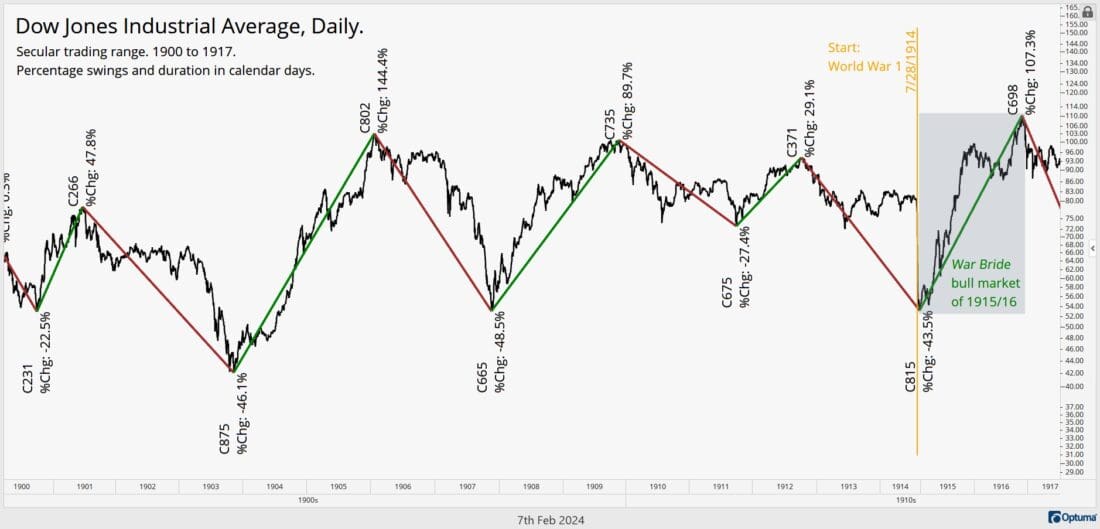
Chart 1. Courtesy of Optuma.
World War 1 officially started on July 28th, 1914. Trading on the New York Stock Exchange closed from July 30th to December 12th, 1914, as foreign investors began liquidating their holdings to raise money to fund the war. When trading resumed, The Dow Industrial average gained more than 86% over 257 trading days. This rally was fueled by the government as it began spending heavily to produce goods for the Europeans to purchase to support the war. The 1915 rally was led by the aptly named War Bride stocks, including munition, iron, steel, shipping, and textiles. See chart 2.
Don Guyon (DG), working in a brokerage house in December 1915, had a difficult time understanding why speculators were losing money at the end of such a spectacular bull run. To figure this out, he went through the accounts of six of the brokerage’s largest active traders. He analyzed their transactions from July 1st, 1915, to February 29th, 1916. See chart 2. He concluded, “…the trading methods of each [speculator] had undergone a pronounced and obviously unintentional change with the progress of the bull market from one stage to another”
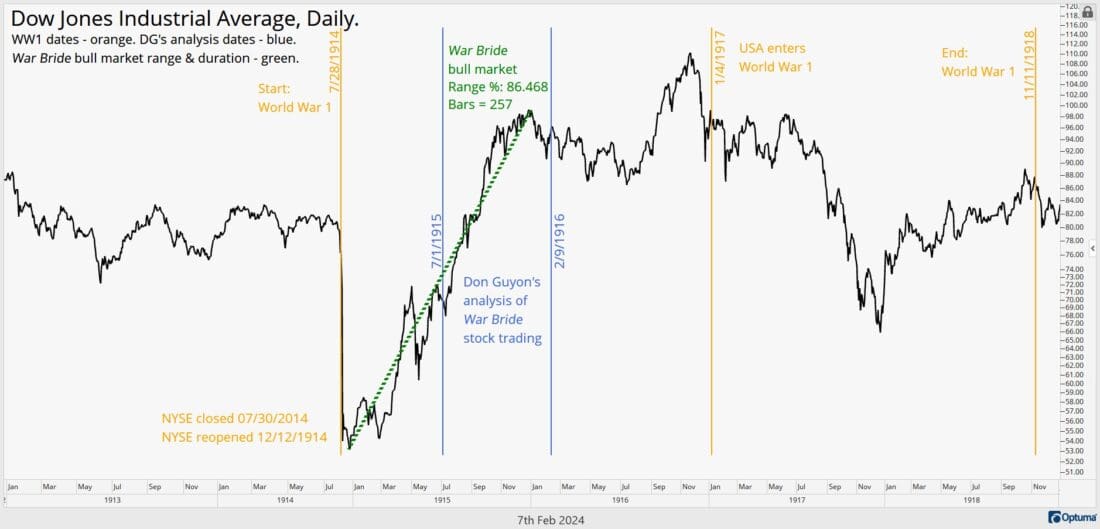
Chart 2. Courtesy of Optuma.
After doing his study by analyzing his brokerage’s order book, DG concluded that the speculators’ behavior was backwards. They were doing the exact opposite of what they should have.
Before we get to DG’s trading methodology, he eventually offers the following regarding a speculator’s psychology. “The operating method I have outlined is not fool-proof or otherwise infallible… But the speculator who adhered closely to its rules may at least rest assured that his trading methods are diametrically opposed to the trading methods of the great majority of speculators – and the great majority of speculators are, as we know, consistent losers in Wall Street.”
and
“The man who applies this or any other speculative method successfully must be able to exercise patience and self-control, to withstand all forms of mental temptation, to ignore the dictates of fear and greed, and to disregard everything he hears, sees, or reads that may cause the slightest deviation from his course.”
and
“The few who make money in the stock market await what they consider exceptional opportunities and then play for profits that are worthwhile. They look ahead a week or a month or a year, as the case may be, and disregard the changes that occur in the price movement in each daily session, which to the daily trader assumes exaggerated proportions.”
DG’s Plan to Speculate Covering a Complete Market Cycle
First determine the trend of the overall market, and then speculate in that direction. Be careful of rangebound markets, but if desired buy low and sell high.
How a bull market starts/when to get long:
DG also tells us:
Seeing the first reaction through:
You are now long. Your stocks have advanced for several days. DG tells us:
The first selling point:
The great distributive stage:
When and what to sell short:
Final Thoughts
DG’s perspective is a fascinating one. He studied actual buy and sell orders of unsuccessful speculators, and then he crafted trading guidelines which do the exact opposite of what they did. He shared important psychological ideas. He even made the case for Technical Analysis as a discipline: “To tell a speculator to base his operations on his interpretation of fundamental factors is to leave him just where he started…The market itself determines the relative importance of all factors more accurately.”
I encourage you to read this book, and I again thank Mr. Farrell for this recommendation. In closing, DG tells us, and I believe Mr. Farrell would agree, “…the only speculative method that would prove profitable in the long run must be the reverse of that followed by the consistently unsuccessful public.”
Quotes taken from Guyon, Don. One-Way Pockets: the book of books on Wall Street speculation. New York, New York: Cosimo, 2005
—
Originally posted 6th May, 2024
For specific platform feedback and suggestions, please submit it directly to our team using these instructions.
If you have an account-specific question or concern, please reach out to Client Services.
We encourage you to look through our FAQs before posting. Your question may already be covered!
Investopedia.com: The comments, opinions and analyses expressed herein are for informational purposes only and should not be considered individual investment advice or recommendations to invest in any security or to adopt any investment strategy. While we believe the information provided herein is reliable, we do not warrant its accuracy or completeness. The views and strategies described on our content may not be suitable for all investors. Because market and economic conditions are subject to rapid change, all comments, opinions and analyses contained within our content are rendered as of the date of the posting and may change without notice. The material is not intended as a complete analysis of every material fact regarding any country, region, market, industry, investment or strategy. This information is intended for US residents only.
Information posted on IBKR Campus that is provided by third-parties does NOT constitute a recommendation that you should contract for the services of that third party. Third-party participants who contribute to IBKR Campus are independent of Interactive Brokers and Interactive Brokers does not make any representations or warranties concerning the services offered, their past or future performance, or the accuracy of the information provided by the third party. Past performance is no guarantee of future results.
This material is from Investopedia and is being posted with its permission. The views expressed in this material are solely those of the author and/or Investopedia and Interactive Brokers is not endorsing or recommending any investment or trading discussed in the material. This material is not and should not be construed as an offer to buy or sell any security. It should not be construed as research or investment advice or a recommendation to buy, sell or hold any security or commodity. This material does not and is not intended to take into account the particular financial conditions, investment objectives or requirements of individual customers. Before acting on this material, you should consider whether it is suitable for your particular circumstances and, as necessary, seek professional advice.
















Very interesting perspective- with some strong arguments for contain investing- Thanks for posting
Thanks for engaging!