
- Solve real problems with our hands-on interface
- Progress from basic puts and calls to advanced strategies
Interactive Options Course
Posted June 11, 2026 at 11:00 am
Dear Investor,
You have probably noticed: semiconductor stocks are booming. The PHLX Semiconductor Index has gained 177.73 percent within a year at the time of writing.
The strong rise attracted many investors. Inflows into leveraged instruments were high, and in Korea it was primarily seniors who took on debt to buy semiconductor stocks.
Euphoria seems to be setting in. We are asking ourselves what comes next.
Seasonality provides an answer to this.
Take a look at the first chart. It shows you the seasonal pattern of the PHLX Semiconductor Index in blue. In gold you can see, for comparison, the seasonal pattern of the S&P 500. Both were calculated over the past 25 years.
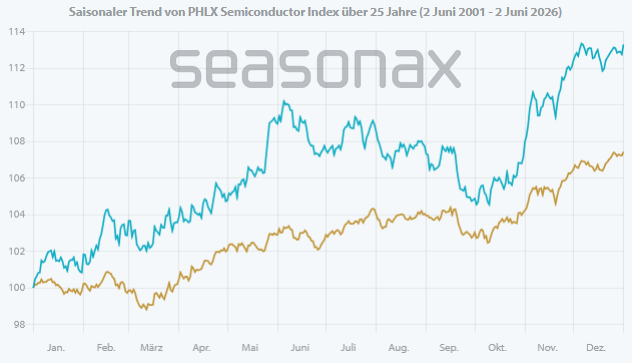
As you can clearly see, semiconductor stocks are set to decline over the coming four months from a seasonal perspective. The broader market in the form of the S&P 500 also does not fare well during this period, as it is the weak summer season. However, its seasonal pattern is notably better than that of the Semiconductor Index.
Bear in mind: the seasonal chart above also incorporates the most recent extreme bull run of the Semiconductor Index. When a phase like 2025/26 is exceptionally strong for the Semiconductor Index, it correspondingly pulls the seasonal average higher.
This raises the question of what the seasonal pattern of the Semiconductor Index looks like without this extreme phase. The next chart therefore shows you the seasonal pattern of the PHLX Semiconductor Index again from 2001, but this time excluding the years 2025 and 2026.
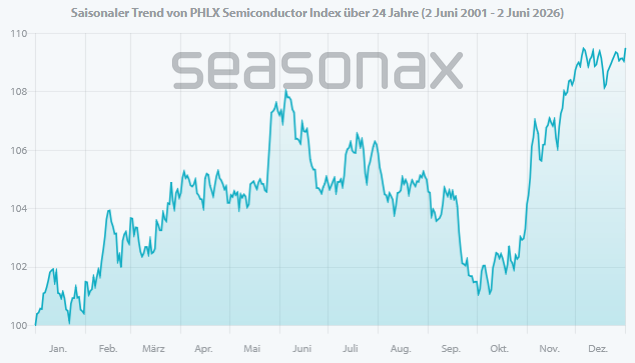
You can now see how weak the seasonal pattern of the Semiconductor Index is during the coming summer months. The seasonal pattern through to the end of September is already genuinely weak without the influence of the most recent extreme rally.
What will happen with semiconductor stocks over the coming months? Nobody can tell you that with certainty – the future is open. From a seasonal perspective, however, the probability of declines in the coming months is significantly elevated, particularly for semiconductor stocks.
—
Originally Posted June 9, 2026 – Semiconductors vs. S&P 500: Who Wins Seasonally?
Past results and past seasonal patterns are no indication of future performance, in particular, future market trends. Seasonax GmbH neither recommends nor approves of any particular financial instrument, group of securities, segment of industry, analysis interval or any particular idea, approach, strategy or attitude nor provides consulting nor brokerage nor asset management services. Seasonax GmbH hereby excludes any explicit or implied trading recommendation, in particular, any promise, implication or guarantee that profits are earned and losses excluded, provided, however, that in case of doubt, these terms shall be interpreted in abroad sense. Any information provided by Seasonax GmbH or on this website or any other kind of data media shall not be construed as any kind of guarantee, warranty or representation, in particular as set forth in a prospectus. Any user is solely responsible for the results or the trading strategy that is created, developed or applied. Indicators, trading strategies and functions provided by seasonax GmbH or on this website or any other kind of data media may contain logical or other errors leading to unexpected results, faulty trading signals and/or substantial losses. Seasonax GmbH neither warrants nor guarantees the accuracy, completeness, quality, adequacy or content of the information provided by it or on this website or any other kind of data media. Any user is obligated to comply with any applicable capital market rules of the applicable jurisdiction. All published content and images on this website or any other kind of data media are protected by copyright. Any duplication, processing, distribution or any form of utilisation beyond the scope of copyright law shall require the prior written consent of the author or authors in question. Futures and forex trading contains substantial risk and is not for every investor. An investor could potentially lose all or more than the initial investment. Risk capital is money that can be lost without jeopardizing ones’ financial security or lifestyle. Only risk capital should be used for trading and only those with sufficient risk capital should consider trading. Past performance is not necessarily indicative of future results. Testimonials appearing on this website may not be representative of other clients or customers and is not a guarantee of future performance or success.
Information posted on IBKR Campus that is provided by third-parties does NOT constitute a recommendation that you should contract for the services of that third party. Third-party participants who contribute to IBKR Campus are independent of Interactive Brokers and Interactive Brokers does not make any representations or warranties concerning the services offered, their past or future performance, or the accuracy of the information provided by the third party. Past performance is no guarantee of future results.
This material is from Seasonax and is being posted with its permission. The views expressed in this material are solely those of the author and/or Seasonax and Interactive Brokers is not endorsing or recommending any investment or trading discussed in the material. This material is not and should not be construed as an offer to buy or sell any security. It should not be construed as research or investment advice or a recommendation to buy, sell or hold any security or commodity. This material does not and is not intended to take into account the particular financial conditions, investment objectives or requirements of individual customers. Before acting on this material, you should consider whether it is suitable for your particular circumstances and, as necessary, seek professional advice.
For specific platform feedback and suggestions, please submit it directly to our team using these instructions.
If you have an account-specific question or concern, please reach out to Client Services.
We encourage you to look through our FAQs before posting. Your question may already be covered!
Related Articles














If a sector is exceeding historical norms during one season why would we assume it would conform to those norms in another season? In other words, while there may normally be the seasonal variation described here what’s to say that whatever is driving the huge run-up of the past year is particularly seasonal?
The basic argument is founded on (it seems) consumer behavior … born of the age of digital technology (the first computer i worked on as a consultant had program max length of 256 bits – on a subsequent job you could walk around in the “mainframe” and programs submitted by punch cards … and about 18 yrs as IT consultant to mostly fortune 100 company’s ). We have now graduated to the age of AI, the demands of expanded memory/processing power exponentially pushing boundaries … quite possibly seasonality included.