
- Solve real problems with our hands-on interface
- Progress from basic puts and calls to advanced strategies
Interactive Options Course
Posted February 3, 2020 at 2:56 pm
The type of market gyrations that we have seen over the past few trading sessions can be very treacherous for active traders, particularly those without a disciplined strategy. Traders who fall victims to markets that swing back and forth are said to be “whipsawed”. The term refers to an old lumberjack’s tool, a two-man saw that is pushed and pulled rapidly and can swing wildly if one user lets go:

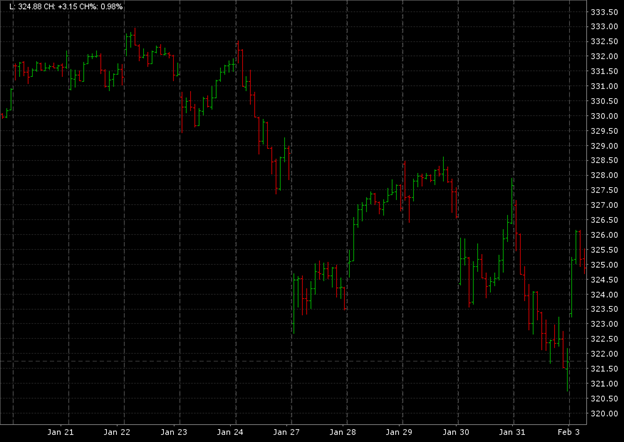
The equity market’s version of a whipsaw looks like the following, illustrated by a 10-minute chart in SPY that displays the sharp swings that have punctuated the broader indices:
And the options market’s version of a whipsaw looks like this, illustrated by comparing snapshots of the VIX futures curves 3 days ago and 1 day ago to the current one:

I expect that many readers find the first graph familiar but would be unaccustomed to seeing the second. Futures on the VIX index are actively traded and usually show an upward sloping curve when the forward months are displayed on a graph. That phenomenon, displayed for most of the red line is known as “contango”, the normal state of most futures markets. Contango reflects a relatively stable supply of a given commodity and the risk-free rate of capital over that time period. The opposite phenomenon, shown for most of the orange line is called “backwardation”. That reflects relative scarcity. The current reading, displayed on the green line, displays a disjointed market for volatility.
Many of you may be wondering about the large hump at the back of the curves. That hump reflects the preemptive volatility hedging that is occurring in the markets ahead of November’s Presidential election. The bumps that we see in the upcoming months may be reflecting uncertainty surrounding the Democratic primary process.
While savvy traders will often view market movements as opportunities, they throw the tradeoff between risk and reward into focus. Here are some tips that I find helpful for avoiding losses in market environments like the current one:
These are some of the techniques that numerous other techniques that I have learned from decades of trading. I’ll be glad to reveal more in future articles and videos.
The analysis in this material is provided for information only and is not and should not be construed as an offer to sell or the solicitation of an offer to buy any security. To the extent that this material discusses general market activity, industry or sector trends or other broad-based economic or political conditions, it should not be construed as research or investment advice. To the extent that it includes references to specific securities, commodities, currencies, or other instruments, those references do not constitute a recommendation by IBKR to buy, sell or hold such investments. This material does not and is not intended to take into account the particular financial conditions, investment objectives or requirements of individual customers. Before acting on this material, you should consider whether it is suitable for your particular circumstances and, as necessary, seek professional advice.
The views and opinions expressed herein are those of the author and do not necessarily reflect the views of Interactive Brokers, its affiliates, or its employees.
Options involve risk and are not suitable for all investors. For information on the uses and risks of options, you can obtain a copy of the Options Clearing Corporation risk disclosure document titled Characteristics and Risks of Standardized Options by going to the following link ibkr.com/occ. Multiple leg strategies, including spreads, will incur multiple transaction costs.
Futures are not suitable for all investors. The amount you may lose may be greater than your initial investment. Before trading futures, please read the CFTC Risk Disclosure. A copy and additional information are available at ibkr.com.
Related Articles

















Join The Conversation
For specific platform feedback and suggestions, please submit it directly to our team using these instructions.
If you have an account-specific question or concern, please reach out to Client Services.
We encourage you to look through our FAQs before posting. Your question may already be covered!