
- Solve real problems with our hands-on interface
- Progress from basic puts and calls to advanced strategies
Interactive Options Course

Posted April 16, 2024 at 11:00 am
The recent rise in long-term interest rates has sent homebuilders to their bunkers, causing construction activity to sink sharply last month. Higher yields are also weighing on the stock market’s performance, as traders contend with a central bank that appears increasingly unsatisfied with inflation’s trajectory amidst longer-term excesses in government debt levels, Treasury issuance and budget deficits. Investors are also highly attentive to geopolitical risks, with Israeli officials vowing retaliation for the recent Iranian offensive.
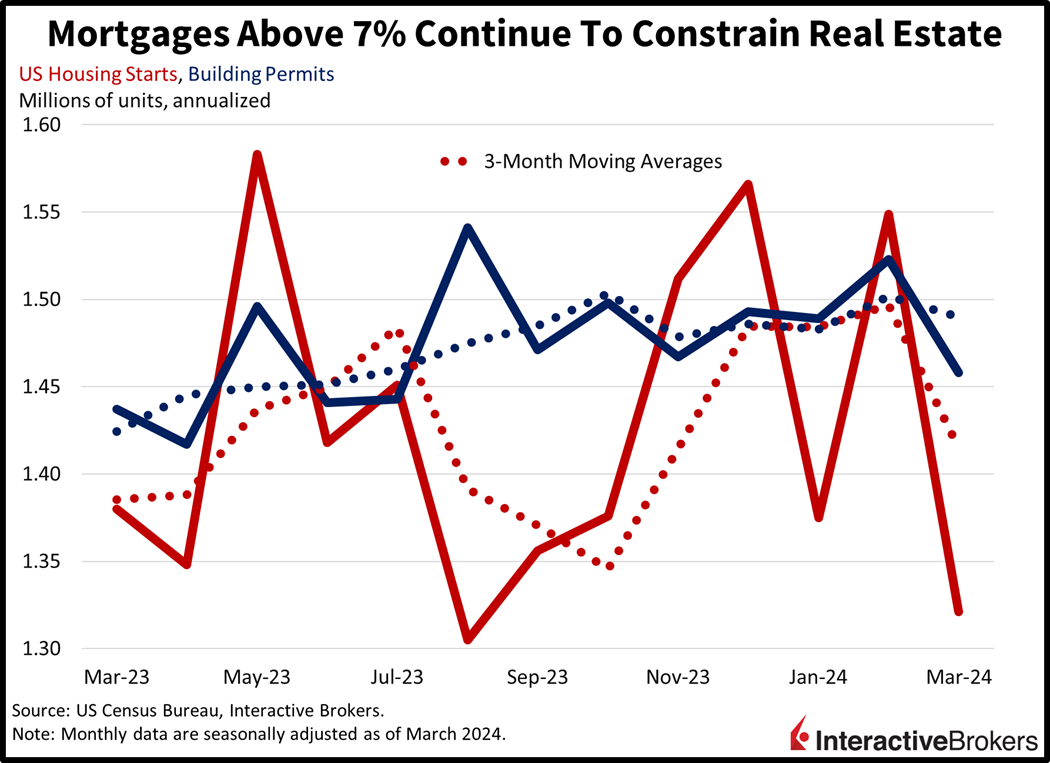
Mortgage rates exceeding 7% continue to punish the real estate sector via lighter construction levels, reduced transactions and a sharp contraction in prices for new homes. The pace of construction sank significantly last month, as both housing starts and building permits declined 14.7% and 4.3% month over month (m/m), according to data from the Commerce Department. Starts came in at 1.321 million seasonally adjusted annualized units (SAAU), way below projections of 1.48 million and February’s 1.549 million. The multi-family segment drove much of the weakness, slipping 20.8% while single-family dropped 12.4% m/m. The Northeast, Midwest and Southern regions led the charge lower with m/m declines of 36%, 23% and 17.8%. The West offset some of the weakness with a gain of 7.1%. Meanwhile, permits, which reflect plans for future construction, were weighed down by single-family, with the component’s pace falling 5.7% m/m while multi-family was unchanged during the period. Similar to permits, applications in the Northeast, Midwest and South declined 20.8%, 14.7% and 0.6%, while the West experienced a 5.1% increase.
Homebuilder Optimism Continues
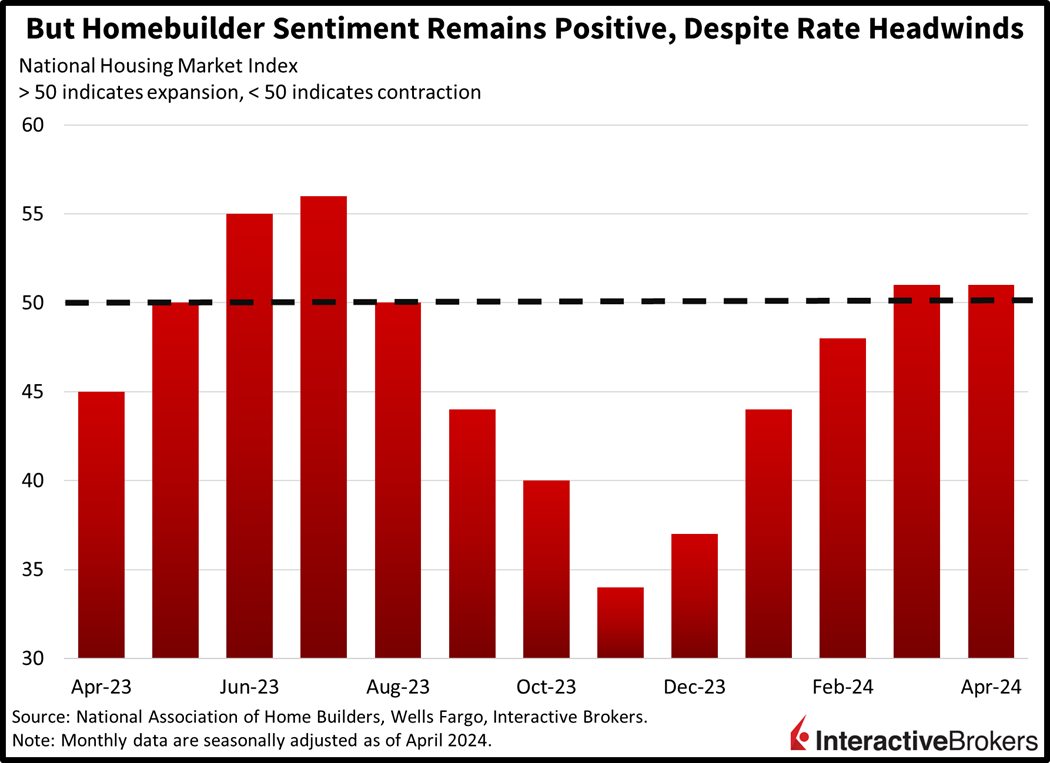
Even though March permits and starts were weak, contractors remain enthusiastic with homebuilder sentiment lingering slightly above the negative/positive threshold of 50. April’s homebuilder sentiment figure of 51 met the analyst consensus estimate and was unchanged from last month. The sub-indices of current single-family sales and traffic of prospective buyers rose from 56 and 34 to 57 and 35, respectively, m/m. But the outlook for sales in the next six months slipped from 62 to 60. Builder motivation increased in three regions by the following amounts:
The South slightly offset the positive moves in the other regions. Sentiment dropped from 52 to 51.
Israel’s rhetoric regarding Tehran’s missile and drone attack on Saturday strengthened this morning when the country’s leaders stated they had no choice but to retaliate. Israel’s war cabinet today continued to discuss its possible reaction to the attack while some reports claim US officials believe that any retaliation will be limited. Despite that, Iran has stated that even small actions will provoke the country to unleash a “severe, extensive and painful” reaction. Investors appear to be assessing how much of Israel’s actions are posturing, or seeking to make the country look strong, rather than a dramatic counterattack that could escalate the conflict. Indeed, oil prices have declined in early trading while bond yields have climbed, implying that the worst may very well be over.
This morning’s earnings reports illustrate that demand for health care, including elective surgery, is robust, and separately, banks are benefiting from strong equity market performance and improved sentiment among business leaders. Consider the following earnings highlights:
Markets are weaker even as equity and bond bulls alike try to hold on amidst yesterday’s painful debacle. Top of mind for stock traders is whether or not the S&P 500 Index can remain above the pivotal 5,000 level, as the benchmark is down 0.3% to 5,047. Meanwhile, the rate sensitive, small-cap Russell 2000 is taking the most pain with the basket down 1%. Against the backdrop, the Nasdaq Composite Index is near the flat line while the Dow Jones Industrial Average gains a modest 0.1%. Fixed-income instruments are getting pounded, as investors think the worst is over in the Middle East for now, contributing to incrementally less demand for risk-off investments and lower oil prices. The 2- and 10-year Treasury maturities are trading at 4.96% and 4.67%, 3 and 6 basis points (bps) loftier on the session. WTI crude is down 0.4%, or $0.35, to $85.26 per barrel. The dollar is benefiting from higher yields with the greenback’s index up 10 bps to 106.29. The US currency is up relative to most of its major, developed market counterparts including the franc, pound sterling, yen, yuan and Aussie and Canadian dollar. It is down slightly against the euro though.
While tighter monetary policy has helped to slow price pressures, home values remain at all-time highs. A combination of an undersupplied market and many homeowners who are locked in at 2% to 4% mortgages has constrained inventory. These headwinds have led to sticky rents as well, with landlords managing margins against the backdrop of rising costs related to interest, labor, maintenance, materials, taxes and insurance. An important goal of economic policy is homeownership, but with affordability at its worst level in history, policymakers are in a pickle. Lower interest rates will bring demand back but will also propel prices. The key to an improved housing market remains supply, but builders won’t build with mortgages above 7%. They will construct with mortgages at 6%, however, but prices will remain unfriendly, as bidders rush to pick up inventory. These concerns are not just relevant to Americans that would like to purchase a home, they’re also a critical component of inflation’s shelter segment, which makes up roughly 40% of the Consumer Price Index and continues to pose a head-scratching problem for the Fed, Congress and the White House.
Visit Traders’ Academy to Learn More About Housing Starts and Other Economic Indicators.
New to Interactive Brokers?
Open AccountInformation posted on IBKR Campus that is provided by third-parties does NOT constitute a recommendation that you should contract for the services of that third party. Third-party participants who contribute to IBKR Campus are independent of Interactive Brokers and Interactive Brokers does not make any representations or warranties concerning the services offered, their past or future performance, or the accuracy of the information provided by the third party. Past performance is no guarantee of future results.
This material is from IBKR Macroeconomics, an affiliate of Interactive Brokers LLC, and is being posted with its permission. The views expressed in this material are solely those of the author and/or IBKR Macroeconomics and Interactive Brokers is not endorsing or recommending any investment or trading discussed in the material. This material is not and should not be construed as an offer to buy or sell any security. It should not be construed as research or investment advice or a recommendation to buy, sell or hold any security or commodity. This material does not and is not intended to take into account the particular financial conditions, investment objectives or requirements of individual customers. Before acting on this material, you should consider whether it is suitable for your particular circumstances and, as necessary, seek professional advice.
Related Articles

















Join The Conversation
For specific platform feedback and suggestions, please submit it directly to our team using these instructions.
If you have an account-specific question or concern, please reach out to Client Services.
We encourage you to look through our FAQs before posting. Your question may already be covered!