
- Solve real problems with our hands-on interface
- Progress from basic puts and calls to advanced strategies
Interactive Options Course
Posted December 19, 2025 at 10:30 am
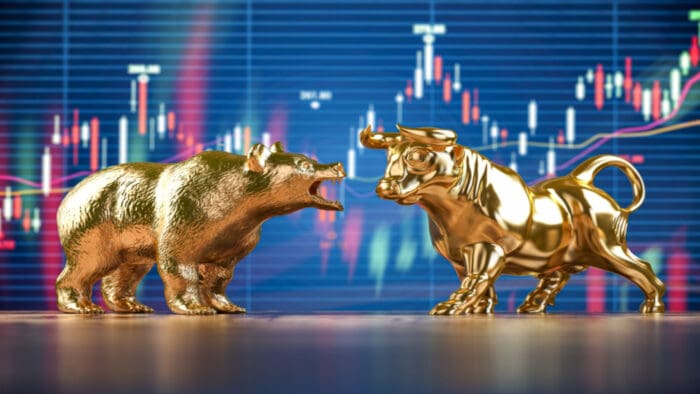
The stock market keeps climbing, yet a lot of people are feeling pretty cautious about the economy. How can we have a booming market when so many signs point to a more uncertain future? This strange disconnect – driven by everything from the AI revolution to how we’re spending our money, to historical precedents – warrants closer examination. Cameron Dawson, CIO of NewEdge Wealth, and Erik Norland, CME Group Chief Economist, unpack six key questions driving this divide and the risks ahead.
This conversation has been edited for brevity and clarity. The full interview can be found here.
Erik Norland: The biggest story is that inflation is still running above target at 3%, which is 1% higher than the Federal Reserve’s desired target. Overall, the economy is growing slowly and is slightly overheated with above-target inflation, even as the central bank is easing policy.
Cameron Dawson: The most critical question is whether the slower hiring seen over the past couple of years will morph into increased firing. In past economic cycles, a slowdown in hiring typically precedes a big uptick in the unemployment rate due to increased firings. The crucial factor to watch is whether U.S. corporations, facing margin pressures in certain areas, will be forced to increase firings. This labor risk remains the key unresolved question for the economy.
Norland: Absolutely, they can coexist. The perfect historical example is the mid-1990s (1995-1996). During this time the U.S. economy slowed into a soft landing, and the stock market loved this scenario because the Federal Reserve was able to ease policy. The Fed cut 75 basis points off rates, and the stock market was up over 30% in 1995 and up a further 25% in 1996.
Dawson: The single most important data point is the divergence between what’s going on within the market cap earnings of the S&P 500 and the equal weight S&P 500. This captures the fact that there’s a huge dichotomy between what’s going on with the top weighted part of the market, which is benefiting from things like AI and CapEx and what’s going on within the average stock, which much more reflects what’s going on within the U.S. economy.
Norland: The key difference is inflation. In the 1990s, inflation was well-behaved. This time, with inflation running above target, the situation is more reminiscent of the early 1970s, in which Federal Reserve Chairman Arthur Burns kept interest rate policy easy and lowered rates in the face of an expanding economy that later on set off a tremendous inflation in 1973 and 1974.
Dawson: A common trope is that “the market is not the economy,” and this is very true. What drives the market, what drives earnings, can be very different from what drives the broader U.S. economy. But one of the reasons why we have seen such a strong market is that it’s become incredibly concentrated and driven by just a few handful of names really benefiting from this massive AI CapEx cycle. And the reality is that that is also actually driving the economy as well. We’re seeing AI CapEx become an increasingly large part of U.S. economic growth.
—
Originally Posted December 19, 2025 – Six Questions Defining the Bull Market, Bear Economy Divide
© [2023] CME Group Inc. All rights reserved. This information is reproduced by permission of CME Group Inc. and its affiliates under license. CME Group Inc. and its affiliates accept no liability or responsibility for the information contained herein, including but not limited to the currency, accuracy and/or completeness of this information, and delays, interruptions, errors or omissions. This information is an unofficial copy and may not reflect the official and accurate version. For the definitive and up-to-date version of any of this information, please see cmegroup.com.
Information posted on IBKR Campus that is provided by third-parties does NOT constitute a recommendation that you should contract for the services of that third party. Third-party participants who contribute to IBKR Campus are independent of Interactive Brokers and Interactive Brokers does not make any representations or warranties concerning the services offered, their past or future performance, or the accuracy of the information provided by the third party. Past performance is no guarantee of future results.
This material is from CME Group and is being posted with its permission. The views expressed in this material are solely those of the author and/or CME Group and Interactive Brokers is not endorsing or recommending any investment or trading discussed in the material. This material is not and should not be construed as an offer to buy or sell any security. It should not be construed as research or investment advice or a recommendation to buy, sell or hold any security or commodity. This material does not and is not intended to take into account the particular financial conditions, investment objectives or requirements of individual customers. Before acting on this material, you should consider whether it is suitable for your particular circumstances and, as necessary, seek professional advice.
Related Articles















Join The Conversation
For specific platform feedback and suggestions, please submit it directly to our team using these instructions.
If you have an account-specific question or concern, please reach out to Client Services.
We encourage you to look through our FAQs before posting. Your question may already be covered!