
- Solve real problems with our hands-on interface
- Progress from basic puts and calls to advanced strategies
Interactive Options Course

Posted May 27, 2026 at 11:30 am
Crypto investors may be mispricing returns. Price is no longer the only driver. Yield is becoming increasingly important. Staking now sits closer to the core of performance, and overlooking it may result in lower total returns over time.
Crypto is maturing. Returns are starting to resemble traditional finance where income matters alongside price. The market is shifting from a price-only lens to a total return framework.
This is not new. It is how all major asset classes already operate.
For crypto, the total return equation is simple: price return + staking yield – fees.
The implications are immediate:
Crypto is catching up to the total return framework, but adoption remains uneven, and this creates opportunity.
Staking is not a binary choice. The method you use has a direct impact on returns, risk and flexibility.
Native staking involves participating directly in the network, typically through a wallet or validator. This approach tends to deliver higher yields because there is less fee leakage. It also provides direct exposure to the network’s economics.
However, it comes with trade-offs. It requires technical setup, ongoing monitoring, and careful validator selection. In some cases, assets are locked up for a period, reducing flexibility.
Liquid staking, by contrast, involves holding a token that represents staked assets, such as Lido Staked Ether (stETH). This approach keeps assets liquid and easier to use, particularly within decentralised finance (DeFi).
The trade-off is cost and risk. Fees reduce yield and smart contract risks are introduced. There can also be small price differences between the token and the underlying asset.
| Dimension | Native staking | Liquid staking |
|---|---|---|
| Yield | High | Slightly lower |
| Liquidity | Low | High |
| Complexity | High | Low |
| Flexibility | Lower | High |
Source: WisdomTree. April 2026.
The choice is not simply about maximising yield. It is about balancing yield with usability.
Native staking generally offers higher returns but lower flexibility. Liquid staking offers lower operational friction and higher flexibility, but at the cost of slightly reduced yield.
This distinction becomes critical when comparing different networks.
Solana tilts the balance towards native staking.
Base yields are relatively high, often around 6% per annum1, which can make the fee drag more meaningful. Unstaking is fast, so the liquidity penalty is limited. The validator market is also competitive, helping keep costs efficient.
For investors seeking Solana exposure, it is largely about capturing native staking yield as efficiently as possible.
Ethereum leads to a different conclusion.
Running a validator requires 32 Ether2, along with technical infrastructure and ongoing maintenance. There are also risks, such as slashing for incorrect performance, and illiquidity, as it takes time to unstake Ether.
At the same time, Ethereum is at the centre of decentralised finance. Capital is actively used across lending, derivatives and structured strategies. Locking assets in native staking can create a meaningful opportunity cost.
Liquid staking addresses these constraints by issuing a token that represents staked Ether.
This structure allows investors to maintain liquidity, redeploy capital across DeFi and avoid managing infrastructure. It simplifies access while preserving exposure.
There are costs. Fees reduce yield, smart contract risk is introduced, and tokens can trade slightly away from the value of Ether. However, these drawbacks are outweighed by flexibility and capital efficiency.
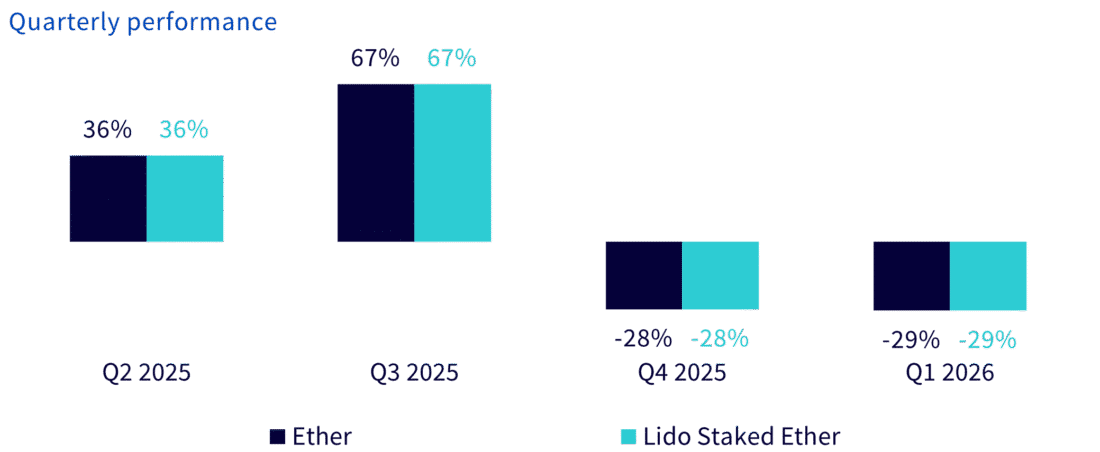
Source: Artemis Terminal, WisdomTree. 09 April 2026. You cannot invest directly in an index. Historical performance is not an indication of future performance, and any investment may go down in value.
In practice, liquid staking has become the widely adopted approach for Ethereum. The yield gap versus native staking is relatively small, while the usability advantage is significant. Adoption reflects this reality, with Lido accounting for 23% of total staked Ether3.
Native staking looks attractive in theory. In practice, it introduces friction.
Investors must manage the technical setup, select validators, monitor performance and handle operational overhead. For most investors, particularly those from traditional finance, this is not scalable.
Staked exchange-traded products (ETPs) provide an alternative route. They capture staking yield on behalf of investors while removing operational complexity. Investors gain exposure to crypto total returns without needing to manage the staking process themselves. The key is selecting the ETP designed to deliver their preferred balance of yield, liquidity and operational simplicity:
Yield is becoming an increasingly important component of crypto returns, and it compounds over time.
Implementation now matters as much as allocation. The way investors access staking can materially change outcomes.
Staking involves a range of risks that may affect returns and capital values. Crypto assets are volatile and investors may lose part or all of their investment. Staking rewards are not guaranteed and may vary over time depending on network conditions and validator performance. Native staking may expose investors to operational risks, including validator failure, slashing penalties and temporary illiquidity during unstaking periods. Liquid staking introduces additional risks, including smart contract risk, counterparty risk and the possibility that liquid staking tokens may trade below the value of the underlying crypto asset. Regulatory treatment of crypto assets and staking continues to evolve and may affect the availability, liquidity and taxation of digital asset investments.
—
Originally Posted May 27, 2026 – Price is not enough: the hidden driver of crypto returns
1 Source: Staking Rewards. 20 April 2026.
2 Source: Ethereum. 20 April 2026.
3 Source: Lido Institutional. March 2026.
This material is prepared by WisdomTree and its affiliates and is not intended to be relied upon as a forecast, research or investment advice, and is not a recommendation, offer or solicitation to buy or sell any securities or to adopt any investment strategy. The opinions expressed are as of the date of production and may change as subsequent conditions vary. The information and opinions contained in this material are derived from proprietary and non-proprietary sources. As such, no warranty of accuracy or reliability is given and no responsibility arising in any other way for errors and omissions (including responsibility to any person by reason of negligence) is accepted by WisdomTree, nor any affiliate, nor any of their officers, employees or agents. Reliance upon information in this material is at the sole discretion of the reader. Past performance is not a reliable indicator of future performance.
Please click here for our full disclaimer.
Jurisdictions in the European Economic Area (“EEA”): This content has been provided by WisdomTree Ireland Limited, which is authorised and regulated by the Central Bank of Ireland.
Jurisdictions outside of the EEA: This content has been provided by WisdomTree UK Limited, which is authorised and regulated by the United Kingdom Financial Conduct Authority.
Information posted on IBKR Campus that is provided by third-parties does NOT constitute a recommendation that you should contract for the services of that third party. Third-party participants who contribute to IBKR Campus are independent of Interactive Brokers and Interactive Brokers does not make any representations or warranties concerning the services offered, their past or future performance, or the accuracy of the information provided by the third party. Past performance is no guarantee of future results.
This material is from WisdomTree Europe and is being posted with its permission. The views expressed in this material are solely those of the author and/or WisdomTree Europe and Interactive Brokers is not endorsing or recommending any investment or trading discussed in the material. This material is not and should not be construed as an offer to buy or sell any security. It should not be construed as research or investment advice or a recommendation to buy, sell or hold any security or commodity. This material does not and is not intended to take into account the particular financial conditions, investment objectives or requirements of individual customers. Before acting on this material, you should consider whether it is suitable for your particular circumstances and, as necessary, seek professional advice.
Trading in digital assets, including cryptocurrencies, is especially risky and is only for individuals with a high risk tolerance and the financial ability to sustain losses. Eligibility to trade in digital asset products may vary based on jurisdiction.
Cryptocurrency based Exchange Traded Products (ETPs) are high risk and speculative. Cryptocurrency ETPs are not suitable for all investors. You may lose your entire investment. For more information please view the RISK DISCLOSURE REGARDING COMPLEX OR LEVERAGED EXCHANGE TRADED PRODUCTS.
Investing in cryptocurrencies such as Ether (ETH) involves significant risk. Digital assets are highly volatile and may experience rapid price fluctuations, including complete loss of value. The Ethereum network, smart contracts, and decentralized applications rely on evolving technologies that may be subject to bugs, cyberattacks, regulatory changes, or operational failures. Trading through Interactive Brokers involves execution, custody, and settlement handled by regulated third party partners, which introduces additional counterparty and operational risks. Cryptocurrency products are not legal tender, are not backed by any government, and may not be suitable for all investors.
Digital assets such as Solana (SOL) involve significant risk and may not be suitable for all participants. Network performance, including speed and availability, may vary and transactions may be delayed or fail to settle. SOL prices are highly volatile and may result in partial or total loss. Staking, smart contracts, and third party applications may expose users to technical, security, liquidity, or operational risks. Regulatory treatment of digital assets is evolving and may adversely impact value or usability.
Related Articles

















Join The Conversation
For specific platform feedback and suggestions, please submit it directly to our team using these instructions.
If you have an account-specific question or concern, please reach out to Client Services.
We encourage you to look through our FAQs before posting. Your question may already be covered!