
- Solve real problems with our hands-on interface
- Progress from basic puts and calls to advanced strategies
Interactive Options Course
Posted July 6, 2020 at 11:37 am
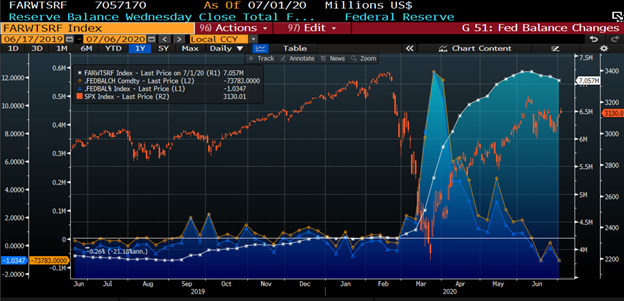
Last Thursday afternoon, while many of us were getting focused on the three day weekend ahead, the Federal Reserve was dutifully issuing its H.4.1 statistical release. As we have seen from the past few releases, the Fed’s balance sheet has stopped growing, and in fact has been shrinking slightly. Please consider the chart below:
Source: Bloomberg
This strikes me as the greatest contradiction in the current market narrative. One of the most common themes that we hear from a wide range of financial experts is that the Fed is actively pumping money into the financial system. That was certainly true from March through May as the Federal Reserve’s balance sheet exploded by about 70%. To put matters into perspective, note the rise in the September – November period. Equity markets reacted well to the 10%+ balance sheet increase that occurred as the Fed responded to a crisis in the repo market. They rebounded from the sideways movement that we saw as the Fed slowly reduced its balance sheet throughout last summer.
I find it hard to believe that equity markets can sustain a meaningful advance without further stimulus from the Federal Reserve or Congress. The economic picture is fuzzy, at best, yet major indices are either flirting with or breaking through their previous high water marks. Price/earnings and similar valuation measures are well beyond their pre-Covid levels as both reported and estimated earnings shrank in response to the crisis. One can justify these higher valuations as a reasonable response to the unprecedented liquidity injections that went to fixed income markets and directly to millions of taxpayers. The questions for investors are how much stimulus is required to keep propelling markets higher, and can they sustain these valuations if those injections fail to meet current expectations.
The month of July should prove to be a month of tests for equity investors. Among them are:
Returning to the present, one needs to consider whether their Federal Reserve’s actions are more rhetorical than active. Their balance sheet clearly indicates that they are holding steady rather than continuing to provide stimulus, at least for the short-term. Remember also that the Fed has never directly intervened in equity markets and has no mandate to even consider equity markets unless they threaten the stability of the banking system or the economy at large. While I am certainly of the opinion that the “Fed Put” (the level of distress that would cause the Fed to resume intervention in the credit markets) remains firmly in place, investors need to question the “strike price” of that implied put. I suspect that the strike is no higher than the 2800 level on the S&P 500, and I also suspect that is further out of the money than many investors would expect.
As of now, investors remain sanguine and path of least resistance in the equity markets remains higher – at least in the short-term and especially in the leading NASDAQ 100 (NDX) names. The coming weeks should test the markets, and are likely to determine whether investors are properly assessing economic and corporate conditions and the risks to their outlook. The savvy ones will be taking a hard look at their portfolios and assess how the likely outcomes to each of the markets’ challenges will affect their potential risks and returns.
For further reference:
The Federal Reserve is Still Not as Accommodating as Many Think
The Fed Is No Longer As Accommodating As Many Think
The analysis in this material is provided for information only and is not and should not be construed as an offer to sell or the solicitation of an offer to buy any security. To the extent that this material discusses general market activity, industry or sector trends or other broad-based economic or political conditions, it should not be construed as research or investment advice. To the extent that it includes references to specific securities, commodities, currencies, or other instruments, those references do not constitute a recommendation by IBKR to buy, sell or hold such investments. This material does not and is not intended to take into account the particular financial conditions, investment objectives or requirements of individual customers. Before acting on this material, you should consider whether it is suitable for your particular circumstances and, as necessary, seek professional advice.
The views and opinions expressed herein are those of the author and do not necessarily reflect the views of Interactive Brokers, its affiliates, or its employees.
Related Articles
















Join The Conversation
For specific platform feedback and suggestions, please submit it directly to our team using these instructions.
If you have an account-specific question or concern, please reach out to Client Services.
We encourage you to look through our FAQs before posting. Your question may already be covered!