
- Solve real problems with our hands-on interface
- Progress from basic puts and calls to advanced strategies
Interactive Options Course

Posted December 3, 2025 at 10:23 am
1/ What’s Next for BTC?
2/ Have We Seen the Highs in Gold for 2025?
3/ Japan’s Yields Break a Two-Decade Barrier
Investopedia is partnering with CMT Association on this newsletter. The contents of this newsletter are for informational and educational purposes only, however, and do not constitute investing advice. The guest authors, which may sell research to investors, and may trade or hold positions in securities mentioned herein do not represent the views of CMT Association or Investopedia. Please consult a financial advisor for investment recommendations and services.
What’s Next for BTC?
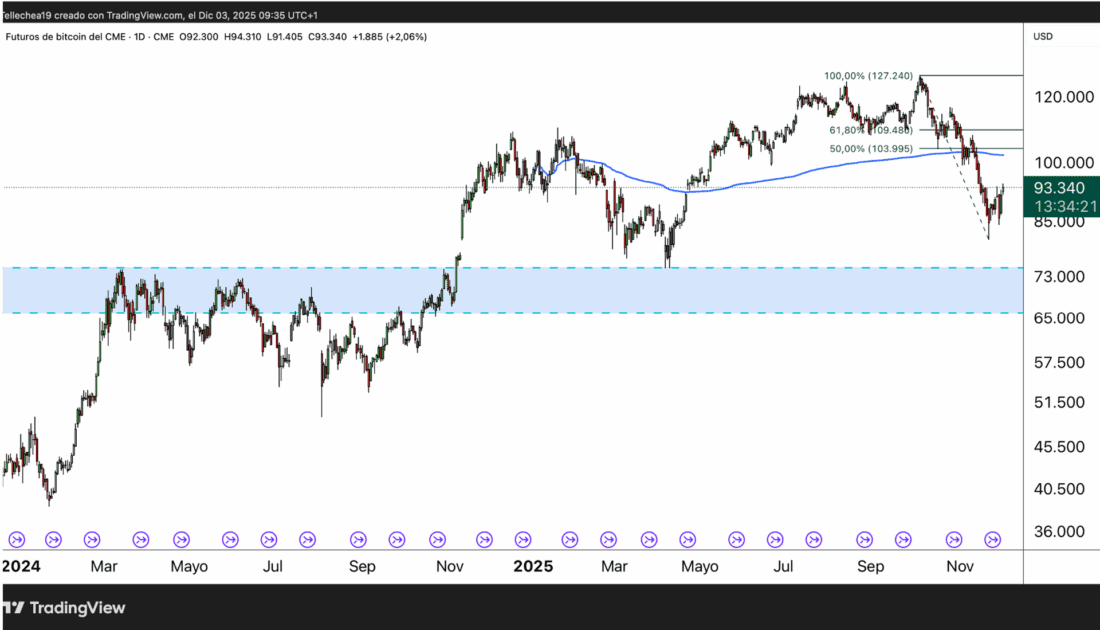
After a very strong rally over the past 4–5 months that pushed Bitcoin to a new all-time high, the market experienced a sharp selloff that produced a nearly 40% pullback. Now, price sits at a key decision point:
In any scenario, the broader trend remains bullish as long as BTC holds above the $80–82k area.
Have We Seen the Highs in Gold for 2025?
The recent sharp rebounds in precious metals reflect a deterioration in the real value of fiat currencies. Gold has consolidated itself as the second most important reserve asset among central banks, only behind the US dollar. In essence, the bull markets in metals remain intact, underscoring the loss of purchasing power of traditional currencies toward the end of October 2025.
Nevertheless, as prices continue to climb, the likelihood of periodic corrections increases. Such pullbacks can be significant in nominal terms, although still consistent with historical patterns. New highs call for caution: buying metals in the midst of a full bullish extension entails greater risks, while purchasing during phases of weakness has proven the most effective strategy in recent months and years.

Among the factors that could put pressure on gold in the coming months, the following stand out:
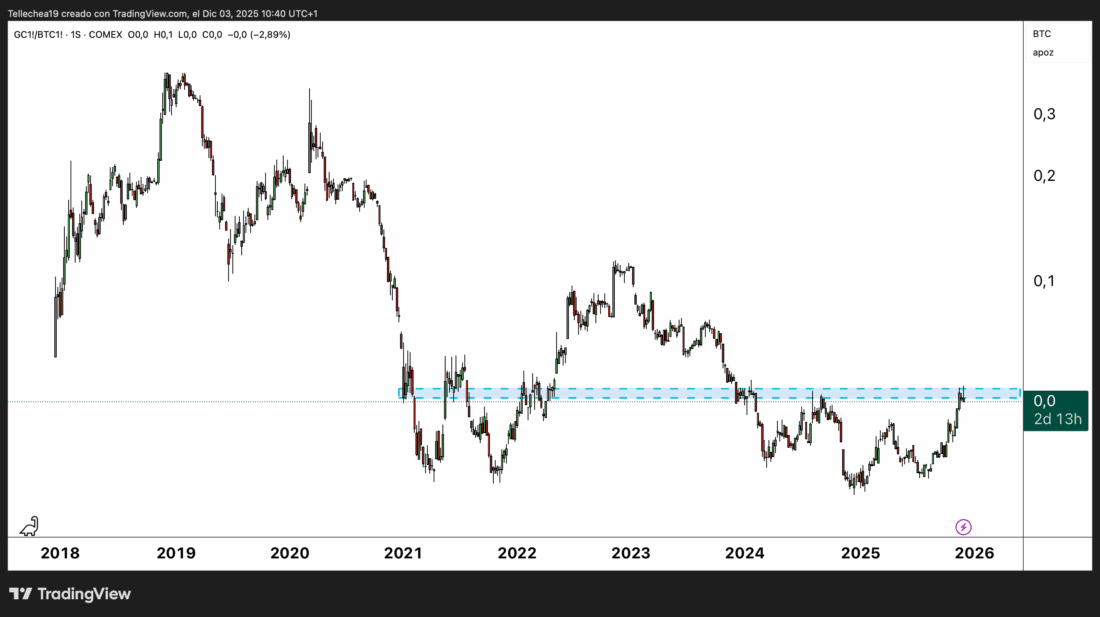
The Gold/Bitcoin ratio is once again approaching a key resistance zone that has acted as a ceiling since 2024. After a very sharp upward move in recent weeks, the ratio has returned to the 0.10 level, coinciding with the area where gold buyers have historically lost traction relative to Bitcoin. Each approach to this zone has produced abrupt reversals in the past, underscoring its technical importance.
On the daily chart, the acceleration in the ratio suggests that gold has temporarily regained ground against Bitcoin. However, in the longer-term structure, the move since 2021 shows a dominant downward trend, implying that gold’s rallies versus BTC have been counter-trend bounces within a broader process of relative depreciation. The recent advance toward resistance also coincides with the defense of the 85,000–90,000 USD area in BTC, adding coherence to Bitcoin’s rebound against the metal.
What to watch now:
If the ratio rejects the 0.10 zone again—as it has repeatedly over the past few years—it could signal a renewed phase of relative strength for Bitcoin over gold. Conversely, a sustained breakout above that level—something not seen since 2022—would imply a structural shift in favor of the metal and add short-term pressure to cryptocurrencies. For now, this resistance remains the critical line separating a simple tactical rotation from a lasting trend reversal.
Japan’s Yields Break a Two-Decade Barrier
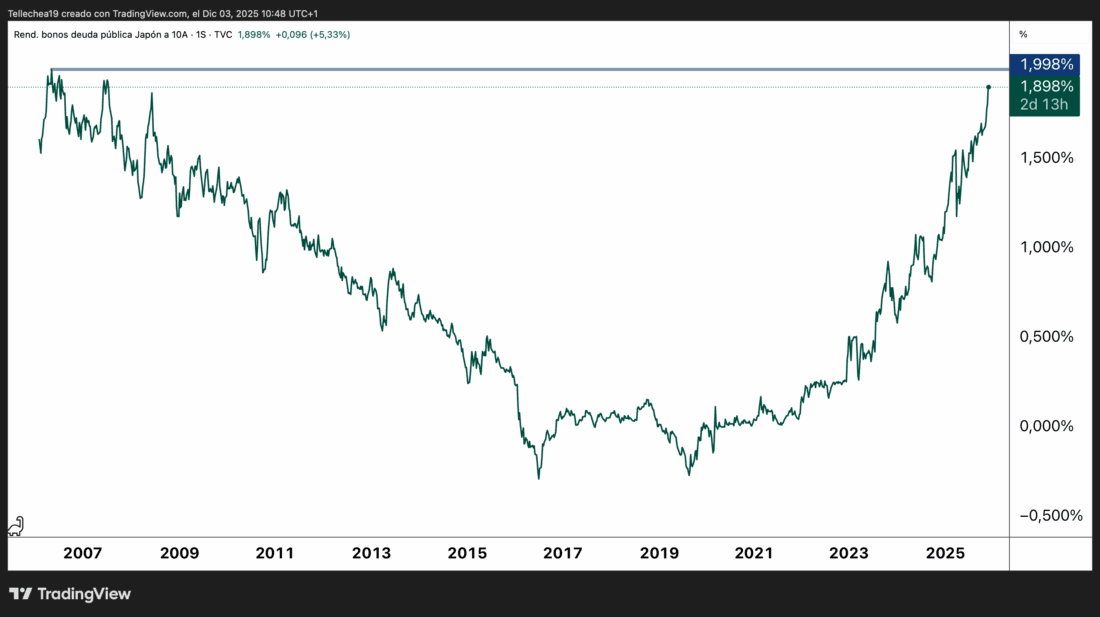
The yield on Japan’s 10-year government bond (JGB 10Y) continues to climb and is once again approaching the psychological and technical 2% level—a ceiling not seen since the early 2000s. This breakout represents one of the most significant structural shifts in the current global monetary policy cycle.
The ongoing uptrend confirms that Japan’s exit from its negative-rate regime was not an isolated event, but rather the beginning of a long-term adjustment in the country’s rate structure. Pressure on the Bank of Japan is increasing, as higher yields may force additional changes to its policy guidance.
What’s next?
If the JGB 10Y stabilizes above 2%, Japan’s monetary normalization could accelerate, with implications for the yen, global capital flows, and valuations of rate-sensitive assets. A rejection at this level would keep intact the range that has been in place since 2024.
Historical Summary
Why This Matters (and Why Yields Are Surging Now)
Outlook for the Coming Days/Weeks
Japan’s 10-year bond is undergoing its most critical moment since the subprime crisis. What happens around the 2% level over the next 5–10 trading sessions will carry significant global implications.
—
Originally posted 3rd December 2025
Investopedia.com: The comments, opinions and analyses expressed herein are for informational purposes only and should not be considered individual investment advice or recommendations to invest in any security or to adopt any investment strategy. While we believe the information provided herein is reliable, we do not warrant its accuracy or completeness. The views and strategies described on our content may not be suitable for all investors. Because market and economic conditions are subject to rapid change, all comments, opinions and analyses contained within our content are rendered as of the date of the posting and may change without notice. The material is not intended as a complete analysis of every material fact regarding any country, region, market, industry, investment or strategy. This information is intended for US residents only.
Information posted on IBKR Campus that is provided by third-parties does NOT constitute a recommendation that you should contract for the services of that third party. Third-party participants who contribute to IBKR Campus are independent of Interactive Brokers and Interactive Brokers does not make any representations or warranties concerning the services offered, their past or future performance, or the accuracy of the information provided by the third party. Past performance is no guarantee of future results.
This material is from Investopedia and is being posted with its permission. The views expressed in this material are solely those of the author and/or Investopedia and Interactive Brokers is not endorsing or recommending any investment or trading discussed in the material. This material is not and should not be construed as an offer to buy or sell any security. It should not be construed as research or investment advice or a recommendation to buy, sell or hold any security or commodity. This material does not and is not intended to take into account the particular financial conditions, investment objectives or requirements of individual customers. Before acting on this material, you should consider whether it is suitable for your particular circumstances and, as necessary, seek professional advice.
Cryptocurrency based Exchange Traded Products (ETPs) are high risk and speculative. Cryptocurrency ETPs are not suitable for all investors. You may lose your entire investment. For more information please view the RISK DISCLOSURE REGARDING COMPLEX OR LEVERAGED EXCHANGE TRADED PRODUCTS.
Futures are not suitable for all investors. The amount you may lose may be greater than your initial investment. Before trading futures, please read the CFTC Risk Disclosure. A copy and additional information are available at ibkr.com.
Municipal Bonds are only available from Interactive Brokers for IBKR LLC, IBKR Canada, IBKR Hong Kong, IBKR Australia and IBKR Singapore entities.
Exchange Traded Commodities (ETCs) are only available from Interactive Brokers for IBKR LLC, IBKR Canada, IBKR Hong Kong and IBKR Singapore entities.
Related Articles















Join The Conversation
For specific platform feedback and suggestions, please submit it directly to our team using these instructions.
If you have an account-specific question or concern, please reach out to Client Services.
We encourage you to look through our FAQs before posting. Your question may already be covered!