
- Solve real problems with our hands-on interface
- Progress from basic puts and calls to advanced strategies
Interactive Options Course

Posted December 19, 2025 at 11:18 am
Every December, parcel giants like FedEx, UPS, and DHL become unofficial subcontractors to Santa. But behind the holiday rush lies a larger story: these companies offer a real‑time read on global demand, trade flows, and how quickly businesses adapt to new rules and technology.
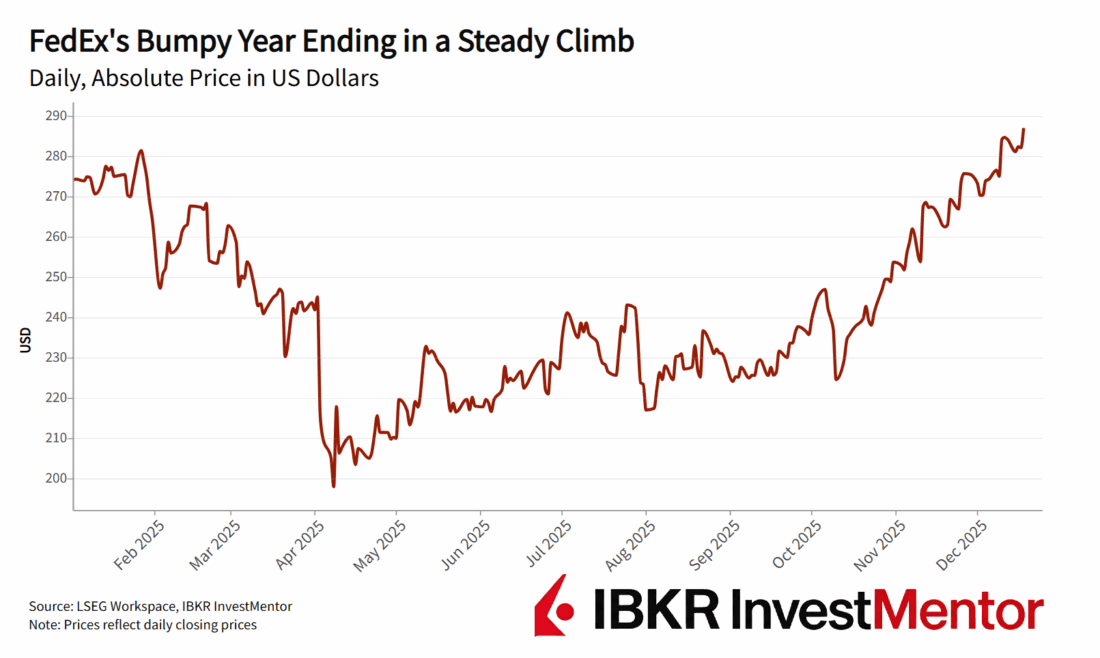
FedEx’s latest results show not just one company’s quarter, but how the global supply chain is being rewired under trade disputes and the AI boom.
FedEx beat forecasts this quarter, with operating income rising to about $1.4 billion on $23.5 billion in revenue. Sales grew roughly 7%, helped by firmer demand and higher prices, and the company nudged up its full‑year outlook. On its own, that’s a solid earnings story.
But FedEx doesn’t operate “on its own.” Alongside rivals like UPS and DHL, it’s a business that literally connects millions of companies and consumers around the world. When factories ramp up, retailers restock, or data centers order more chips, someone has to move the boxes.
That’s why investors often treat these companies as bellwethers: if parcel volumes and margins are holding up, the global economy probably isn’t falling apart.
This time around, the message is mixed but broadly resilient. Costs, regulation, and geopolitics are all adding friction, yet the packages are still moving, and customers are still paying. In a year of recession chatter, that matters.
The same results also show how fragile that system can be. After a fatal crash involving a UPS‑operated cargo plane in Kentucky last month, regulators grounded all Boeing MD‑11 cargo jets, including FedEx’s 28‑plane fleet. FedEx wasn’t involved in the accident, but it still had to improvise at the worst possible time: the holiday peak.
To keep parcels flowing, the company scrambled for extra trucks and aircraft, adding roughly $175 million in costs spread across two quarters.
One safety issue in one part of the system can ripple: capacity disappears, routes need redesigning, and last‑mile operations come under strain just as consumers expect on‑time delivery more than ever. FedEx and its rivals are being paid to manage the world’s “just in time” expectations, and occasionally absorb the bill when something goes wrong.

Regulation is reshaping the business, too. In 2024, nearly 1.4 billion packages valued under $800 entered the US duty‑free. That changed this year when the White House scrapped this de minimis exemption, and the EU plans to follow with its own clampdown on cheap parcels next year.
For FedEx and UPS, that means fewer ultra‑cheap cross‑border packages padding volumes. Revenue takes a hit at the low end, but the parcels that remain tend to involve more customs work and better pricing power, which can help margins.
FedEx has already been tilting its mix toward business‑to‑business shipments, now about 66% of revenue, and those flows rely less on $5 trinkets from Temu and more on components, equipment, and high‑value goods.
All of this makes the job more complex. Stricter trade rules and the end of tariff‑free small parcels mean getting customs codes right is both more important and more tedious. Here, FedEx is leaning on one asset most investors can’t see: data. The company handles roughly 17 million packages a day, each generating information on routes, timing, and customs classifications. That gives FedEx and its peers a detailed, bottom‑up view of global trade – and a rich dataset to feed into AI tools.
FedEx is already using AI to predict customs codes, trim delays, and support more demanding segments like healthcare logistics, where regulation is tight, and mistakes are costly. It’s also moving the chips and components that underpin the current data‑center build‑out and AI boom. The same networks that deliver toys and sweaters in December are also moving the hardware that powers the next generation of software.
FedEx and its rivals are no longer just about parcels. They’re an economic indicator, and increasingly, part of the data and AI story too. If you want to understand where global trade, corporate spending, and supply‑chain risk are headed, watching “Santa’s helpers” once a quarter isn’t a bad place to start.
To learn more about global trade and its challenges, check out free courses and daily explainers on IBKR InvestMentor.
IBKR InvestMentor (dba “InvestMentor”) is a service of Interactive Academy LLC, an affiliate of IB LLC and majority-owned by IBG LLC. All content provided by InvestMentor is for informational and educational purposes only and should not be interpreted as implying any sponsorship, partnership, endorsement, recommendation, or approval by IB LLC or its affiliates.
Information posted on IBKR Campus that is provided by third-parties does NOT constitute a recommendation that you should contract for the services of that third party. Third-party participants who contribute to IBKR Campus are independent of Interactive Brokers and Interactive Brokers does not make any representations or warranties concerning the services offered, their past or future performance, or the accuracy of the information provided by the third party. Past performance is no guarantee of future results.
This material is from InvestMentor, an affiliate of Interactive Brokers LLC, and is being posted with its permission. The views expressed in this material are solely those of the author and/or InvestMentor and Interactive Brokers is not endorsing or recommending any investment or trading discussed in the material. This material is not and should not be construed as an offer to buy or sell any security. It should not be construed as research or investment advice or a recommendation to buy, sell or hold any security or commodity. This material does not and is not intended to take into account the particular financial conditions, investment objectives or requirements of individual customers. Before acting on this material, you should consider whether it is suitable for your particular circumstances and, as necessary, seek professional advice.
Related Articles

















Join The Conversation
For specific platform feedback and suggestions, please submit it directly to our team using these instructions.
If you have an account-specific question or concern, please reach out to Client Services.
We encourage you to look through our FAQs before posting. Your question may already be covered!