
- Solve real problems with our hands-on interface
- Progress from basic puts and calls to advanced strategies
Interactive Options Course
Posted April 13, 2026 at 1:36 pm
Once again, this weekend brought a slew of unpleasant news regarding the situation in the Persian Gulf. The failure of the peace talks in Pakistan and the subsequent announcement of a US blockade of the Strait of Hormuz were treated as catalysts for sharply higher oil futures and lower stock index futures when they re-opened last night. As I type this, only one of those market reactions remains in place. Care to guess which?
We could certainly attribute the ferocity of the initial 1.3% drop to early jitters, but note the speed of the subsequent bounce on the first modest decline in oil futures. That shows how eager stock traders are for any hint of decent news. That first dip in oil futures didn’t last long, but the ratchet effect in stocks did. By the time that US traders began waking up, ES futures had recovered more than half their initial drop even as oil remained within its early trading range.

Source: Bloomberg
The prevailing feeling among many traders was that things would somehow work out before the 10AM ET deadline. The notion of the “TACO trade” or “Trump Put” remains firmly embedded in traders’ mindsets. Many seemed to be expecting some sort of announcement that ameliorated the situation shortly before the blockade began.
But this time they did not. The President announced that the blockade had begun as scheduled, and early reports showed that at least two tankers turned away from the Strait shortly thereafter. Nonetheless, stock traders once again heard what they wanted to hear (and disregarded the rest, to paraphrase Paul Simon) just before the deadline.
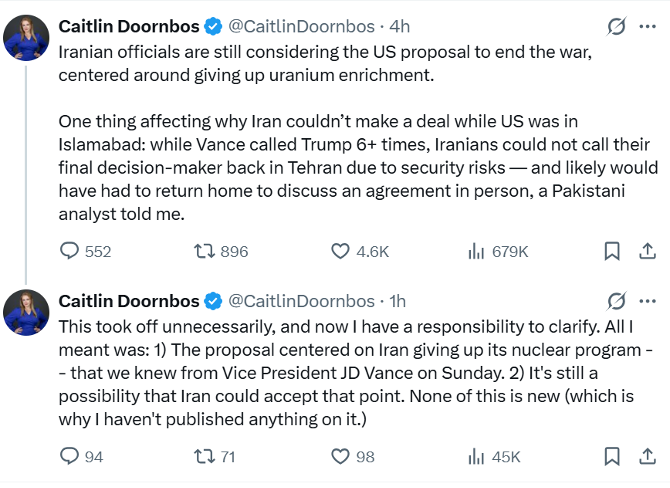
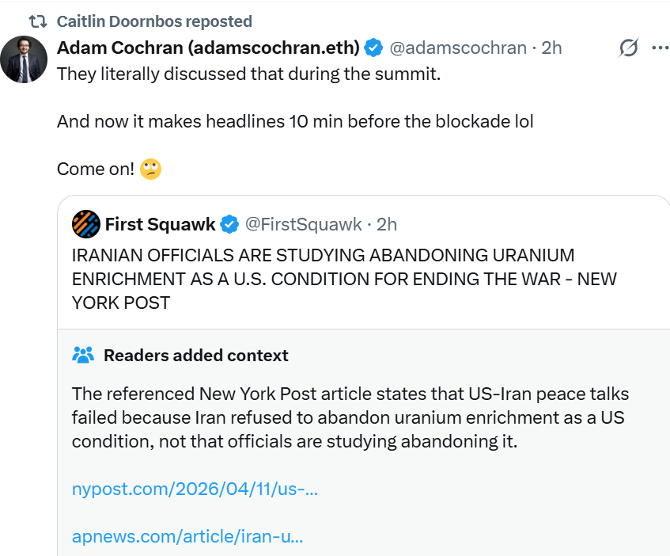
Around 9:45 ET, stocks shot higher and oil ticked lower without an initially obvious headline. It soon became evident that the reason was a post on X by a New York Post reporter that Iranian officials were still considering giving up nuclear enrichment in order to end the war. That indeed would be good news, of course, as would any serious proposal by either side that could bring an end to the situation. Unfortunately, the reporter herself clarified the reporting after doubts emerged about its timing and accuracy.
Source: X
Source: X
Interestingly, the reporter’s initial tweet was ignored for about two hours, so it is not clear what caused it to move markets at that particular moment just before the deadline. Presumably it got an influential re-tweet that hit eager traders at the correct moment. Yet the initial market reaction held, and the advance continued regardless.
What we learned is that the news doesn’t actually matter to stock traders. Instead, what does matter is that there is an excuse for stocks to do what the majority of investors want and expect them to do. Commodity traders are forced to live in the present, where immediate considerations of supply and demand influence current prices. Indeed, while the price of crude has fallen from its initial highs, it remains elevated. Stock traders, on the other hand, live in a world of expectations. If the prospects for the future are rosy, they can outweigh inconvenient news in the present tense.
That is what we see now. Investors expect an imminent end to the war in the Gulf with few lasting consequences. The gloomy present is being deemed as irrelevant to future prospects. Perhaps that is the case, perhaps not. But it is clear that positive psychology rules, and thus the efficacy of buying dips remains in place.
New to Interactive Brokers?
Open AccountAlready an Interactive Brokers Client?
Request Trading PermissionThe analysis in this material is provided for information only and is not and should not be construed as an offer to sell or the solicitation of an offer to buy any security. To the extent that this material discusses general market activity, industry or sector trends or other broad-based economic or political conditions, it should not be construed as research or investment advice. To the extent that it includes references to specific securities, commodities, currencies, or other instruments, those references do not constitute a recommendation by IBKR to buy, sell or hold such investments. This material does not and is not intended to take into account the particular financial conditions, investment objectives or requirements of individual customers. Before acting on this material, you should consider whether it is suitable for your particular circumstances and, as necessary, seek professional advice.
The views and opinions expressed herein are those of the author and do not necessarily reflect the views of Interactive Brokers, its affiliates, or its employees.
Futures are not suitable for all investors. The amount you may lose may be greater than your initial investment. Before trading futures, please read the CFTC Risk Disclosure. A copy and additional information are available at ibkr.com.
For specific platform feedback and suggestions, please submit it directly to our team using these instructions.
If you have an account-specific question or concern, please reach out to Client Services.
We encourage you to look through our FAQs before posting. Your question may already be covered!
Related Articles













Stock market bubble update: After ten straight up days, the S&P 500 market cap is now $63.23 Trillion. The top eight stocks–the “Mag 7” plus Broadcom (which has surpassed Tesla) now have a combined market cap of $23.02 Trillion, which is more than 36 percent of the entire S&P 500, and just the value of those eight tech stocks would equal $2875 for every man, woman and child on the planet.