
- Solve real problems with our hands-on interface
- Progress from basic puts and calls to advanced strategies
Interactive Options Course

Posted October 6, 2026 at 1:14 pm
News that Middle East crude exports exceeded the pre-war average level of 18 million barrels per day during the end of September has Wall Street applauding as the raging bull carries stocks to fresh record highs. The fourth consecutive session of equity gains arrives as oil prices and rates plunge because the energy supply outlook has effectively overcome the ongoing conflict between Washington and Tehran while being helped separately by the G7 nations unloading their strategic fuel inventories to constrain costs. Additionally, excitement about artificial intelligence alongside optimism that the Fed may not need to hike many more times has the 11 principal sectors participating in the advance while the Treasury curve descends in bull-flattening motion led by duration. The looser financial conditions accompanied by a dovish tilt in the fixed income complex are a response to softening inflation expectations motivated by cheaper gasoline which if sustained, would result in the 4.2% May CPI marking the peak. Against this backdrop, the wide 100-bp spread delineating the headline and core versions is poised to compress and take the overall annualized figure back to a 2-handle, a terrific development for asset performance, generally speaking. The higher likelihood of an increasingly relaxed central bank has investors piling into other areas outside of shares and credit, with precious metals, non-energy commodities, cryptocurrencies and prediction markets catching bids. And as one would expect, the greenback is depreciating in light of appreciating government debt, while volatility protection instruments premiums are declining in consideration of a risk-on mood on the trading floor.
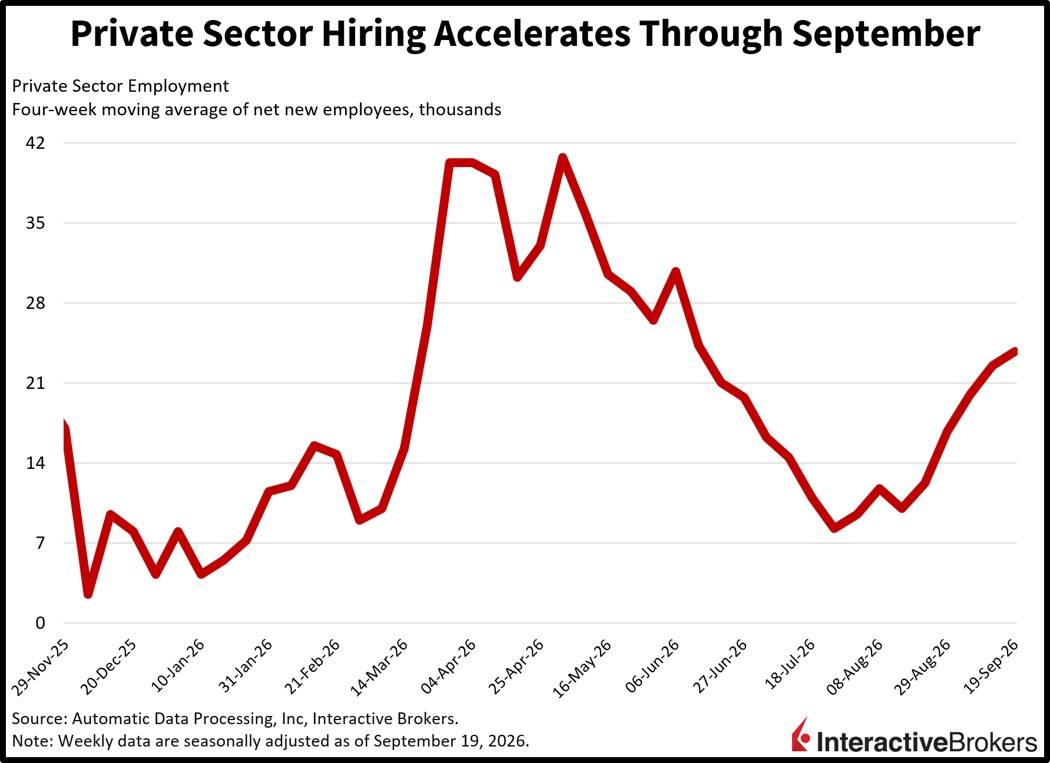
Hiring momentum accelerated to the fastest pace in 14 weeks, according to ADP’s short-term tracker of private-sector employment. The 23.75k overall statistic represents the average number of workers added during each of the four weeks culminating on Sept. 19. It was the strongest since the 24.25k recorded back in June 13. The increase is easing concerns of slower payrolls stemming from last Friday’s huge miss on the government’s headline figure, which was accompanied by a lift in unemployment.
The return of the AI fever that sent Nvidia and AMD to fresh all-time highs today alongside the S&P 500 and the Nasdaq 100 creates a favorable backdrop as we enter the final weeks of 2026. The setup is even more constructive when considering early trends in disinflation that are conducive to steady central banks and falling bond yields, which can motivate investors to raise equity valuations in response to lighter borrowing costs amidst a heavier risk premium. Furthermore, a loosening of financial conditions is likely to bolster economic growth, recharge consumers and generate a broadening in stock market participation that would be led by the rate-sensitive areas, such as the Russell 2000, which has been struggling lately. Finally, crude oil is still too elevated with West Texas Intermediate standing at $89 per barrel, and a move towards $70 would offer a robust tailwind for overall activity and corporate earnings.
Declines in business output, new orders and payrolls combined with increased pessimism pushed Hong Kong’s economic activity further into contraction in September with the S&P Global Hong Kong SAR PMI sinking 0.3 percentage points to 49.2. It was the gauge’s second consecutive month below the contraction-expansion threshold of 50. New business fell only marginally, but firms said competitive pressures hampered their ability to capture potential orders. With that in mind, some survey respondents implemented promotional pricing to secure customers. Encouragingly, new export demand grew for the first time in three months and at the fastest pace since May, which nearly stabilized new orders. Mainland China was a considerable factor. It increased its orders for companies in the special administrative region for the fourth consecutive month. Growing demand from abroad did little to offset the impact upon sentiment from tariffs, challenging economic conditions and intense competition for new business. In fact, sentiment sank to the lowest level since August 2020. Concerns over costs, furthermore, caused businesses to refrain from replacing departing workers, causing employment to fall at the fastest pace since April 2020. The trend might reverse because growing back orders could cause companies to increase production.
The Australia Westpac-Melbourne Institute Consumer Sentiment Index sank 4.7% in October to 80.4, the worst reading since April, but among individuals surveyed after the country’s central bank hiked its key interest rate on Sept. 29, the result was even worse. In that decision, policymakers set the cash rate at 4.6%, its highest level since 2008. For the headline print, economists anticipated a decline of only 1.7%. The Westpac-Melbourne Institute maintains that the dour results combined with other weaker prints this year has resulted in the country experiencing “the worst period of recurring extremely weak sentiment since the disastrous recession in the early 1990s.” Australians reported that higher fuel costs and interest rates had increased pressure on their personal finances. Among surveyed respondents, 80% said they expect mortgage rates to climb during the next year. Consumers also reported growing unease about the job market. The central bank’s tightening decision weighed heavily on results. Among consumers surveyed prior to the rate hike, sentiment came in at 86.9, but it plunged to 67.2 for individuals who were polled after the decision.
The number of September help-wanted ads in Australia was up 12.9% year over year and 2.2% from August, according to the ANZ-Indeed Australian job ads index. The monthly increase follows the 2.6% month over month August jump. The growth in job vacancies have occurred even as the Reserve Bank of Australia has been hiking its key interest rate, notes ANZ Senior Economist Jasmine Zheng. She expects that job ads will eventually decline because a time lag usually exists between central bank tightening and declines in demand for workers. The unemployment rate is also likely to modestly drift higher, but only modestly, because labor market resiliency has potential for dampening the impact of monetary policy tightening.
New to Interactive Brokers?
Open AccountInformation posted on IBKR Campus that is provided by third-parties does NOT constitute a recommendation that you should contract for the services of that third party. Third-party participants who contribute to IBKR Campus are independent of Interactive Brokers and Interactive Brokers does not make any representations or warranties concerning the services offered, their past or future performance, or the accuracy of the information provided by the third party. Past performance is no guarantee of future results.
This material is from IBKR Macroeconomics, an affiliate of Interactive Brokers LLC, and is being posted with its permission. The views expressed in this material are solely those of the author and/or IBKR Macroeconomics and Interactive Brokers is not endorsing or recommending any investment or trading discussed in the material. This material is not and should not be construed as an offer to buy or sell any security. It should not be construed as research or investment advice or a recommendation to buy, sell or hold any security or commodity. This material does not and is not intended to take into account the particular financial conditions, investment objectives or requirements of individual customers. Before acting on this material, you should consider whether it is suitable for your particular circumstances and, as necessary, seek professional advice.
Futures, event contracts, and forecast contracts are not suitable for all investors. Before trading these products, please read the CFTC Risk Disclosure. For a copy, visit our Warnings and Disclosures Page.
Investments in certain commodities (precious metals) may be subject to significant price volatility and often involve risks related to market fluctuations, liquidity constraints, geopolitical events, and changes in global economic conditions that could adversely affect their value.
Trading in digital assets, including cryptocurrencies, is especially risky and is only for individuals with a high risk tolerance and the financial ability to sustain losses. Eligibility to trade in digital asset products may vary based on jurisdiction.
Related Articles

















Join The Conversation
For specific platform feedback and suggestions, please submit it directly to our team using these instructions.
If you have an account-specific question or concern, please reach out to Client Services.
We encourage you to look through our FAQs before posting. Your question may already be covered!