
- Solve real problems with our hands-on interface
- Progress from basic puts and calls to advanced strategies
Interactive Options Course
Posted July 20, 2026 at 12:58 pm
Today’s Theme Music: The Thamesmen
Three pieces of global news are theoretically affecting global markets today: two from the Middle East, one from the U.K. Oil futures seemed poised to shoot higher when they opened in Asian trading but came off their highest levels of the session after an Iranian foreign ministry spokesman reported receiving mediation proposals aimed at resuming diplomacy. Seemingly not wanting to be left out, Yemen’s Houthi rebels announced a blockade on Saudi Arabia’s Red Sea ports. And once again, the U.K. has a new Prime Minister.
The last piece of news is the least significant for markets, but I can’t avoid the comedic movie reference that came to mind. Andy Burnham officially became the seventh U.K. Prime Minister in a decade this morning, or fifth in four years. Faithful readers should not be too stunned if I reveal that my first question was whether the U.K. was cycling through PMs faster than the fictional British band Spinal Tap went through drummers. After some research, which could easily be classified as a fun trip down the Wikipedia rabbit hole, I found that Spinal Tap went through six drummers in three years. Fortunately, no U.K. PMs died in bizarre gardening accidents or spontaneously combusted, but the fact that I could credibly consider that question might explain why the FTSE 100 was down 0.7% on a day when most of Europe was flattish.
Asian markets showed much more volatility during their Monday sessions. Those that are most heavily exposed to globally prominent technology stocks, specifically Korea’s KOSPI and Japan’s Nikkei 225, each fell more than 4% both in response to the selloff in U.S. tech shares on Friday and the higher oil prices that prevailed for much of their sessions.
Nonetheless, almost on cue, we got the sort of hopeful news about a peace process in the Persian Gulf that causes an almost Pavlovian response in equity traders. Think of how many times in the past few months that we’ve heard of some positive development after markets reacted negatively. We have frequently referred to this as the “ratchet effect” because of stocks’ propensity to rally on any hopeful noises about a ceasefire but largely ignore any backsliding in the process. To be fair, crude oil traders seemed to take both the weekend escalation and the news out of Iran quite seriously. The chart below shows the higher open and the subsequent return to roughly unchanged levels after the news from Iran emerged at roughly 2:30 am ET:
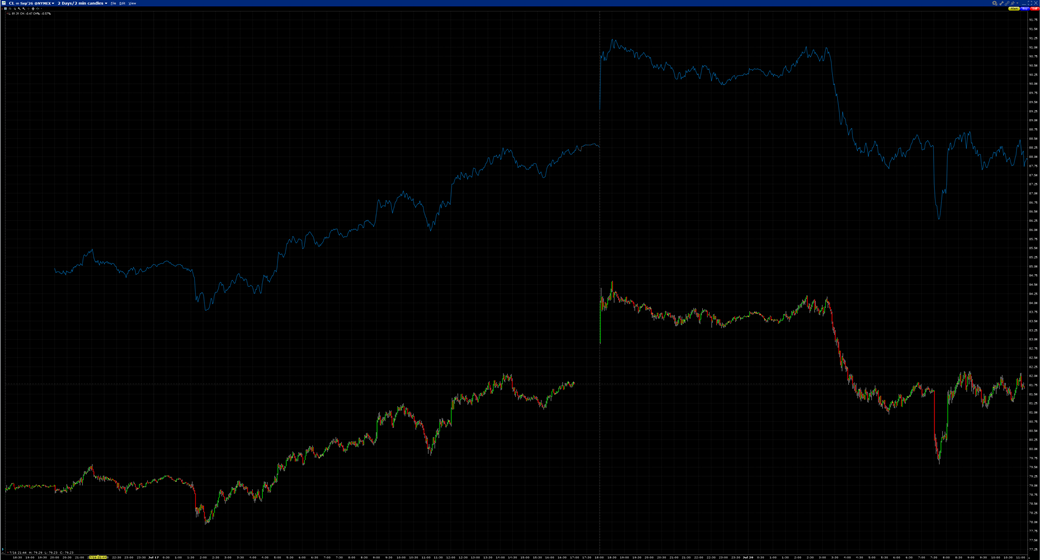
Source: Interactive Brokers
The Houthi threat is not being taken as seriously by the markets and may have led to the brief dip that occurred around 7:30 am. Frankly, the Red Sea passages are bigger than the Strait of Hormuz and the Houthis have less military capability than their Iranian sponsors. Thus, US index futures felt free to open at modestly higher levels in the pre-market before clawing their way higher as the open loomed.
That too is a familiar pattern. We see a bit of understandable dip buying after a reasonably significant fall in prior sessions – in this case a three-day, roughly 3.5% drop in the Nasdaq 100 (NDX) – only to then see enthusiasm build among traders who don’t want to risk missing the opportunity to buy that dip. All too often, however, we have seen stocks fail to follow through after the initial enthusiasm. That is what we saw today, with stocks failing to recoup their opening levels by noon today.
My thoughts are these: if you want to take your shot at buying a dip, by all means do so, but do so responsibly. In other words, resist the temptation to chase a nascent rally unless there is a meaningful reason to. Today, it was notable that the hopeful news about ceasefire talks came from Iran, which has been reticent to offer such commentary. But when oil futures failed to register true enthusiasm, it was not apparent that stock traders should pile en masse onto hopes that the recent tech trade would suddenly reverse. It might, but those moves generally require some base building, not a knee-jerk reaction.
New to Interactive Brokers?
Open AccountAlready an Interactive Brokers Client?
Request Trading PermissionThe analysis in this material is provided for information only and is not and should not be construed as an offer to sell or the solicitation of an offer to buy any security. To the extent that this material discusses general market activity, industry or sector trends or other broad-based economic or political conditions, it should not be construed as research or investment advice. To the extent that it includes references to specific securities, commodities, currencies, or other instruments, those references do not constitute a recommendation by IBKR to buy, sell or hold such investments. This material does not and is not intended to take into account the particular financial conditions, investment objectives or requirements of individual customers. Before acting on this material, you should consider whether it is suitable for your particular circumstances and, as necessary, seek professional advice.
The views and opinions expressed herein are those of the author and do not necessarily reflect the views of Interactive Brokers, its affiliates, or its employees.
Futures are not suitable for all investors. The amount you may lose may be greater than your initial investment. Before trading futures, please read the CFTC Risk Disclosure. A copy and additional information are available at ibkr.com.














Join The Conversation
For specific platform feedback and suggestions, please submit it directly to our team using these instructions.
If you have an account-specific question or concern, please reach out to Client Services.
We encourage you to look through our FAQs before posting. Your question may already be covered!