
- Solve real problems with our hands-on interface
- Progress from basic puts and calls to advanced strategies
Interactive Options Course
Posted June 30, 2026 at 2:49 pm


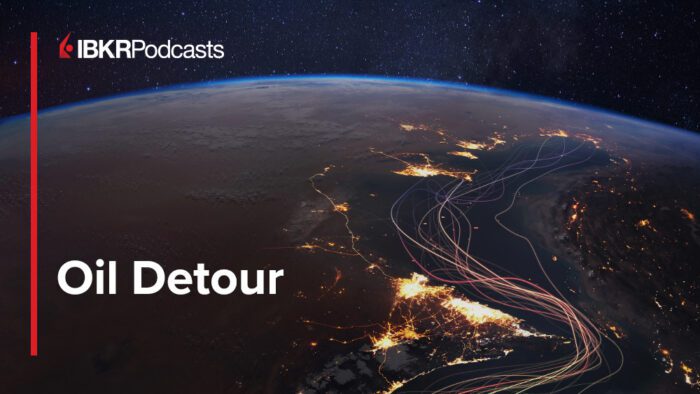
As global energy producers build new pipelines and alternative export routes, could the Strait of Hormuz be losing its strategic importance? Macro strategist Sam Rines joins IBKR’s Elizaveta Gridneva to explore energy security, geopolitical risk, the resilience trade, AI and where investors may find opportunities in a rapidly changing world.
The following is a summary of a live audio recording and may contain errors in spelling or grammar. Although IBKR has edited for clarity no material changes have been made.
Welcome to our latest podcast. Today my guest is Sam Rines, a Global Macro Strategist for WisdomTree in the United States. It’s a delight to host you on this week’s podcast, Sam. Welcome to the program.
Samuel Rines
Hey, thank you so much for having me, Eliza.
Recently, you delivered a fascinating webinar about possible opportunities for investors in what you term a world on fire. We will link to the webinar in the show notes for anyone interested in watching the recording. And let’s talk all things macro today. Let’s jump straight into it. So you emphasized the importance of having a framework rather than reacting to headlines. What is the core framework investors should use today to translate geopolitical shocks into actionable portfolio decisions?
Again, I do think that stepping back and having a framework of sorts, and it doesn’t have to be perfect, it can be iterated on, et cetera, is incredibly important in this political environment. I think it’s really important to go back to the big poster boards on the White House lawn that we had about tariffs, for example. That was a really interesting time for beginning to develop a framework for dealing with the current geopolitical environment, particularly when it emanates from the US, right? We all saw those big boards. We all were like, “Wait a minute, those are very large numbers. How exactly is that going to work out?” ‘Cause it would’ve been very interesting to see a world where the average tariff rate coming into the US was in the high 20s. But if you really dug deep and thought about what the administration in the US was looking for, you came to a conclusion that was pretty straightforward, which was this probably isn’t where they’re going to end, right? This is a starting point of a negotiation. You start up here and you wanna end up here, and you eventually end up where you wanna end up. It’s the same thing with Greenland, right? When we moved through tariffs and all of that happened and, you know, then the Supreme Court said, “No, those are illegal,” and now they’re getting paid back and all that fun stuff.
But then you pivoted to Greenland and NATO, and all of a sudden it was the US wants Greenland. We’re only going to accept, you know, a deal with Europe if we get Greenland, and we’re going to leave NATO and all this stuff. If you really dug into it, what did the US want? It really wanted a return to something like the ’80s and ’90s, where the US had significant bases in Greenland, had access to it.
And guess what? Greenland has really fallen out of the narrative. All of a sudden, the US got access to the bases and now it’s kind of over. We never hear about that anymore. The concept of leaving NATO, what did that do? It really sparked a little bit of an underlying fear within Europe that, you know, they had to spend on defense and, you know, that spiraled into something.
Same thing with tariffs, right? Tariffs spiraled into the US beginning to pivot, you know, US producers beginning to pivot where their things were made associated with lower tariffs. So these all had, call it– and I like to call it a resilience play, but we’ll talk about that a little later.
Now you have the Iran-US-Israel conflict, and it’s very similar, right? At the start of the conflict, the US and Israel were saying: We want regime change. It’s going to be democratic, and we’re going to own all the oil. And then we had the Marco Rubio speech, and all of a sudden, the goalposts were moved to, well, it’s really about the Navy. It’s really about their ability to make drones and ballistic missiles and a nuclear bomb. That is a significant shift in goalposts all of a sudden, and I think that, again, it starts here and kinda goes here. Obviously, that’s still ongoing. Negotiations are ongoing. But you can really, if you entered with the framework of the last two major things, you kind of understood when you had this called détente and ceasefire, that was really something to pay attention to, that the US was likely to be done with major kinetic events and really want to negotiate an end. So that’s really what I mean by having a framework. It’s understand that when you get these very big claims, that really what’s underlying is something that’s a little less than what you start off with, that you’re going to end up coming down. That’s really important, I think, for investors, particularly when it comes to geopolitical events and understanding how to navigate them, right?
If you got scared out of markets because of tariffs, that was bad. If you got scared out of markets because of Greenland and NATO, that was bad. If you got scared out of markets because of the Iran-Israel conflict, that was bad, right? It was really about having a forward look into what was actually going to go on, et cetera, and maybe beginning to look through some of the oil price shocks as well.
Great, Sam. That was a really great debrief of what happened in the last months and kind of the analysis of where we should react to. And, um, okay, if we talk about now, so currently across the geopolitical landscape, we see tariffs, conflicts, shifting alliances. So what do you think are the biggest investment themes you believe the market is still underappreciating?
Because you mentioned that we need to kind of really understand what’s the most important and to react to that, not to the headlines.
So what do I think the market is underappreciating? I think the market is underappreciating the underlying strength of the global economy, specifically the US and really, on the margin, even Europe and Japan, right? Those are the big three in terms of, you know, minus China, but those are the big three in terms of the developed markets. And when you look at those three, guess what? They’re holding up. You know, yes, oil is $90 to $100, but all of a sudden it’s one of those times where you look at same-store sales in the US via Redbook. I love the Redbook data, and those are running 9% year over year and have been for the last month.
You know, there’s a lot of underlying strength in the global economy that I think is kind of shrugged aside and kind of left for dead because of sentiment indices or whatever it might be, right? Never believe what people say, believe what they do. Um, you know, people can say that they’re not having a great time, but if they go out and spend, that’s what matters. It doesn’t really matter what they say, it matters how they spend. And people are continuing to spend. Yeah, there’s some trade down, but trade down is still spending. So I would say, to me, what’s underappreciated in all the geopolitical shocks is that the developed world is holding up incredibly well. It’s not just AI, it’s not just the energy sector and, you know, call it West Texas and a few little pockets in the United States. It’s really, I would say, pretty broad in terms of the underlying strength that has been kind of pushed aside. And I think that’s really one of the mistakes that investors might be making, is assuming that all of these shocks are somehow going to knock the global economy into a recession instead of looking at the actual data and saying, “Oof, this actually looks pretty interesting here. Maybe I need to dig in a little bit more to all of what’s actually happening on the ground.”
You highlighted a structural shift towards increased European defense spending. How should investors think about gaining exposure to this theme? Specific sectors or maybe companies?
Sure. We hear a lot about European defense in terms of the conflict that the US has had with NATO and, you know, all the potential wranglings there. But when you look at, call it, the beginning of the Ukraine-Russia war, I think that is incredibly important to pay attention to because that was really a catalyst for the countries that were paying attention. It’s not as though Trump threatening NATO was the major catalyst. It was a catalyst, but it wasn’t the major catalyst. Poland is spending 5% of its GDP on defense consistently. It is doing… It’s seen this, it’s seen this before and doesn’t really want it to happen again. So Poland is spending an incredible amount of money. Germany is beginning to step up to the plate and spend money, and it has the balance sheet to do it in Europe. It’s one of the few countries that actually has a balance sheet still in Europe to do this type of investment. And then you have the UK, you have France, you have even Italy to a degree. Greece is also spending quite a bit. Then you have the Nordic countries, right? It’s very similar to Poland. They’ve seen this story before, too. We forget the Winter War that Finland fought. So I do think that there’s a number of catalysts there that are not short term, and it’s not reliant on headlines around NATO. I think that’s really important, that this is not something where all of a sudden the Ukraine-Russia war ends and Europe is like, “Oh, okay, we’ll stop spending on defense.” This is a very long-tailed, we call it the defense supercycle at WisdomTree, very long tail. Now, where would I be looking?
I’d be looking at some of the places where people have really kind of overlooked, again, like Saab, for example, right? At least in the US, we think of it as a car company. That’s not what it is anymore. They have the Gripen, I might have mispronounced that, but they have a very cost-effective fighter jet. They have very cost-effective submarines, some of which Poland are buying. So I’d be paying attention to some of those off-the-radar kind of companies. Alongside, and I don’t think this can be overstated, I would be paying very close attention to what’s going on with those drone companies. When you look at the conflict in the Middle East, what are Saudi Arabia, Qatar, Dubai, Kuwait, what are they looking for? They’re looking for drones and drone deterrence and drone detection. And who is really beginning to become the leader there? That’s going to be Europe.
To a lesser extent Asia, but almost right there as well. You really want to pay attention to where the incremental orders are going. It used to be if you had a conflict like this, you were going to see companies like Raytheon and Lockheed Martin really get a lot of orders out of it. That’s just not what you’re seeing this time. The marginal order is going to drones, it’s going to lower-cost systems, and really trying to fight that asymmetric cost structure that we’ve seen recently in conflicts.
Really great insight. Thank you. And really thought-provoking, and yeah, I really want to research some of the, at least, fields that you mentioned. And if we step back, I remember you mentioning resilient trade. Let’s talk about that. Can you tell us more about your idea on resilient trade and energy infrastructure? Which companies, regions, or maybe asset classes are best positioned to benefit from the shift away from choke points like the Strait of Hormuz?
So this is a broad one, and it’s one of those, again, where I like to step back from the headlines and really dig into a little bit of history, ’cause I do think context is always really important. If you go back to the ’80s, you had the Iran-Iraq War, and Saudi Arabia saw that and said, “Wait a minute. This type of conflict is something that could close the Strait of Hormuz, and that would be existential to our revenue. We need to have some resilience here.” I like to say conflict and geopolitics create resilience, and resilience creates opportunity. And what did they do? They built the East-West Pipeline. So instead of going through the Strait of Hormuz, seven million barrels can make it to the Red Sea very quickly and easily. It’s a pretty straightforward thing. You put the crude in the pipeline, it gets out the pipeline, and then you ship it and you have no exposure to the Strait of Hormuz on those seven million barrels. You look at the UAE, right? The UAE has a pipeline of about 2.5 million barrels, if I remember correctly. And when you look at what the UAE is doing right now, what are they doing? They’re doubling that pipeline. And by doubling that pipeline, you get to roughly five million barrels a day. That’s more than they export on a daily basis at the moment, right? So all of the UAE exports will just go right around the Strait of Hormuz and be gone. It wouldn’t surprise me to see additional announcements out of Saudi that they are going to increase the capacity of the East-West Pipeline or build a sister pipeline next to it. And then all of a sudden, guess what? If you double the capacity of the East-West Pipeline, that’s more than Saudi has ever exported on a daily basis going to the Red Sea. So all of a sudden you have two countries exporting, you know, call it roughly 14 million barrels a day that have no exposure to the Strait of Hormuz.
Then Kuwait. Kuwait can plug into a couple of pipelines, maybe go through Syria, which all of a sudden is somehow one of the most stable countries in the Middle East. I don’t think anybody had that on their bingo card three years ago, but it is. So you can begin to ship it out a different corridor as well. That does strand some Iraqi crude. It strands some Iranian crude, but that’s their own problem. So it’s interesting to me that this is probably Iran’s last time actually having the Strait of Hormuz card to pull in a conflict or in some sort of geopolitical position because what they’ve told everybody in the Middle East is, “Don’t rely on the Strait of Hormuz.
Go around it.” And that’s exactly what they’re doing and what they’re capable of doing. So to me, by, you know, call it the end of 2027, I think we’ll be talking about how the Strait of Hormuz is a really interesting thing that we used to talk about and doesn’t matter anymore. And what does that do? It stabilizes the long-term energy cost because you just don’t care about one more choke point. You know, there are more choke points out there that might matter one day, but the Strait of Hormuz might not. And so I do think that’s one of the more interesting plays. You can look at companies that supply the steel for pipes. You know, there are companies like Tenaris that are interesting and have a long history of supplying that type of project. You can really dig into—no pun intended there—you can really dig into who has supplied the construction labor, the engineering, et cetera, in that area.
And the other thing that this type of conflict does is it reinforces the need for less geopolitically risked supply on the energy market. So I would say you’re going to continue to see development, particularly in North and South America. That is going to continue to be a thing. You’ve seen Venezuela, you know, doesn’t get talked about a whole lot anymore, but Venezuelan exports have exploded recently. They’re up very significantly. You have Guyana right next to Venezuela, which used to produce absolutely no oil, call it seven years ago, and all of a sudden, that’s cruising towards two, two and a half million barrels a day. And it’s not a country that consumes most of its own oil. It’s a country that exports most of it, and that’s jointly owned by Exxon, Chevron, and the Chinese National Oil Company, CNOOC. So those are the types of plays that I would be thinking about from the energy side. And when it comes to the resilience trade more broadly, we like to think of it as a way of contemplating what’s going to be built in the US, how it’s going to be built, et cetera, and why the Trump administration did things like funding Intel, right? It wants foundries in the US. Why did the Trump administration do rare earths? It wants more production in the US, right? It wants that resilience against not necessarily just the Middle East, but also the potential for deteriorating relations with China, et cetera. Again, it’s also the reason why the US is beginning to fund quantum in a more real and significant way. Not only is it AI that we’re competing with, it’s also quantum and those go-forward technologies that are very important. So overall, I would say those really are resilience trades. They’re not all things you necessarily want to be all in on, but they’re really things you want to pay attention to and pay attention to what might be the next one.
Those resilience trades have been very good as of late, and I would say it’s really about what is the next piece of resilience and how do you put a portfolio in front of that?
That’s fascinating. Thank you. It’s like you’re drawing the picture of, you know, moving elements of the world for our listeners, so I think that will be very interesting. And let’s talk about AI a little bit. You framed AI not just as a tech trend, but also as a geopolitical arms race. Where should investors look beyond the obvious mega-cap tech names to capture value in this build-out?
So this is one of my favorite questions because everybody talks about the chips, everybody wants to talk about the hyperscalers, et cetera. They’re important, right? It’s important to have NVIDIA dominating the AI chips. It’s important to have the hyperscalers really be at the forefront of putting AI in people’s hands. But where does it really get interesting for me on the AI investment front that people haven’t paid attention to? I mean, it’s gone from just the chips and just the hyperscalers to now you have optics and you have fiber beginning to rip. You’ve got memory ripping. But where does it really make a difference? It makes a difference in—we always talked about demographics 10 years ago, right? Demographics, or five years ago. The demographics were destiny, and it was always going to be a problem, et cetera, et cetera. What does AI do? Theoretically, it makes people far more productive. And if all of a sudden you have AI making things far more productive, maybe demographics aren’t as big of a deal as we thought.
So I would say it’s worth digging into places like Japan, for example, where the demographics were supposed to be a problem. It was supposed to be this existential crisis for them. But there’s an interesting company called Sompo, and it’s an insurance company in Japan, and they realized a long time ago that elder care was going to be a problem in Japan. You didn’t have enough young people to take care of the older people. And so who did they partner with? They partnered with a company called Palantir in the US a long time ago, as in five to six years ago, somewhere in there, to begin to be able to make it more efficient for people to go and provide that elder care. And they ended up owning a very significant stake in Palantir, and obviously, that worked out very well for them.
I think it’s really that type of mentality. If you approach AI with what does it solve in the medium term, what problems are being solved, what’s being underpriced at the moment, it avoids a little bit of the hype cycle. It avoids the need to trade in and out of chips. It avoids the need to really worry about what headline’s coming out when, and it provides an opportunity to really take advantage of the longer-term structural shifts that AI, even if it under-delivers in terms of its promises, can actually begin to deliver on the margin.
So that’s where I think AI is incredibly undervalued right now, is really thinking about what problems it can help solve, even if it doesn’t fully solve them in the near term.
Thank you, Sam. And I think the last question for today. We discussed quite a few topics. I think it was super interesting. I learned quite a lot. But if investors today are building a globally diversified portfolio, let’s talk about where you think they should be overweight and underweight across regions.
What’s the key thesis behind those positioning decisions for investors?
So as I just said, and I do run model portfolios at WisdomTree, so I’m going to say where I’m overweight and where I’m underweight. So not just talking, actually giving where I have allocations. I would be overweighting places like, I just said, Japan, particularly given the potential tailwind of AI and valuations. You can get some pretty incredible global companies at pretty incredibly cheap prices that will benefit radically from AI on the margin. Even, again, if AI under-delivers, it’s still going to be a big deal for these companies, and if AI over-delivers, it’s going to be tremendous. And so overweight places like Japan.
I would be overweight things in the US that are quality on the growth front. I don’t think you have to take incremental, significant cyclical risk in order to outperform in the US, so I’d be overweighting the quality side of the portfolio, but quality growth.
I don’t think that you just want to have pure exposure to the quality side of the equation. You want to have exposure to the growth side of the equation on a quality front, paying attention to what those balance sheets are actually looking like and what the growth in cash flow might look like. I think that’s going to be very important, and I think that allows a portfolio to take advantage of what AI is capable of returning to the bottom line of some of these traditionally, call it, less interesting companies from a tech perspective.
Then I would be overweight, call it, the emerging world ex-China. I think there’s some very interesting opportunities there. I do think the US and China are going to be in perpetual competition for the foreseeable future. And while China may have its cyclical booms on the equity side, I think it’s worth trying to find a way to keep up without taking that risk. I do think there’s a significant amount of sanctions risk there. The US kind of found its footing when Ukraine invaded Russia in terms of how to sanction again. I would say there’s a substantial potential that China does get sanctioned. Well, not the entire country, but that you get individual companies sanctioned, and that creates a problem, at least for US-based investors. But a country like India continues to grow very quickly. You can find exposure there and be overweight India relative to China in terms of the emerging world, and overweight places like Mexico and Poland as well. I think those two are very well-positioned to be, I would say, the China-plus-one trade, where you want to have manufacturing in places that, you know, that’s not China for tariff purposes. Poland is a very interesting place to look if you’re a European country looking for close-in manufacturing, and Mexico continues to have a very good relationship with the Trump administration and has USMCA being renegotiated. And I think there’s a number of reasons why you haven’t heard much about USMCA negotiations, and that’s because the negotiations, particularly with Mexico, are going very well. So I would be overweight those, and am overweight those two as well.
Great. That’s very unique insight, that if you haven’t heard about something, think about it. Sam Rines has been my guest today, and he’s the macro strategist for WisdomTree United States. On behalf of our audience, thank you so much for taking the time to sit down with me today.
Hey, thank you. Really appreciate it.
Thank you very much. And to the audience, if you enjoyed this edition, please remember to like and subscribe to our channel. Thank you very much.
The analysis in this material is provided for information only and is not and should not be construed as an offer to sell or the solicitation of an offer to buy any security. To the extent that this material discusses general market activity, industry or sector trends or other broad-based economic or political conditions, it should not be construed as research or investment advice. To the extent that it includes references to specific securities, commodities, currencies, or other instruments, those references do not constitute a recommendation by IBKR to buy, sell or hold such investments. This material does not and is not intended to take into account the particular financial conditions, investment objectives or requirements of individual customers. Before acting on this material, you should consider whether it is suitable for your particular circumstances and, as necessary, seek professional advice.
The views and opinions expressed herein are those of the author and do not necessarily reflect the views of Interactive Brokers, its affiliates, or its employees.
This material is prepared by WisdomTree and its affiliates and is not intended to be relied upon as a forecast, research or investment advice, and is not a recommendation, offer or solicitation to buy or sell any securities or to adopt any investment strategy. The opinions expressed are as of the date of production and may change as subsequent conditions vary. The information and opinions contained in this material are derived from proprietary and non-proprietary sources. As such, no warranty of accuracy or reliability is given and no responsibility arising in any other way for errors and omissions (including responsibility to any person by reason of negligence) is accepted by WisdomTree, nor any affiliate, nor any of their officers, employees or agents. Reliance upon information in this material is at the sole discretion of the reader. Past performance is not a reliable indicator of future performance.
Please click here for our full disclaimer.
Jurisdictions in the European Economic Area (“EEA”): This content has been provided by WisdomTree Ireland Limited, which is authorised and regulated by the Central Bank of Ireland.
Jurisdictions outside of the EEA: This content has been provided by WisdomTree UK Limited, which is authorised and regulated by the United Kingdom Financial Conduct Authority.
Investors should carefully consider the investment objectives, risks, charges and expenses of the Funds before investing. U.S. investors only: To obtain a prospectus containing this and other important information, please call 866.909.WISE (9473) or click here to view or download a prospectus online. Read the prospectus carefully before you invest. There are risks involved with investing, including the possible loss of principal. Past performance does not guarantee future results.
You cannot invest directly in an index.
Foreign investing involves currency, political and economic risk. Funds focusing on a single country, sector and/or funds that emphasize investments in smaller companies may experience greater price volatility. Investments in emerging markets, real estate, currency, fixed income and alternative investments include additional risks. Due to the investment strategy of certain Funds, they may make higher capital gain distributions than other ETFs. Please see prospectus for discussion of risks.
WisdomTree Funds are distributed by Foreside Fund Services, LLC, in the U.S. only.
Interactive Advisors offers two portfolios powered by WisdomTree: the WisdomTree Aggressive and WisdomTree Moderately Aggressive with Alts portfolios.
Futures are not suitable for all investors. The amount you may lose may be greater than your initial investment. Before trading futures, please read the CFTC Risk Disclosure. A copy and additional information are available at ibkr.com.










Join The Conversation
For specific platform feedback and suggestions, please submit it directly to our team using these instructions.
If you have an account-specific question or concern, please reach out to Client Services.
We encourage you to look through our FAQs before posting. Your question may already be covered!