
- Solve real problems with our hands-on interface
- Progress from basic puts and calls to advanced strategies
Interactive Options Course
Posted December 16, 2025 at 10:42 am
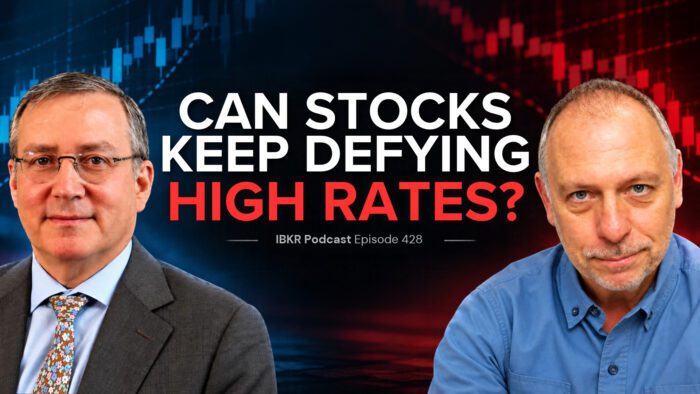
Geopolitical tensions remain elevated across the globe, yet markets appear surprisingly calm. Erik Norland of CME Group joins IBKR Podcasts to explore whether investors are becoming desensitized to conflict, how inflation and central bank policy are reshaping risk, and why gold and commodities may be telling a different story.
The following is a summary of a live audio recording and may contain errors in spelling or grammar. Although IBKR has edited for clarity no material changes have been made.
Welcome to this week’s edition. Joining me to discuss global markets, welcome back to IBKR Podcast, Erik Norland, who is the Group Economist for CME Group over in Europe. How are you, Erik?
I am doing well. How are you?
Not bad for a sunny December morning. It’s been a good year for equities on average. We’re kind of getting there towards the end. We’re middle of December now. How about the European markets? How have they performed relative to U.S. markets?
Yeah, I would say they’ve kind of broadly done about the same. If you look at the total return of the S&P 500, it’s up around 17% year to date. The total return of the NASDAQ index is up around almost 22% year to date. The European markets are kind of in the same range, like the CAC up 15%, the DAX and the FTSE 100 kind of around 17% to 22%, depending on the index. A similar story for Euro Stoxx 50. They’ve all been kind of doing about the same thing.
I’m kind of a little surprised by that because they tended to perform quite well when the U.S. markets crashed, and a lot of the reason for that was the weakness of the dollar. Are you surprised that the dollar hasn’t weakened further this year, or is that maybe a story for 2026 when inflation data permitting that’s going to allow the FOMC to cut rates further?
Well, you know, the currency markets have barely even moved this year, and so they really haven’t had much of an impact on equities. And the reason why the U.S. stock market’s gone up is mainly because of technology stocks, which I don’t think are very sensitive to currency in general. And the main reason why European stocks have gone up is because the defense sector in Europe is doing really well, and the banking sector has really taken off. So they’re rallying for different reasons.
But when it comes to the currency, I think the jury is still out on what’s going to happen. It looks to me like the European Central Bank is pretty much done cutting interest rates, and the Bank of England is kind of struggling to cut further. They would maybe like to, but they’re a little hesitant because inflation is still way above target. I think the bigger question is what will happen in the United States. The markets are essentially pricing for the Fed to reduce rates to around 3%. If you look at the Fed Funds futures or SOFR futures, that’s a big, big rate cut or series of rate cuts from where we are presently. But I guess it would depend whether the Fed cuts more than that. And that, in turn, depends maybe on what the Fed’s leadership looks like next year, and we really don’t know the answer to that just yet.
So gold has been a surprisingly large mover this year, but it’s not just gold or other precious and semi-precious and industrial metals moving. What have you noticed there, Erik?
So gold prices have absolutely soared. You’re right, they’ve had a phenomenal year, far outpacing the equity market. And the reason for that is threefold. First, almost every country in the world is running gigantic budget deficits, including the U.S., China, Japan, France, Britain, Brazil, Mexico, et cetera.
Secondly, they have really no plan to do anything about this. There’s no leader anywhere in the world who’s really significantly raising taxes or slashing spending to bring those deficits in. Third, inflation is above target in almost every major country, usually kind of on average about 1% above the central bank targets. There are exceptions like mainland China and Switzerland and Singapore, but generally speaking, inflation is running above target.
And then lastly, the central banks have all been cutting interest rates despite the fact that inflation is above target. And so investors have been looking at this and they’ve been saying to themselves, you know what, why hold fiat currency when inflation’s above target, the central banks are easing policy for some reason anyway, and fiscal deficits are out of control and nobody’s doing anything about it? So gold’s been the primary beneficiary, but now it’s spilled over massively into silver, and also to some extent into platinum and palladium, whose prices rose 80% or 90% from the month of April to mid-October before they began consolidating a bit.
So with everything that we know about inflation, as you’ve just described, and fiscal deficits and so on, cryptocurrency was doing extremely well, and gold were probably very strongly correlated, but that correlation seems to have broken recently. Any thoughts on that?
I think the crypto-gold correlation is sort of a bit exaggerated. If you look at their day-to-day correlation, they were positively correlated back in 2020 and 2021. During the pandemic, we had this massive, simultaneous fiscal and monetary expansion. The prices became positively correlated for a while, but even by 2022 and 2023, the correlation had basically gone back to zero, where it remains today. What crypto assets do tend to correlate with is the NASDAQ 100 and U.S. technology stocks. Those correlations are not extremely high. They’re usually like positive 0.4, maybe positive 0.5, but it’s still pretty significant. But by and large, crypto beats to its own drummer.
And what we’ve been seeing in crypto is that a lot of the early investors in Bitcoin have been selling out. We know this from the blockchain. We can see that some of the large early buyers or early miners of Bitcoin have been, I guess, diversifying their portfolios. And so what we’ve seen in the crypto world is sort of a diversification, where people appear to be switching out of Bitcoin and, to some extent, buying things like XRP and Sol.
Fascinating. Let’s wind up on geopolitics here. It’s been another arduous year. President Trump, the White House has been at the forefront, but also the Israel-Gaza conflict and the war in Ukraine, which seemingly has no end despite efforts to move towards peace. Investors don’t seem to be very concerned by this. Do you think they’re too complacent looking ahead, Erik?
Well, it’s hard to say. I mean, you know, at the beginning of the Russo Ukraine War, we saw huge run up in commodity prices, some of which was anticipatory of disruptions that, to some extent, didn’t happen. There were actually real disruptions in corn and wheat supplies for a while, but thanks in large part to diplomacy from Turkey and other countries, those were largely resolved.
And so now grains are flowing out of Ukraine and Russia fairly unimpeded. We have seen some attacks on Russian shipping in the Black Sea recently. I’m not sure how much further that will continue. We also have seen quite a lot of Ukrainian drone attacks on Russian energy infrastructure, but focusing mainly on refined products, which is making gasoline and diesel fuel maybe less reliable or less available in Russia, but not really impacting global crude oil prices very much. How this conflict evolves next year, I really have no idea. I think if it were to come to an end, you might see a little bit of risk premium coming out of corn, wheat, and crude oil. With respect to the situation in the Middle East, the ongoing part of that situation that may still have a little bit of impact on the market is that there’s still very little traffic through the Suez Canal. The Suez Canal is still seeing traffic down by about 85%. That means a lot of the Middle Eastern oil that heads to Europe has to circumnavigate Africa. A lot of the Russian oil that which historically would’ve been sold to Europe, but is now mainly sold in Indian China, also has to circumnavigate Africa.
So if that situation were to be resolved, and the insurance companies were to start, you know, reissuing insurance for vessels traveling through the Red Sea and the Suez Canal, that might also take some risk premium out of that and maybe lead to a very slight easing of the global prices of those commodities.
Got it. Erik Norland, group economist at CME Group over in London, thank you very much for joining me. It’s been a pleasure to catch up with you before the end of 2025.
Thank you.
And to the audience, if you enjoyed today’s episode, please remember to subscribe wherever you download your podcast from. Bye for now.
© [2023] CME Group Inc. All rights reserved. This information is reproduced by permission of CME Group Inc. and its affiliates under license. CME Group Inc. and its affiliates accept no liability or responsibility for the information contained herein, including but not limited to the currency, accuracy and/or completeness of this information, and delays, interruptions, errors or omissions. This information is an unofficial copy and may not reflect the official and accurate version. For the definitive and up-to-date version of any of this information, please see cmegroup.com.
The analysis in this material is provided for information only and is not and should not be construed as an offer to sell or the solicitation of an offer to buy any security. To the extent that this material discusses general market activity, industry or sector trends or other broad-based economic or political conditions, it should not be construed as research or investment advice. To the extent that it includes references to specific securities, commodities, currencies, or other instruments, those references do not constitute a recommendation by IBKR to buy, sell or hold such investments. This material does not and is not intended to take into account the particular financial conditions, investment objectives or requirements of individual customers. Before acting on this material, you should consider whether it is suitable for your particular circumstances and, as necessary, seek professional advice.
The views and opinions expressed herein are those of the author and do not necessarily reflect the views of Interactive Brokers, its affiliates, or its employees.
U.S. Spot Gold trading through IB LLC accounts is only available to legal residents of the United States that do not reside in Arizona, Montana, New Hampshire, and Rhode Island.
Futures are not suitable for all investors. The amount you may lose may be greater than your initial investment. Before trading futures, please read the CFTC Risk Disclosure. A copy and additional information are available at ibkr.com.
Trading in digital assets, including cryptocurrencies, is especially risky and is only for individuals with a high risk tolerance and the financial ability to sustain losses. Eligibility to trade in digital asset products may vary based on jurisdiction.











Join The Conversation
For specific platform feedback and suggestions, please submit it directly to our team using these instructions.
If you have an account-specific question or concern, please reach out to Client Services.
We encourage you to look through our FAQs before posting. Your question may already be covered!