
- Solve real problems with our hands-on interface
- Progress from basic puts and calls to advanced strategies
Interactive Options Course
Posted October 9, 2025 at 2:40 pm
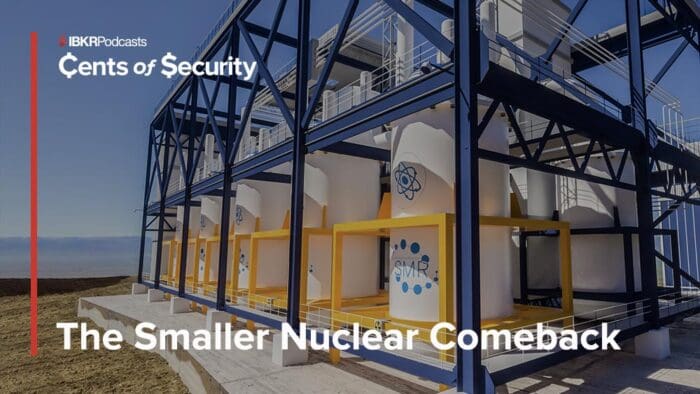
Mary MacNamara speaks with Mobeen Tahir of WisdomTree about the global comeback of nuclear energy, its role in powering AI infrastructure, and how investors can tap into the nuclear value chain.
The following is a summary of a live audio recording and may contain errors in spelling or grammar. Although IBKR has edited for clarity no material changes have been made.
Hello everybody and welcome to the Cents of Security Podcast. I’m Mary MacNamara, and today we are going to talk about nuclear energy, and I am here with WisdomTree, Director of Macroeconomics and Thematic Investing, Mobeen Tahir.
Welcome, Mobeen. How are you?
I am very well and thank you so much for having me. It’s a pleasure. And of course, we’re talking about a very exciting topic looking forward to the conversation.
So why is nuclear energy suddenly back in favor globally? And what changed in investors sentiment?
Mary, a few days ago, me and my friends, we were having a dinner chat, and we were just comparing different AI tools, and we were saying, oh, have you tried this tool? Have you tried that? This one works better for this application. That one is quicker. This one delivers images better, and so on and so forth.
And after that conversation I was reflecting on what we were talking about, and I realized one thing we didn’t talk about is how energy intensive all of these applications are. And to get a response to a query and an AI model, you. You require a lot of energy somewhere in the backend. So of course we use it, we treat it as an application in the cloud, but somewhere that computation is happening in a physical computer somewhere on the planet.
And of course, for the model to become better and for it to deliver better responses, it needs to be trained. And that training process requires a lot of energy as well. And that’s where nuclear energy is coming in because. Tech companies, governments, they’re all seeing nuclear as a very viable solution to power this very energy hungry technology that we are developing.
And we can’t live without AI, of course, being what we are talking about here, data centers are the infrastructure that power technologies like ai and in the US alone, we are going. Over the next seven years. So, comparing 2023 where data center energy consumption was 150 TW hours, by 2030, it’ll increase to 400 TW hours.
So that’s 2.7 times increase in just seven years for data center energy consumption. In the US alone, and of course US is not the only country developing data centers. This is a global thing. So, the question is, can we power these data centers sustainably and can we have uninterrupted power that doesn’t?
Destroy the environment and the process. That’s where nuclear energy comes in. It’s clean, it’s cheap, it’s reliable. It ticks all the boxes, and that’s why there’s so much focus on nuclear energy infrastructure, powering AI infrastructure in the future. Okay.
So, what are some of the key countries leading the charge in nuclear energy development and how might that influence global markets?
So, in 2024 at the United Nations, 31 countries agreed to triple global nuclear capacity by 2050. And. US went further. So, talking about key countries. US was one of those 31 countries, but US went further in May 2025 when President Trump announced that. US capacity will be quadrupled by 2050. Of course, US is the number one country in terms of total capacity of nuclear generation.
And quadrupling that in just the next two and a half decades is a bold goal. So, it, it made a lot of headlines and got a lot of interest from markets. So, US is certainly very important in this space. Particularly after the recent executive orders from President Trump in May 2025. They are going to do this by doing a number of things.
US is going to build new large reactors and there’s talk of 10 new large reactors. There is going to be. Reopening of old reactors that were shut down, like three Mile Island, which shut down in 2019 is now going to be reopened in partnership with Microsoft. There is going to be the development of small modular reactors, and we can certainly talk about that in our chat today and what role they will play, and also regulatory support.
So regulatory support in terms of making it easier. For the development and deployment of nuclear reactors to make it through the regulatory approval process. So, all of those things us is doing. Other countries, of course, we have to talk about France because France, in terms of the share of nuclear in the in the electricity grid is 70%.
So, 70% of France’s electricity comes from nuclear, which is the highest among all countries, but most of. France’s infrastructure in nuclear was developed in the seventies and eighties. Over the past three decades, they haven’t really added much in terms of new capacity, but now that’s changing.
In 2022, they announced six new reactors, and this could potentially go to eight more. Beyond that, those six announced reactors. So, France is making announcements in this space again and finally. China because China is creating a blueprint for all other countries to potentially adopt. And in the last 15 years alone, China has increased its nuclear capacity by five times in just 15 years.
Around the turn of the millennium, China was. In a place where they didn’t really have a significant nuclear footprint. But now, particularly over the last decade and a half, they’ve expanded. They’ve now got 58 reactors. They’ve got another 33 under construction. So, they’re really scaling it up and the way they’ve done it is by.
Building out their supply chains standardizing designs and building at scale. And when you build things at scale, you get economies of scale. You bring your costs down; you leverage the expertise and the learning. You develop from one project, and you take it to the next. And that is a blueprint that other countries will potentially take inspiration from and look to adopt. So us, France, and China are key, but certainly, these days it seems like every country is looking to explore this topic and see what they can do.
So, we talked a little bit about obviously AI and tech, but are there any other specific sectors? Or companies that stand to benefit most from, this resurgence of nuclear.
Sure. So, we think about the value chain at WisdomTree. We think about the value chain of the uranium and nuclear energy industry. These are the companies that will benefit as the industry grows. So, what is the value chain? You start from upstream. Upstream typically refers to miners of nuclear fuel, which is uranium. So, uranium miners are an established part of the value chain. They are perhaps the largest part of the value chain as well and they tend to be very pure play businesses because uranium miners, they tend to be specialized businesses. They don’t tend to mine lots of things. They tend to focus their activities there.
So, an exposure to upstream. Minus of uranium is one. Of course, as we see demand for more uranium pickup, these companies will benefit because they’re producing the uranium. Then you have the midstream companies, and midstream companies are those companies that are providing the products and services to the nuclear industry.
Now, of course when we think about the uranium that comes out of the ground, that’s raw uranium, but to. Make it ready to be used in a nuclear reactor and generate electricity. It has to go through certain processes. Those processes are referred to as nuclear conversion and enrichment, and those sorts of activities are provided typically by midstream companies.
That’s one aspect of what midstream companies can do. There can be an overlap between upstream and midstream companies as well in some cases. But also, companies that are producing the equipment that gets used in. In nuclear power plants the safety equipment, radiation detection equipment, the turbines and so forth, all of that has a place in a nuclear value chain.
As the industry grows, these companies will benefit. And finally, innovators. Innovators we refer to at WisdomTree, we, these are companies that are developing advanced nuclear reactors. These are small modular reactors. There’s that expression once again, small modular reactors. Very exciting because they have a place in the ecosystem.
We won’t just be talking about large. Traditional nuclear power plants. In the future, there will be these smaller nuclear reactors as well, and the companies that are developing them have garnered a lot of attention from markets in recent months. So, it makes sense to have an exposure so upstream, midstream, and innovators.
If you think about the value chain and those three segments, then you’re very well covered.
So, the small nuclear reactors would be considered the innovators?
Correct. Yes.
I read an article recently that open AI is developing a new huge data center in Texas, I think it’s Abilene, Texas. And they were talking about small nuclear reactors in that development. And so, it looks like it’s, is it more of a big corporation, especially the Magnificent S even doing this or is it other cities, countries, or is it just primarily like the technology world that is investigating this?
So, the technology world is leading. The charge, but others could potentially follow as well. Right now, we’ve seen big tech companies that are developing data centers make a lot of headlines. You mentioned OpenAI, and of course Google and Amazon have struck deals as well with.
Providers of small modular reactors four data centers. Microsoft and Meta have struck their own deals and some of those deals are with traditional, larger nuclear power plants. But some deals particularly with Google and Amazon include small modular reactors as well. Now, the rationale of a small modular reactor is it can give you energy independence.
Now if you’re developing a data center, ideally you don’t want to be dependent on the grid because if you can be energy independent and deploy. The small nuclear reactor on site, then you don’t necessarily need the infrastructure, the transmission cables and the, and you don’t have the dependence on the grid to keep the lights on and the computers running 24 7, which is what you need for data centers and data centers, depending on how big they are, they can require as much energy. In some cases, as a small city. The, these are very energy hungry places of infrastructure that big tech is developing. Scale. So there’s that benefit that you can be energy independent, not rely on the grid you have energy being generated locally.
Then there are other benefits that small modular reactors bring as well. These things are factory assembled so they can be built. On scale and again, when you develop things on scale, you have economies of scale. So, costs can come down and then you can transport them and deploy them locally. So easier to construct and get them up and running compared to a large nuclear power plant.
Then they have some technological features as well, lower refueling requirements some modern alternatives to. Cooling the reactors, large reactors typically require water. These small modular reactors, in some cases can use alternatives like liquid sodium, and that adds to their environmental credentials and also the flexibility that you don’t necessarily need water to cool.
The reactor, if you can. Use alternatives. So, lots of things working in their favor. Recycled fuel is also something talked about which is a company that is developing small modular reactors as soon as 2027. So, they’re looking to deploy one as soon as 2027. So, this is not a pipe dream anymore.
This is a reality about to happen very soon. They do talk about running their small modular reactors on recycled fuel. So again, this is very cutting-edge technology, which is why we call them innovators. This is advanced technologies, very exciting lots of innovation, but of course goes hand in hand to your question, goes hand in hand with data center development, but no reason why in the future other.
Countries or cities could not develop and seek small modular reactors to to power them as well.
Mary MacNamara
So, what role do government policies and subsidies play in shaping the future of nuclear energy investments?
Mobeen Tahir Governments have a very important role from multiple facets. There is the regulatory side, of course if governments. Paved the way for the industry to grow, then that, that helps. And regulatory support, as I mentioned earlier with the United States saying the regulatory approval process will be made more favorable.
That helps a lot and that. That catalyzes the deployment of more reactors and so the industry can grow more quickly. So, there’s the regulatory side, there is the financing side. Of course, a lot of these projects are very capital intensive, and governments can play a role in ensuring that, the financing is in place. In some cases, even subsidies could be offered to, to these developers to really accelerate the development and deployment of this. And finally, public sentiment. Ultimately there is a very important role that governments have to play to. Shape public sentiment in favor of this technology.
Of course, in the past there have been certain incidents that have caused people to view nuclear electricity unfavorably favorably, and of course there have been accidents there in the past, but technology has come a very long way. Global standards have come a very long way since then. That’s where the public needs more awareness and that’s where governments can play such an important role.
People not, people often worry about things like nuclear waste, and nuclear waste is perhaps more of a, of a public sentiment problem than a technological problem or an actual problem that the industry faces. In reality, when you speak to people in the industry, they say that there are ways to store nuclear spent fuel or nuclear waste very safely.
But of course, we’ve seen the Simpsons and we’ve seen the green sludge coming out of the barrels, and that’s. Created an unfortunate caricature of nuclear waste and shaped public sentiment. So that’s where governments can play a very important role in educating their people and saying that, look, this is a safe technology. And this is a clean technology, and this is one that can bring economic growth, as you were saying, if it can, if it powers the data center economy that creates jobs and that creates a lot of economic growth. So that’s the sort of direction that we see. Governments taking and the line governments taking to, to educate and encourage their their populations to adopt and see this very exciting technology more favorably.
So, we need some positive sentiment here from the Simpsons about…
That could help.
support. That would help. Absolutely. Okay, good. So how can investors start exploring some nuclear energy opportunities without taking on too much risk?
Of course, investors should in the first instance study the topic. And if they are listening to this episode on your podcast, they’ve done very well to to inform themselves. And of course, as they inform themselves, they can make informed decisions. There are a few things to remember that you can still build a diversified portfolio here.
And yes, it’s not a huge industry that there aren’t hundreds and hundreds of publicly listed companies to choose from, but you can still build a diversified portfolio, and you have to be. Prepared to adapt and evolve as the space evolves. So those two principles and that’s what thematic investing is all about.
And when you invest in a theme, and we certainly at Wisdom Tree we call this a theme because it’s a mega trend. It’s a long-term structural shift in the world around us. And nuclear energy is a topic that you want to. You want to access in a way that you remain agile. You remain aware that new companies will come in and new technologies will come in and your portfolio should evolve as well.
Of course, coming from WisdomTree, we I’m a representative of the exchange traded fund industry. So, ETFs are one way to access this space, and you can get a good, diversified portfolio, smart exposure to the entire value chain, as I was saying, if you approach it that way. But that’s not the only way you can invest directly in the companies that are interesting.
And doing great things. I’d say inform yourselves for any investor interested in this space. Look at what is happening and how that’s changing the industry. And then look at the value chain because the value chain is. Is where the companies belong, and those are the companies that will benefit and look at a look at the best tools out there that can give you the best exposure to the value chain and that might help you get to a good portfolio. I.
So, I think I hear two terms here. And I’d like a brief explanation of them. One is value chain, and two is thematic investing. Can you elaborate?
Yeah, so value chain, of course, in the context of nuclear energy. We spoke about upstream companies, midstream companies, innovators. We generally like the idea of a value chain in. Many parts of thematic investing and I’ll come to thematic investing next. Whenever you’re thinking about a theme, like whether it’s nuclear energy or you’re thinking renewable energy, whether you’re thinking artificial intelligence, it’s not just one type of company that fits into that topic. It’s not just one business model. Think about artificial intelligence. It’s not just semiconductors. Of course, people know Nvidia but there are going to be software companies in there as well. So very different types of businesses, but all very relevant to the same topic and the way to. Understand how it all comes together is through typically through a value chain. And just again bringing it back to the nuclear topic, we saw how a uranium miner is a very different business to a company that is. Making radiation detection equipment or a company that is producing small modular reactors, but they’re all very important components of the nuclear industry, and so we call it a value chain.
All of those components of the value chain are adding value. And they will and value will accrue to them as the industry grows. So that’s the value chain. Thematic investing is about investing in structural shifts that are going to change the world. And these are long-term trends. Typically, that’s why we don’t say thematic investing is something that’s you pick a theme for the next two months.
Yes, markets can move in, in one direction in the next two months, and then maybe they turn. Yes, you can never rule those things out, but the fundamental. Drivers behind the theme are typically long term in nature. So, these are structural shifts in, in our world, artificial intelligence. I mentioned that’s a structural shift.
That’s a new technology that’ll, that’s changing the world we live in. And nuclear energy is another one. We spoke about data centers. That’s an important change in the world around us. Cybersecurity is another one. How do we remain safe online as technology continues to advance?
That’s another thematic topic. So thematic investing typically is something that people look to add into their portfolios for growth. Ultimately you want to see these topics grow and add value to your portfolio. So, it’s a way to approach the idea of growing your portfolio for the long run.
If you have conviction in a topic that you believe is going to change the world.
Thank you for that. We needed to hear those definitions, so Mobeen Tahir Wisdom Tree. Thank you so much for your time. We appreciate it and thank you dear Listeners.
Thank you so much for having me.
This material is prepared by WisdomTree and its affiliates and is not intended to be relied upon as a forecast, research or investment advice, and is not a recommendation, offer or solicitation to buy or sell any securities or to adopt any investment strategy. The opinions expressed are as of the date of production and may change as subsequent conditions vary. The information and opinions contained in this material are derived from proprietary and non-proprietary sources. As such, no warranty of accuracy or reliability is given and no responsibility arising in any other way for errors and omissions (including responsibility to any person by reason of negligence) is accepted by WisdomTree, nor any affiliate, nor any of their officers, employees or agents. Reliance upon information in this material is at the sole discretion of the reader. Past performance is not a reliable indicator of future performance.
Please click here for our full disclaimer.
Jurisdictions in the European Economic Area (“EEA”): This content has been provided by WisdomTree Ireland Limited, which is authorised and regulated by the Central Bank of Ireland.
Jurisdictions outside of the EEA: This content has been provided by WisdomTree UK Limited, which is authorised and regulated by the United Kingdom Financial Conduct Authority.
Information posted on IBKR Campus that is provided by third-parties does NOT constitute a recommendation that you should contract for the services of that third party. Third-party participants who contribute to IBKR Campus are independent of Interactive Brokers and Interactive Brokers does not make any representations or warranties concerning the services offered, their past or future performance, or the accuracy of the information provided by the third party. Past performance is no guarantee of future results.
This material is from WisdomTree Europe and is being posted with its permission. The views expressed in this material are solely those of the author and/or WisdomTree Europe and Interactive Brokers is not endorsing or recommending any investment or trading discussed in the material. This material is not and should not be construed as an offer to buy or sell any security. It should not be construed as research or investment advice or a recommendation to buy, sell or hold any security or commodity. This material does not and is not intended to take into account the particular financial conditions, investment objectives or requirements of individual customers. Before acting on this material, you should consider whether it is suitable for your particular circumstances and, as necessary, seek professional advice.
Any discussion or mention of an ETF is not to be construed as recommendation, promotion or solicitation. All investors should review and consider associated investment risks, charges and expenses of the investment company or fund prior to investing. Before acting on this material, you should consider whether it is suitable for your particular circumstances and, as necessary, seek professional advice.
Futures are not suitable for all investors. The amount you may lose may be greater than your initial investment. Before trading futures, please read the CFTC Risk Disclosure. A copy and additional information are available at ibkr.com.










Join The Conversation
For specific platform feedback and suggestions, please submit it directly to our team using these instructions.
If you have an account-specific question or concern, please reach out to Client Services.
We encourage you to look through our FAQs before posting. Your question may already be covered!