
- Solve real problems with our hands-on interface
- Progress from basic puts and calls to advanced strategies
Interactive Options Course

Posted November 14, 2025 at 2:34 pm
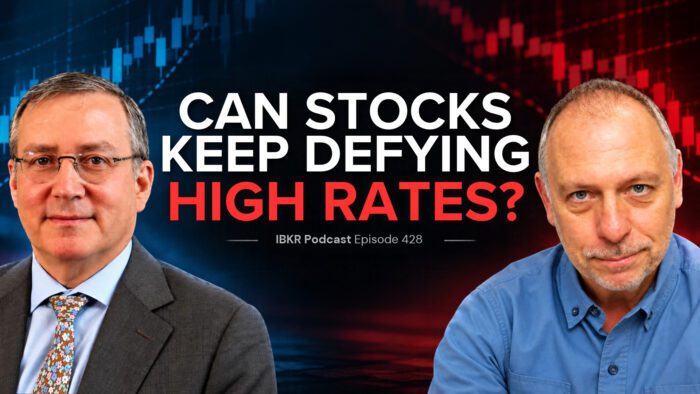
Jose Torres, Senior Economist at Interactive Brokers, joins Mary MacNamara to unpack market volatility, Fed rate cut probabilities, repos and what delayed economic data means for risk appetite.
The following is a summary of a live audio recording and may contain errors in spelling or grammar. Although IBKR has edited for clarity no material changes have been made.
Hello everybody and welcome to the Cents of Security Podcast. I’m Mary MacNamara, and today we’re talking to Interactive Brokers, Senior Economist, Jose Torres. Hi Jose. How are you?
Hi, Mary. Great to be here again. Unfortunately, it’s November 13th and we have a really bearish day in the markets. Stocks are going down, rates are going up. It appears that the government reopening serves to be a buy the rumor, sell the news event.
Lots of red today. And do you expect the Federal Reserve to cut its benchmark rate in December or January? It might be too early to say, how might that influence risk appetite?
It’s going to absolutely influence risk appetite, whether they remain on hold or they cut 25 basis points. Now our Forecast trader tool is signaling near coin flip odds for a fed reduction in December. So, we’ve had a data blackout in the last 43 days due to the shutdown. We haven’t had the pivotal public sector data come out, which informs investors as well as members of the Fed, what’s going on with growth, employment, inflation, et cetera. So now that we’re going to start getting those delayed data points soon, we don’t know yet, but the government’s going to provide us with a calendar, letting us know when those data points will be available. Now those figures carry a lot more weight because we’re analyzing delayed figures as well as on time figures simultaneously.
So, volatility measures for both equity and fixed income are quite elevated because What could happen, Mary, is that if the data come in justifying recent market moves, then the market can advance further or can neutralize, but if the data comes in. Rejects the recent pattern of the market, right? So, if the data reflect a much sharper slowdown than what we’ve perceived here on Wall Street, then all of a sudden the asset prices can move significantly.
In that case, bonds would appreciate. Meaningfully rates would come down strongly and that rate cut in December, probability would jump, but stocks would also decline because corporate earnings expectations would have to come down if unemployment prospects are a lot worse. On the flip side, if the numbers come out pretty strong in terms of employment hanging in there, in terms of inflation.
Stabilizing then, the market might stay where it’s at and not necessarily move too strongly in one direction or the other.
Okay. Jose, you brought up a good phrase and we’re at Cents of Security podcast, so we want to dive deep into the jargon that is what is. What was it again? Sell the rumor. Yeah.
Buy the rumor, sell the news. So, the rumors that the government’s about to reopen, the government’s about to reopen, okay, let’s buy. The government’s going to reopen now that the government reopened. Everyone bought already. So now no one else wants to buy. So now we’re going down.
There’s been rumors about the AI capital expenditures and the impact of long-term returns, depreciation, and so forth. So, what’s going on there and what sectors stand to benefit the most?
First we have to see if the significant capital expenditures in artificial intelligence do generate strong returns. But if that is the case in the. Does come to fruition, then the firms that are going to benefit the most are the ones that are investing the most in the space, and that’s going to be the mags in seven firms.
There’s been valuation worries, there’s been concerns that the market is far too optimistic on the prospects for artificial intelligence, and that’s also what’s driving today’s selling. On November 13th, really those valuation worries alongside a series of Federal Reserve speakers that have been a little cautious in terms of signaling further rate cuts.
And then finally, the buy the rumor sell. The news dynamic that we’re seeing were folks wanted to get into the market, essentially investing based on the perception that the government was going to reopen, but now that the government has reopened, we’re having selling pressure after the fact.
So those are the moves that we’re seeing today in markets. It seems that everyone got overly excited about the Government reopening. And now perhaps there’s no buyers left.
So everything, the temperature is like going down a bit. So, as you mentioned, with 43 days of delayed economic data, how are portfolio managers adjusting their strategies with without key public sector statistics?
Yeah, they’ve been pretty bullish going into the today’s reopening. But now we’re seeing managers step back a little bit, wanting to buy hedges. We’re seeing that the prices for hedges on treasuries as well as for stocks, those premiums are up. The VIX is at 21. It was at a low of 17.51 earlier.
So, premiums are get getting up there, they’re getting pricier. And the reason is we are going to have to contend with, like I said earlier, delayed data coinciding with. Data that’s scheduled to be published. So, in essence, we’re going to be juggling September, October, and perhaps even November data all at the same time.
So that means that those figures carry a lot more weight on the landscape. But then also you have the the valuation worries in AI and tech. You also have the. Fed not, perhaps not cutting. And folks are less enthusiastic about the prospects going lower. In fact, December is now close to a coin flip.
And just the fact that we got a maybe a little too excited about this government reopening and too many buyers piled in, and now we’re having some selling pressure after the event is known. Yeah, pretty much folks are clamor, clamoring on to safe haven assets, excluding treasuries because of the inflation risk, as well as the liquidity issues that we’re seeing in the overnight funding markets.
So, prior to the past few months’ banks had a lot of cash. And they were depositing money into the Fed Federal, into the Federal Reserve’s reverse repo facility. They would give cash and get treasuries back as collateral, but now we’re having the opposite issue where banks don’t have that much cash, and they have a lot of collateral.
So now they’re tapping into now the reverse repo facilities isn’t being utilized. Now on a relative basis. Now, the regular, not reverse repo, the regular repo facility is being used because banks find themselves short on cash. So, they’re showing up to the repo facility, giving in their treasuries, getting cash in a return.
Why are they low on cash? Bank reserves have been declining alongside the Fed’s balance sheet. So, when the Fed starts trimming its balance sheet, that’s downward pressure on reserves when it’s adding to its balance sheet, creates reserves at a snap of a finger, so that process is unwinding. So, banks are contending with lighter reserves.
Also, there’s increased treasury bill issuance. So, they’re all, a lot of cash is going to buy those treasury bills. The primary dealers essentially, are, have to show up at the table. Then you also have credit losses amongst some financial institutions that’s prohibiting them from having the adequate liquidity levels.
And then those factors in combination are making it where, there is some risk of funding event or some liquidity issues in the credit and banking system. Why is that not a terrible thing? Overall because the Fed historically responds to those problems like they did back in 2019 by reversing policy and then starting to add cash to their balance sheets, not cash securities to their balance sheet.
So, once they start adding securities to their balance sheet, they’re now expanding their balance sheet and. Putting downward pressure on treasury yields, and that really introduces more cash into the banking system and supports loftier prices for risk assets, namely stocks. We saw the situation in 2020 how fast we recovered from the COVID bottom.
That was the Fed expanding its balance sheet, and then in 2021 that. Terrific run. Also fed, expanding its balance sheet, so now we’re getting towards the end of the fed, trimming down its balance sheet. And the way it works, really, they’re looking to bring their balance sheet down to a point where the market can function and the supply and demand signals are there, while at the same time there’s enough reserves in the banking system, so that the financial system could function properly.
That’s essentially a significant risk right now that markets are paying attention to.
Absolutely. Okay, so I want you to unpack something very simply. The repo and reverse repo, that happens every single night, correct?
Yeah, so the reverse repo and the repo, it’s, these are facilities so that the Fed can maintain. Its target range. It can maintain interest rates within a specific target. So back when rates were zero in 2020 and in 2021, post pandemic banks had too much cash on their hands. So, without the reverse repo facility, there was a risk that rates could go negative because all these banks would’ve bought. There weren’t enough treasury bills for these banks to buy so that rates wouldn’t go below zero. The Fed set up a facility saying, “Hey, we’ll pay you 0.05% for you to deposit your cash here”. If you don’t have any bills to buy or if you don’t want to, issue loans or anything with that money ca banks had too much cash.
If the Fed didn’t set up that facility, that was the floor on interest rates would’ve went negative. Now that’s the reverse repo facility. Now we are seeing as of the last four to eight weeks or so, we’re seeing now interest in the repo facility. Banks don’t have enough cash. They do have collateral; they do have treasuries.
So, they show up at the fed’s window, they give treasuries and they get cash back in return. But we’re seeing that interest rates are. To the extent that banks don’t have that cash, there is upward pressure on interest rates. So, the Fed has a 25-basis point spread between its upper target and its lower target.
Interest rates can move around in that range. The Fed wants to keep it there, usually at the midpoint, around the midpoint. So, once it starts going above the midpoint and you start seeing use in the repo facility indicating that banks don’t have enough cash, then you know, folks start to worry a little bit about the potential for.
A treasury auction to occur, for example, and not enough purchasers being there, or a bank getting caught, without enough liquidity. Back in 2019, we saw these rates spike because a ton of banks showed up at the window at the same time, and there wasn’t enough cash. There wasn’t a counterparty there to give them cash in exchange for the treasuries.
Today’s yield curve shows a bear steepening pattern. What is that signal about growth prospects and investor sentiment?
Yeah, so when the longer maturities on the yield curve rise faster than the shorter tenors. So, in this case, the 10 year is rising faster than the 2 year. Essentially it could be several different reasons. It could be that either economic growth projections, inflation expectations, or term premiums.
Fiscal concerns are rising faster than monetary policy tightening expectations on a relative basis. So, today’s reopening really bolstered economic growth projections because now that we have a reopening, now activity is expected to. Re-accelerate. So, because of that, but the Fed is not necessarily expected to tighten.
So because of that, the longer tenors are rising faster than the shorter tenors. Not a terrific thing from a yield curve perspective because bear steep manure are usually. Bad for stocks. And obviously today is a perfect example. On November 13th, we’re seeing a bear steepening and we’re seeing stocks declining sharply.
Albeit it’s not due to the bear steepening itself, it’s due to a plethora of factors coinciding simultaneously. But generally speaking, that’s what the bear steepening indicates. Why does it slow economic conditions? Because most loans and most financing terms. Aren’t based on the Fed’s benchmark.
They’re based on longer term debt. So, mortgages, car loans that are four to six years that’s from the belly of the curve starting at around three to four years, out to 10 or 30 years. So, the Fed controls overnight rates. And that’s why really bear steepening is the most painful kind of motion across the yield curve when considering, stock market valuations as well as economic activity.
We always talk about gold and precious metals. How are those cyclical commodities, precious metals and volatility instruments reacting to the current liquidity conditions and policy uncertainty?
Yeah, so gold and silver we’re catching strong bids. Those are your safe haven commodities. And then those growth projections that I spoke to you about earlier that drove up the longer tenors on the yield curve, those were really supporting. The lumber and copper commodities, as well as crude oil and natural gas.
Those commodities that are more cyclical, gold and silver, those are safe haven. But now the only ones that are green are natural gas and crude oil. Looks like at this point. It’s 3:30 PM now Eastern Time, looks like at this point that investors just want to sell everything.
Okay Jose, let’s wrap up, but before we do, give us a highlight for next week and also is now that the government is back, is ADP still going to do their weekly report?
Yes, ADP is going to do their weekly report, but it’s confusing because on the weeks that they do their monthly report, which is just one week a month. not going to be releasing their weekly numbers. So, we’ll be watching the weekly numbers coming out on November the 18th. But most pivotal will be the schedule for when we’re going to be releasing the data, when we will be seeing official data from September as well as October.
That’ll be top of mind. As far as on the Census Bureau, they have, we have building permits and housing starts. Not sure if that’s going to be released on Wednesday or not. We have industrial production data from the Fed on Tuesday that’s used with a lot of other government data to produce an output.
So, I’m not too sure that we’re going to be seeing those figures on Tuesday. And then when we look at Thursday unemployment and claims, I think we should be getting them on Thursday. That’ll be good. Hopefully we get some of the weeks prior to just last week of the weeks in October as well as the final week of September.
And then also we get a final reading on consumer sentiment. On Friday we got the preliminary, which was a 41-month low, the lowest since June of 2022. Also, the Dallas Fed Weekly economic index. We’ll get that Thursday. That’s been distributed though, including today on November 13th. So that’s what we’ll be looking at.
Hopefully the markets will rebound. We are also. Looking for flights to start normalizing on Sunday, Monday, right before the Thanksgiving holiday. That’s going to be a supporter for economic growth. Now that this quarter I was expecting 3.5% or so, growth is probably going to be only 1.4, 1.3 after the shutdown. But first quarter, 2026 will be a lot better I think.
Awesome. Jose Torres, Senior Economist at Interactive Brokers, as always, thank you.
Thank you, Mary. I’ll see you next time. Biggest risk is the labor market. Take care folks.
The analysis in this material is provided for information only and is not and should not be construed as an offer to sell or the solicitation of an offer to buy any security. To the extent that this material discusses general market activity, industry or sector trends or other broad-based economic or political conditions, it should not be construed as research or investment advice. To the extent that it includes references to specific securities, commodities, currencies, or other instruments, those references do not constitute a recommendation by IBKR to buy, sell or hold such investments. This material does not and is not intended to take into account the particular financial conditions, investment objectives or requirements of individual customers. Before acting on this material, you should consider whether it is suitable for your particular circumstances and, as necessary, seek professional advice.
The views and opinions expressed herein are those of the author and do not necessarily reflect the views of Interactive Brokers, its affiliates, or its employees.
Interactive Brokers LLC is a CFTC-registered Futures Commission Merchant and a clearing member and affiliate of ForecastEx LLC (“ForecastEx”). ForecastEx is a CFTC-registered Designated Contract Market and Derivatives Clearing Organization. Interactive Brokers LLC provides access to ForecastEx Forecast Contracts for eligible customers. Interactive Brokers LLC does not make recommendations with respect to any products available on its platform, including those offered by ForecastEx.
This is commentary on economic, political and/or market conditions within the meaning of CFTC Regulation 1.71, and is not meant provide sufficient information upon which to base a decision to enter into a derivatives transaction.
U.S. Spot Gold trading through IB LLC accounts is only available to legal residents of the United States that do not reside in Arizona, Montana, New Hampshire, and Rhode Island.
Futures are not suitable for all investors. The amount you may lose may be greater than your initial investment. Before trading futures, please read the CFTC Risk Disclosure. A copy and additional information are available at ibkr.com.












Join The Conversation
For specific platform feedback and suggestions, please submit it directly to our team using these instructions.
If you have an account-specific question or concern, please reach out to Client Services.
We encourage you to look through our FAQs before posting. Your question may already be covered!