
- Solve real problems with our hands-on interface
- Progress from basic puts and calls to advanced strategies
Interactive Options Course

Posted February 13, 2024 at 10:21 am
Learn about key components of Value at Risk with Part I of this guide.
Value at Risk (VaR) is a widely used risk management metric in the financial industry, and it is applied in various trading activities to assess the potential losses that a portfolio may face over a specific time horizon and with a certain level of confidence.
Below are some areas of application where Value at Risk is commonly applied in trading to assess potential losses:
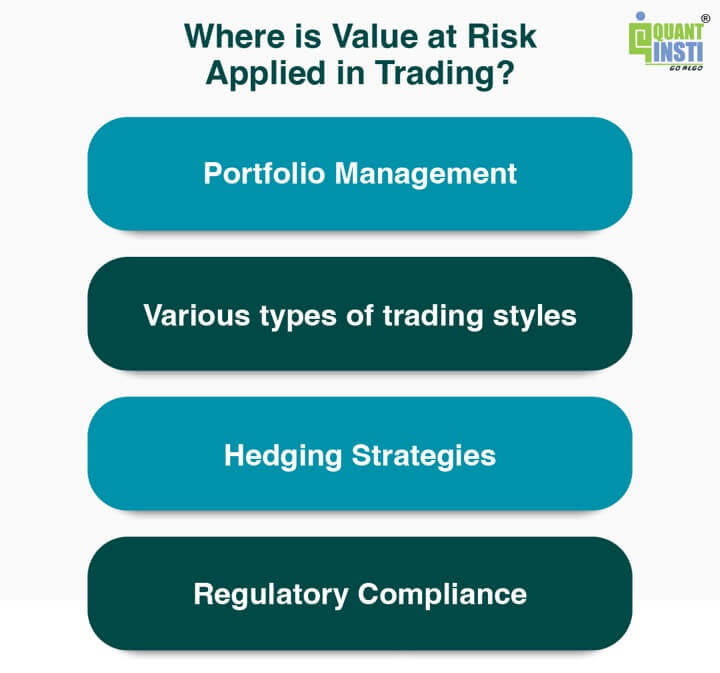
Below are the various types of trading styles where Value at Risk is applied.
Value at Risk (VaR) is a statistical measure used to quantify the potential loss on a financial asset or portfolio over a specified time period and with a certain level of confidence. There are different methods for calculating Value at Risk, and the choice of method depends on the characteristics of the portfolio and the assumptions made.
Three common methods for calculating Value at Risk are:
You can check the detailed calculation part of the two most commonly used methods known as historical simulation and variance-covariance in the blog Value at Risk (VaR) calculation in excel and Python.
Briefly, below you can see how historical simulation and variance-covariance approaches are calculated.
Let’s start with the Variance-Covariance approach. The Variance-covariance is a parametric method which assumes that the returns are normally distributed.
In this method,
Please note that the above mentioned figures are based on a subjective assumption ⁽²⁾.
Moving on, the steps for Value at Risk calculation using the Historical simulation approach are as follows:
Let’s delve into the Value at Risk (VaR) and its role in risk management.
Imagine you’re steering a ship through a vast and unpredictable sea. Your goal is to navigate through waves and storms, ensuring that your vessel reaches its destination safely. In the financial world, that sea is the market, and Value at Risk is your compass, guiding you through the uncertainties.
Value at Risk is like a financial compass that helps institutions and investors gauge the potential loss they might face in their investment portfolios. It’s not a crystal ball predicting the future, but rather a tool that estimates the level of risk given current market conditions.
Let’s say you have a portfolio of stocks and bonds. Value at Risk allows you to put a number on the potential loss your portfolio might experience over a specified time period, let’s say one day or one week. This numerical value represents the downside risk within a certain confidence level, typically 95% or 99%. So, it’s like saying, “There’s a 95% chance that our losses won’t exceed this amount.”
Value at Risk is particularly handy when you’re managing a diverse portfolio. It helps you understand how different assets contribute to the overall risk. For instance, if you have a mix of stocks and bonds, Value at Risk lets you see which asset class has a higher potential for volatility and how they interact. This insight is crucial for optimising your portfolio, ensuring you’re not overly exposed to a particular type of risk.
In essence, Value at Risk is a valuable tool in the risk management toolkit. It doesn’t eliminate risk, but it gives you a sense of the waters you’re navigating and helps you make strategic decisions to sail through the financial seas with confidence.
Regulatory requirements often play a significant role in shaping risk management practices within the financial industry. Value at Risk (VaR) has historically been a key metric in regulatory frameworks, providing a quantitative measure of the potential downside risk of financial portfolios.
Here’s a brief overview of the relationship between regulatory requirements and VaR:
Now, let us find out the challenges which a trader might face while using Value at Risk and these are:
Here are some useful tips for overcoming the challenges mentioned above.

By incorporating these tips, traders can strengthen their risk management frameworks and navigate the challenges associated with using Value at Risk more effectively.
In summary, Value at Risk (VaR) is like a trustworthy guide helping traders navigate the uncertain seas of the market. It puts a number on possible losses in portfolios, giving a clear picture of risk with a certain confidence level. From managing portfolios to dealing with regulations, Value at Risk has many uses, making it a key player in understanding financial risk.
You can explore more about value at risk and other risk management methods with our course on Quantitative Portfolio Management. Recommended for portfolio managers and quants, this course is designed for those who wish to construct their portfolio quantitatively, generate returns and manage risks effectively. In this course, you will also learn different portfolio management techniques such as Factor Investing, Risk Parity and Kelly Portfolio, and Modern Portfolio Theory.
Originally posted on QuantInsti blog.
Information posted on IBKR Campus that is provided by third-parties does NOT constitute a recommendation that you should contract for the services of that third party. Third-party participants who contribute to IBKR Campus are independent of Interactive Brokers and Interactive Brokers does not make any representations or warranties concerning the services offered, their past or future performance, or the accuracy of the information provided by the third party. Past performance is no guarantee of future results.
This material is from QuantInsti and is being posted with its permission. The views expressed in this material are solely those of the author and/or QuantInsti and Interactive Brokers is not endorsing or recommending any investment or trading discussed in the material. This material is not and should not be construed as an offer to buy or sell any security. It should not be construed as research or investment advice or a recommendation to buy, sell or hold any security or commodity. This material does not and is not intended to take into account the particular financial conditions, investment objectives or requirements of individual customers. Before acting on this material, you should consider whether it is suitable for your particular circumstances and, as necessary, seek professional advice.
Options involve risk and are not suitable for all investors. For information on the uses and risks of options, you can obtain a copy of the Options Clearing Corporation risk disclosure document titled Characteristics and Risks of Standardized Options by going to the following link ibkr.com/occ. Multiple leg strategies, including spreads, will incur multiple transaction costs.
Futures are not suitable for all investors. The amount you may lose may be greater than your initial investment. Before trading futures, please read the CFTC Risk Disclosure. A copy and additional information are available at ibkr.com.
There is a substantial risk of loss in foreign exchange trading. The settlement date of foreign exchange trades can vary due to time zone differences and bank holidays. When trading across foreign exchange markets, this may necessitate borrowing funds to settle foreign exchange trades. The interest rate on borrowed funds must be considered when computing the cost of trades across multiple markets.












Join The Conversation
For specific platform feedback and suggestions, please submit it directly to our team using these instructions.
If you have an account-specific question or concern, please reach out to Client Services.
We encourage you to look through our FAQs before posting. Your question may already be covered!