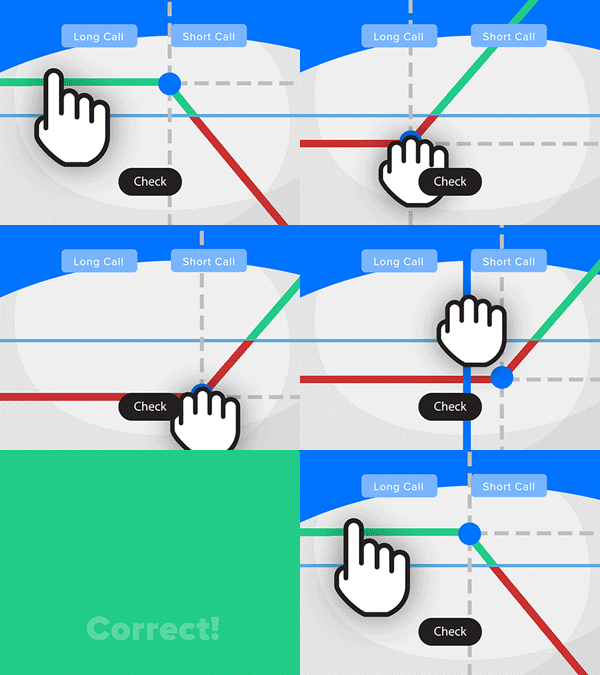
- Solve real problems with our hands-on interface
- Progress from basic puts and calls to advanced strategies
Interactive Options Course

Posted May 26, 2026 at 2:00 pm

The article “Understanding Bond Convexity and Interest Rate Sensitivity” was originally published on PyQuant News blog.
In the world of bond trading, knowing how bond prices and interest rates interact is vital. Bond convexity, a concept that measures the response of bond prices to interest rate changes, is a key tool for traders. This article explores bond convexity, its importance, and how it aids in making smart trading decisions.
Bond convexity is all about the curve in the bond prices and interest rates relationship. It shows how a bond’s duration shifts as interest rates move. While duration offers a straight-line prediction of price changes for a 1% interest rate change, convexity captures the curve, especially during bigger rate movements.
When interest rates go up, duration might suggest a straightforward price drop. However, bond convexity often indicates that the decline is less than expected, acting as a buffer against rate changes. Higher convexity implies that a bond’s price will climb more when interest rates fall and decrease less when they rise.
Convexity is mathematically defined as the second derivative of a bond’s price with respect to interest rates. While duration provides a linear perspective, convexity introduces a quadratic aspect for a more precise prediction. The convexity formula is:
[ \text{{Convexity}} = \frac{{1}}{{P}} \sum \left( \frac{{C_t}}{{(1 + y)^{{t+2}}}} \times t \times (t+1) \right) ]
This equation highlights how future cash flows, adjusted for present value and time, contribute to the bond’s convexity.
Understanding bond convexity is significant for several reasons:
Duration and convexity play distinct roles in bond analysis. Duration forecasts price changes for small rate shifts with a linear assumption, whereas convexity considers the curve, refining predictions. For example, a bond with a 5-year duration and 60 convexity might face a 5% price drop if rates rise by 1%, but convexity suggests a smaller decrease, demonstrating the bond’s resilience. Conversely, if rates drop, the price may rise more than 5%, highlighting the advantages of high convexity.
Factors like coupon rate, maturity, and yield affect a bond’s convexity. Bonds with longer maturities and lower coupons often show higher convexity. Zero-coupon bonds typically have higher convexity compared to similar maturity bonds with higher coupons.
Traders can leverage bond convexity in several ways:
Understanding bond convexity provides insights into how bond prices and interest rates interact. By enhancing duration analysis, convexity equips traders with tools for precise risk assessment and strategic decision-making. As interest rates remain a focal point in global finance, mastering bond convexity is vital for successful bond trading. From portfolio management to risk assessment, grasping the nuances of convexity can significantly influence trading outcomes.
Information posted on IBKR Campus that is provided by third-parties does NOT constitute a recommendation that you should contract for the services of that third party. Third-party participants who contribute to IBKR Campus are independent of Interactive Brokers and Interactive Brokers does not make any representations or warranties concerning the services offered, their past or future performance, or the accuracy of the information provided by the third party. Past performance is no guarantee of future results.
This material is from PyQuant News and is being posted with its permission. The views expressed in this material are solely those of the author and/or PyQuant News and Interactive Brokers is not endorsing or recommending any investment or trading discussed in the material. This material is not and should not be construed as an offer to buy or sell any security. It should not be construed as research or investment advice or a recommendation to buy, sell or hold any security or commodity. This material does not and is not intended to take into account the particular financial conditions, investment objectives or requirements of individual customers. Before acting on this material, you should consider whether it is suitable for your particular circumstances and, as necessary, seek professional advice.










Join The Conversation
For specific platform feedback and suggestions, please submit it directly to our team using these instructions.
If you have an account-specific question or concern, please reach out to Client Services.
We encourage you to look through our FAQs before posting. Your question may already be covered!