
- Solve real problems with our hands-on interface
- Progress from basic puts and calls to advanced strategies
Interactive Options Course
Posted November 12, 2025 at 11:18 am
The article “The Evolution Of Trading: Barter System To Algo Trading” was originally posted on QuantInsti blog.
Today the algorithmic trading system is quite popular amongst the traders, but how did it all start?
What is the background of trading practices?
Trading began with the barter system. In those good old ancient days, goods were traded for goods in return. Eventually, trading of goods was replaced by the currency system and then the exchanges came about which transformed into automated or electronic systems with time.
Let’s explore the journey of trading, starting from the barter system and progressing to modern-day trading. Later on, we’ll delve into the transformed regulatory and risk management practices, as well as the advantages and disadvantages they bring.
This blog covers:
Evolution of trading has gradually occurred from barter to algorithmic trading.
But how did this evolution of trading take place? Let’s find out!
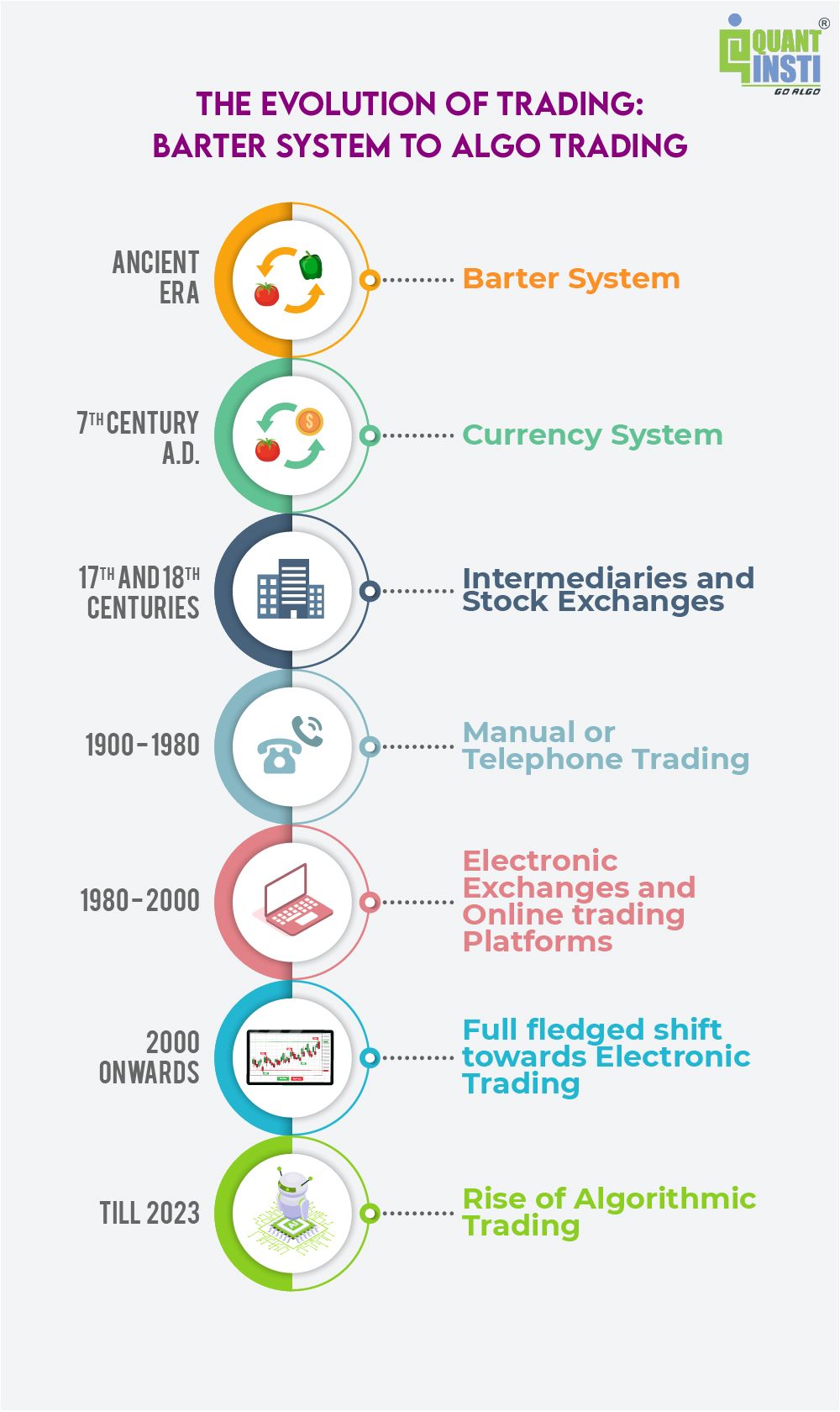
Let us now see each time frame in detail below.
In ancient times, people engaged in direct exchange or barter, where some goods and services were traded for other goods and services.

Barter system
The value of each item was determined by several factors such as the rarity, usefulness, or perceived value of the two items getting exchanged or bartered.
But, bartering involved mutual agreement between individuals and relied on the double coincidence of wants, making it inefficient and cumbersome.
As societies grew, the barter system became impractical because the exact value of two barter goods could not be ascertained. Hence, this led to the emergence of various forms of currencies. These currencies included items such as beads, metals, shells and eventually standardised coins and paper money.
This way, the introduction of currency made the trading system more efficient by providing a medium of exchange and a unit of account.

Currency system
Back in the 17th and 18th centuries, something exciting happened in the world of trading. Stock exchanges burst onto the scene, creating a happening hub for buying and selling company shares. These exchanges brought order to the chaos, introducing rules, dedicated trading floors, and brokers to keep things running smoothly.
As trade and commerce boomed, a new breed of financial intermediaries emerged: banks and merchants. These savvy folks made our lives easier by facilitating transactions, safeguarding our deposits, and even extending credit when needed.
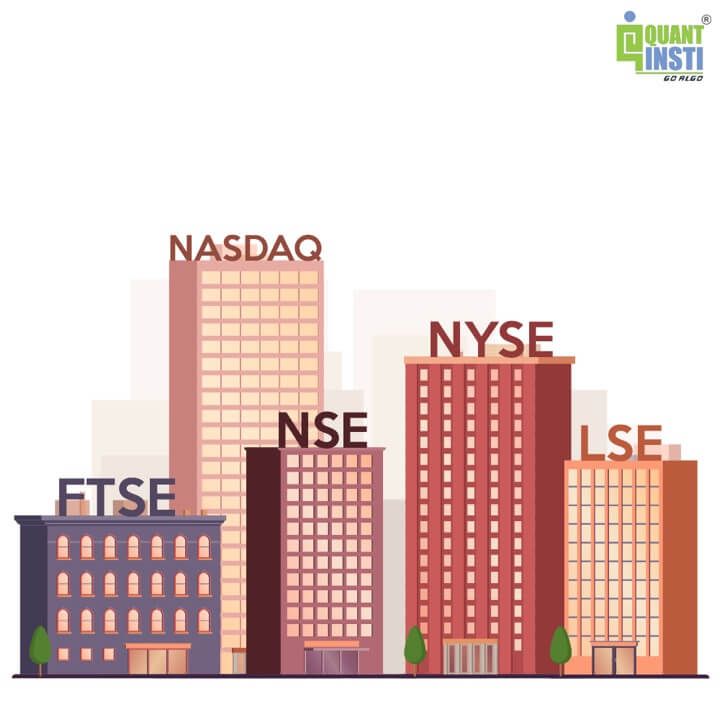
Intermediaries and stock exchanges
Back in the late 1900s, the invention and widespread adoption of telephone led to telephone trading. Suddenly, brokers and traders could connect with each other in real-time, regardless of the distance between them!
This meant traders could chat with their counterparts, seize trading opportunities, and gather market info faster than ever before. It was a game of speed and efficiency.
Telephone trading ushered in a new era, where traders could react swiftly to market events and conduct business effortlessly across long distances. It was a game-changer that made trading smoother and faster for everyone involved.

Manual or telephone trading

Source: Wikipedia Electronic exchanges
This was a huge turning point in the evolution of the trading domain.
Electronic exchanges and online trading platforms refer to online systems that facilitate the trading of financial instruments and assets electronically.
Between the 1980s and 1990s, the computerised order routing systems were adopted. These systems allowed traders to electronically send and execute orders, replacing manual methods.
The Electronic Communication Networks (ECNs) was introduced in the 1980s itself. ECNs facilitated the direct matching of buy and sell orders, bypassing traditional exchanges.
However, it is important to note that these systems were mostly limited to large institutional investors and were not widely accessible.
In 1990, Instinet became the first ECN to provide electronic trading services to institutional investors.
The growth of the internet in the 1990s led to the emergence of online trading platforms that provided individual investors with direct access to financial markets. Online brokerages like E*TRADE, Ameritrade, and Charles Schwab gained popularity, enabling retail investors to trade stocks, options, and other financial instruments from their own computers.
However, the introduction of Electronic Communication Networks (ECNs) in the 1980s paved the way for increased electronic trading.
It was only in the 1990s that the Electronic communication networks (ECNs) expanded and gained prominence, offering transparent and efficient electronic trading. ECNs like Island ECN and Archipelago gained traction, providing an alternative to traditional exchanges by matching buy and sell orders electronically.
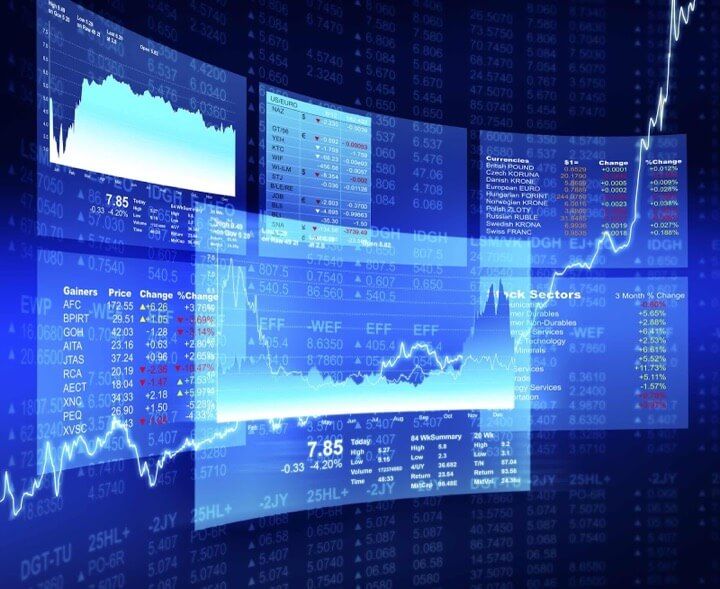
Electronic trading
The evolution of the trading domain took to new heights when the full fledged shift happened towards electronic trading.
It was only in the year 2000 that The New York Stock Exchange (NYSE) and other similar major exchanges underwent a significant shift towards electronic trading. The NYSE introduced the Hybrid Market Model in 2006, combining electronic order matching with traditional floor-based trading. Other exchanges, such as NASDAQ, transitioned to fully electronic trading platforms.
These electronic exchanges or platforms revolutionised the way financial markets operate, offering efficiency, speed, and accessibility to market participants.
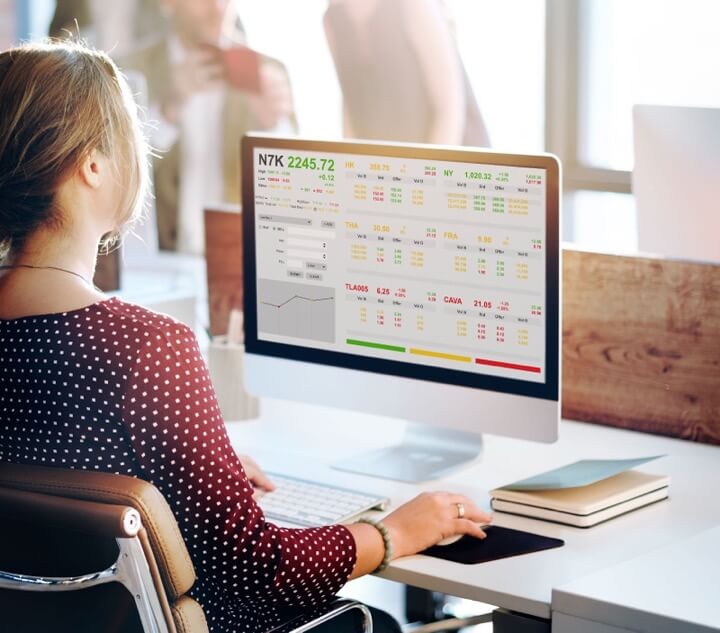
Rise of algo trading
Algorithmic trading, including Algorithmic trading online has experienced significant growth, leveraging technology and market data. Machine learning and artificial intelligence are playing an increasingly important role in developing advanced trading algorithms in 2023.
Regulatory focus continues to ensure a balance between innovation and market integrity.
Algorithmic trading’s rise has played a significant role in the evolution of trading.
Let us see below a brief overview of all the key advancements made so far between 2007 and 2023.
The evolution of trading has reached the point where AI can be used extensively from stock selection and market research to backtesting the strategy and trade execution.
ChatGPT is an AI language model that can help a trader with each of the steps while trading in the financial market.
Furthermore, ChatGPT with its capabilities in language processing , has the potential to assist and benefit the trading domain in several ways.
A trading domain powered by the dynamic duo of ChatGPT and algorithmic trading is like having a trading assistant right at your fingertips, ready to help you at every step.
But how exactly does ChatGPT revolutionise the trading landscape?
Let’s dive in!
Below, let us briefly go through all the ways ChatGPT is useful in algorithmic trading.
Note: Although ChatGPT is of tremendous help to the traders, it must always be used in conjunction with human expertise to receive the best results. The reason for not relying completely on ChatGPT is that the user can get misguided by the wrong information given by ChatGPT. After all, it is a machine and can not use human logic!
In today’s time, trading has evolved quite a lot. There are a lot of advancements and improvements as compared to the days of manual trading.
Let us discuss the most integral trading methods combined with algorithmic trading and automated trading that are prevalent today. These methods lead to more reliable and faster order executions and maximise the returns. These trading methods are:
High frequency trading or HFT and Medium Frequency Trading or MFT are the trading strategies that utilise advanced algorithms, powerful computing systems, and high-speed data connections to execute a large number of trades within extremely short timeframes. HFT and MFT firms aim to profit from small price discrepancies, often exploiting market inefficiencies that may exist for only brief moments.
The practice of quantitative trading is a part of algorithmic trading. Quantitative trading involves using mathematical models, statistical analysis, and quantitative techniques to make trading decisions. It focuses on the development and application of quantitative models and strategies based on market data analysis.
Quantitative traders rely only on data-driven insights and historical patterns to identify trading opportunities and determine the optimal entry and exit points for trades.
Artificial Intelligence and Machine Learning techniques are increasingly employed in trading for tasks like market analysis, prediction, and risk management. These techniques can analyse vast amounts of historical and real-time market data to identify patterns, generate trading signals, and improve decision-making processes.
AI in trading enhances these processes by continuously adapting to changing market conditions, refining trading strategies over time. With the ability to process large datasets quickly, AI-driven models help traders make more informed decisions, optimize trade execution, and manage risks more effectively, giving them a competitive edge in fast-paced markets.
In the trading world today, the combination of big data and cloud computing plays a huge role. Both are two interconnected concepts that have transformed the way traders handle and process large volumes of data.
Big data refers to extremely large and complex data sets that cannot be easily managed, processed, or analysed using traditional data processing techniques. Big data is useful because the more historical data for analysis, the more the accuracy of prediction!
Cloud computing involves the delivery of computing resources, such as servers, storage, databases, software, and analytics, over the internet on a pay-as-you-go basis. It provides scalable and flexible access to computational power and storage without the need for on-premises infrastructure.
By combining big data and cloud computing, organisations store, process, analyse, and extract value from vast amounts of data more effectively and efficiently. Also, they leverage the scalability, cost-effectiveness, and advanced capabilities offered by cloud platforms to address the challenges associated with big data processing and analysis.
Along with the evolution of trading, the regulatory and risk management practices have also evolved quite a lot.
Trading today operates within a regulatory environment designed to ensure market integrity, fairness, and investor protection.
Ever since the trading practices are being driven by technology there has been a need for moulding the regulatory and risk management practices accordingly.
Regulators impose rules and regulations on trading activities for risk management, including measures to combat market manipulation, ensure transparency, and safeguard against systemic risks.
Following the global financial crisis of 2008, there has been a significant increase in regulations aimed at ensuring market stability and transparency. Regulatory bodies, such as the Securities and Exchange Commission (SEC) in the United States and the Financial Conduct Authority (FCA) in the United Kingdom have implemented stricter rules to govern trading activities.
Moreover, the regulators and trading firms have embraced technological advancements to enhance risk management practices. This includes the use of advanced analytics, machine learning, and artificial intelligence to identify potential risks, detect anomalies, and automate compliance processes.
The evolution of trading practices, driven by technological advancements and innovation, have brought numerous benefits to the financial markets.
Simultaneously, there are some cons that the traders must be aware of. It is important to ensure that the online trading platforms are regulated to maintain market integrity, fairness, and investor protection.
Let us discuss some pros and cons of the evolved trading practice below:
| Pros | Cons |
| Automation, algorithmic trading, and electronic platforms have reduced manual processes, minimised human errors, and increased the speed of trade execution. | Sophisticated trading algorithms and strategies may be difficult to understand if you do not have the required knowledge and the skills to do algorithmic trading. |
| Online trading platforms have made it easier for investors to participate in the financial markets, providing greater access to investment opportunities and fostering financial inclusion. | The dependency on automation has introduced the risk of technology failures and glitches that can disrupt trading operations. Hence, you must keep the system updated to avoid such glitches.Hence, quantitative models, statistical analysis, and machine learning algorithms should be employed to assess and manage risk effectively. |
| High-frequency trading (HFT) and market-making algorithms have contributed to improved market liquidity. | Evolved trading practices rely heavily on automation and algorithmic decision-making. This reduces human oversight in the trading process, which can lead to challenges in managing unforeseen events or black swan events. |
| Electronic exchanges, online trading platforms enable traders from different regions to participate in international markets seamlessly. This has increased investment horizons. | The absence of human judgement can also limit the ability to adapt to rapidly changing market conditions or assess qualitative factors that may impact trading decisions. |
It is essential to strike a balance between the benefits and risks of evolved trading practices. Effective regulation, monitoring, and risk management measures are necessary to mitigate the potential drawbacks and ensure the stability and fairness of the financial markets.
Bibliography
The evolution of trading practices have transformed the landscape of financial markets, bringing both advantages and challenges. These practices, driven by technological advancements and innovation, have increased efficiency, improved accessibility, enhanced market liquidity, and fostered global market integration.
Trading practices today also facilitate advanced risk management, promote transparency, and create opportunities for innovation.
To navigate these challenges, effective regulatory frameworks, monitoring, and risk management measures are crucial. Striking a balance between fostering innovation and maintaining market integrity is essential. Ongoing evaluation of evolved trading practices, continuous technological advancements, and a focus on investor protection are necessary to ensure the long-term sustainability of financial markets.
If you wish to find out more about algorithmic trading and you are a beginner, you can explore our learning track titled Algorithmic Trading for Beginners, which can be your first step to getting started with algorithmic trading and gaining essential skills required for different Quant trading desk roles.
Disclaimer: All data and information provided in this article are for informational purposes only. QuantInsti® makes no representations as to accuracy, completeness, correctness, suitability, or validity of any information in this article and will not be liable for any errors, omissions, or delays in this information or any losses, injuries, or damages arising from its display or use. All information is provided on an as-is basis.
Information posted on IBKR Campus that is provided by third-parties does NOT constitute a recommendation that you should contract for the services of that third party. Third-party participants who contribute to IBKR Campus are independent of Interactive Brokers and Interactive Brokers does not make any representations or warranties concerning the services offered, their past or future performance, or the accuracy of the information provided by the third party. Past performance is no guarantee of future results.
This material is from QuantInsti and is being posted with its permission. The views expressed in this material are solely those of the author and/or QuantInsti and Interactive Brokers is not endorsing or recommending any investment or trading discussed in the material. This material is not and should not be construed as an offer to buy or sell any security. It should not be construed as research or investment advice or a recommendation to buy, sell or hold any security or commodity. This material does not and is not intended to take into account the particular financial conditions, investment objectives or requirements of individual customers. Before acting on this material, you should consider whether it is suitable for your particular circumstances and, as necessary, seek professional advice.
Trading in digital assets, including cryptocurrencies, is especially risky and is only for individuals with a high risk tolerance and the financial ability to sustain losses. Eligibility to trade in digital asset products may vary based on jurisdiction.










Join The Conversation
For specific platform feedback and suggestions, please submit it directly to our team using these instructions.
If you have an account-specific question or concern, please reach out to Client Services.
We encourage you to look through our FAQs before posting. Your question may already be covered!