
- Solve real problems with our hands-on interface
- Progress from basic puts and calls to advanced strategies
Interactive Options Course

Posted December 1, 2025 at 11:20 am
The article “Rhino Strategy Family: From Broken-Wing Butterfly to Genetic Optimization” was originally posted on Deltaray blog
The Rhino Options Strategy is a conservative, broken‑wing butterfly income trade with an upside hedge. Rhino is not just a simple trade; it’s a whole family of related strategies that have evolved over nearly a decade in response to changing market conditions.
Monthly, Giant, and Baby Rhino variants coexist alongside variants from other developers like the White Rhino by Randy Schwartzenburg. Several modern income trades share similar DNA: Amy Meissner’s A14, the BWB‑Cal trades from Ron Bertino, and more recent public trades such as Time Flies Spread and Flyagonal.
They all blend a put‑side income structure with a calendar or diagonal hedge. Whether they were directly inspired by the Rhino or evolved in parallel, they live in the same design space.
In this article we will show how Rhino has evolved, share our personal experience with related strategies, and we use a Genetic Algorithm to provide a variant that works well in recent market conditions.
This will be a long one, settle in like you accidentally picked the director’s cut.
TL;DR: Performance at a glance
The Rhino Options Strategy was developed by Brian Larson and published at Capital Discussions (now Aeromir) in 2015. After the initial publication, Bruno Voisin played a major role in the strategy development and has been steadily refining the trade ever since.
At its core, the trade combines:

Rhino Shape
The risk graph resembles a Rhino’s head: the BWB and the upside hedge form two horns, with a broad, relatively flat T+0 between them.
Trade characteristics:
The Rhino family directly shaped MesoSim’s approach to leg selection and adjustments, therefore it is it is well-suited to showcase MesoSim’s capabilities.
Most Rhino variants are discretionary to some degree. In such setups, the delta limits, scaling decisions, and hedge choices are guidelines, rather than a strict algorithm.
These are often choices of the developer. To quote Bruno:
“I would never use specific mechanical rules, simple or sophisticated, and instead chose meta parameters in the form of risk management ratios combining margin and Greeks.”
While we respect Bruno’s opinion, we believe that clear rules are essential for trading, at least when it comes to strategies we trade. This disparity is common in the trading world: traders are frequently opinionated and there is no single “correct” way to trade.
When recreating these trades in MesoSim, we aimed to:
To keep things honest, we share backtests based on the rules available at the time of development.
The Rhino’s evolution is a case study in that principle.
If you are interested in the detailed evolution of the Rhino strategy, please click the Rhino Development History below. It contains a summary from all the presentations from Brian and Bruno, highlighting the key changes over time. We included the presentation links for reference.
2014-2017: Early Rhino
The early Rhino, as documented in the Original Video and Bruno’s 2016 and 2017 deck, is a fixed‑distance RUT BWB with clear delta triggers and a profit target ladder.
Core features:
The trade assumes a fairly “normal” volatility regime. Fixed strikes and ATM entries mean:
2017–2019: from trade to trade family
By 2017–2018, Bruno emphasized that the real Rhino is less a single trade and more a family of BWBs run as a capital‑allocation process.
Two ideas arrive here:
1. Trade phases
From the 2018 decks (deck 1, deck 2, deck 3 and deck 4):
Each capital reallocation step (scale‑in, peel‑off, roll) is a chance to rebalance delta and gamma, with delta triggers becoming a “measure of last resort” rather than the primary decision driver.
2. Horizontal layering & the Rhino family
The 2019 Rhino Strategy formalises three related trades:
Overlapping these cycles at different expirations introduces horizontal layering — smoothing P&L and turning the Rhino into a small BWB portfolio rather than a single isolated position.
Delta triggers also get sharpened:
2020-2022: Volatility-adaptive structures
The Evolving Rhino presentation emphesizes that the ruling principle of the trade:
“A flattish Delta over the largest possible range.”
Everything else — entry, wings, hedges, capital — is adjusted to serve that principle in a volatile, post‑2018 market.
Key changes from that presentation and the 2022 high‑vol update:
1. OTM entries & larger wings in high vol
“Major Changes (1)” section introduces simple rules of thumb for SPX:
The PDS (debit) wing is weaker on an OTM Rhino, but the trade gains robustness in volatile markets and is less sensitive to “vol pops.”
2. Phase‑based capital management
3. Risk metrics: MtE & VaR
Rather than managing only by per‑trade delta, Bruno introduces:
Delta triggers remain, but capital and margin become the primary risk knobs.
4. Hedging style
5. Profit expectations
In this high‑vol, conservative variant Bruno explicitly sets:
The modern conservative Rhino is therefore:
2023: Flexibility to adapt to lower vol & 0DTE effects
The 2023 “An Overdue Rhino Update” revisits the strategy in the context of today’s market: lower headline volatility but heavy 0-DTE activity, Interest Rate changes and fast‑flipping regimes.
Key messages:
1. Environment: lower vol is not automatically safer
The takeaway: “Lower volatility = higher risk” for a slow income trade that sells options across weeks, because short‑dated order flow can whip prices through your tent.
2. Market reading: a “delta‑neutral” trade is not market‑neutral
Bruno doubles down on basic market reading:
3. What has changed: more flexibility
The “What has changed” slide highlights flexibility and tool choice in lower‑vol conditions:
In other words, the modern Rhino toolkit is broader: calendars, diagonals, split‑strike BWBs, balanced flies all live under the same philosophy.
Many variants – public and proprietary – of the Rhino trade exist as MesoSim Strategy Definitions, and we can’t cover them all here. We will try to capture the final version presented by Bruno in 2023, with some adjustments to match our personal beliefs and preferences.
There are, however, some aspects we have adjusted to match our personal beliefs and preferences:
We used ChatGPT for Strategy Development:
The resulting Strategy Definition can be summarized as follows:
Underlying: SPX
Tenors: front month around ~77 DTE (window 56–84), back month ~107 DTE.
Core structure at entry (5 legs):
| Parameter | VIX < 12.5 | 12.5 < VIX < 19.5 | VIX > 19.5 |
|---|---|---|---|
| BWB Upper Long OTM offset from ATM | 15 pts | 25 pts | 35 pts |
| BWB Upper Long – Shorts width | 75 pts | 100 pts | 125 pts |
| BWB Shorts – Lower Long width | 50 pts | 75 pts | 100 pts |
| Calendar Shorts Delta | 30 Δ | 30 Δ | 30 Δ |
| Calendar Longs Delta | 30 Δ | 30 Δ | 30 Δ |
Entry: Daily, 30 min before close, only on “very down day”: price < open < prior close. Concurrency allows up to 9 positions with 7-day entry spacing.
Adjustments: Daily, 30 min before close
Exit: Daily, 30 min before close; profit target = $500, stop loss = $2,500 (both constants scaled from $25k base); OR exit if front BWB DTE ≤ 14
Fills, fees, margin: At mid (no slippage), $1.50/contract, PM-like margin
Here are the Risk Graphs at various stages:
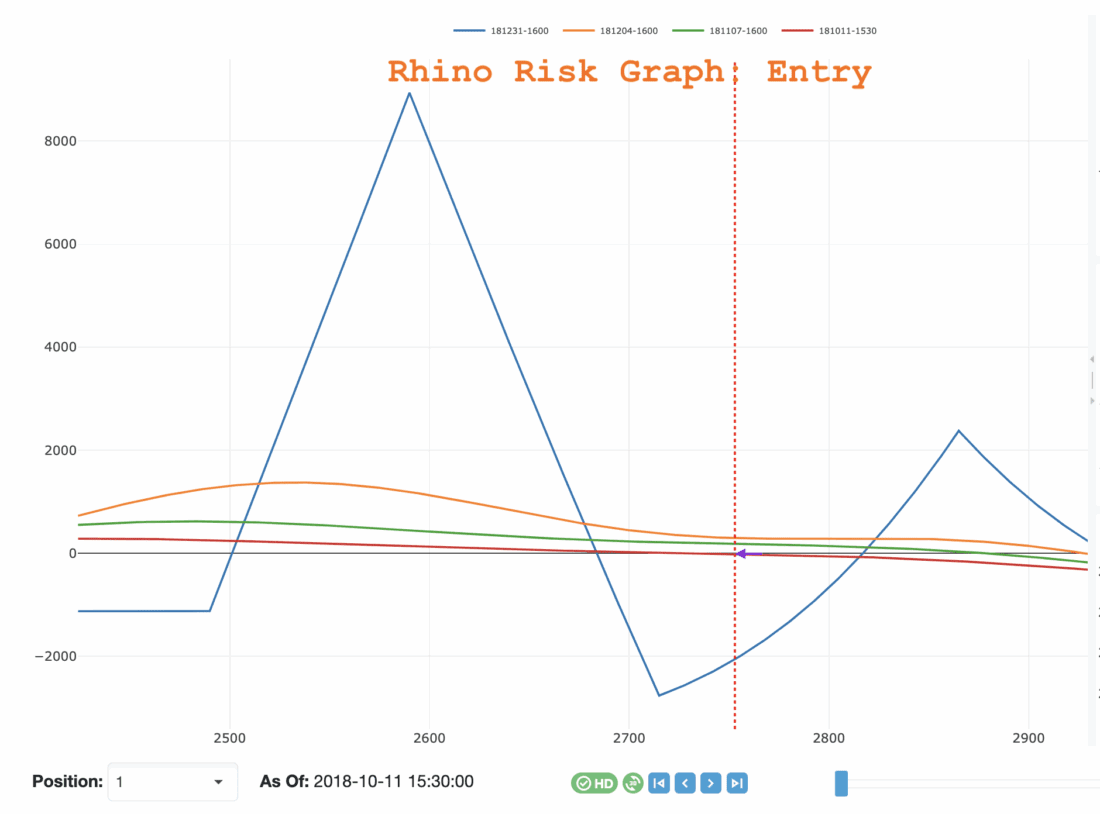
Source: MesoSim

Source: MesoSim
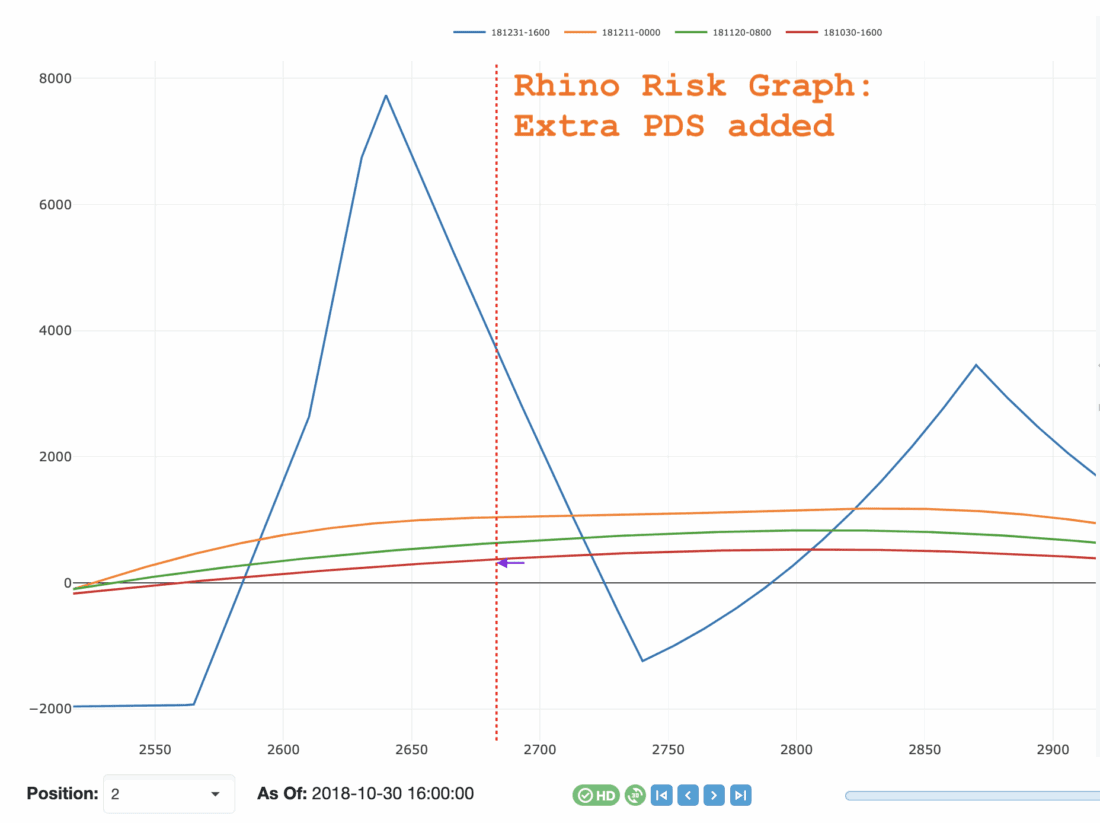
Source: MesoSim

Source: MesoSim
Source: MesoSim
Source: MesoSim
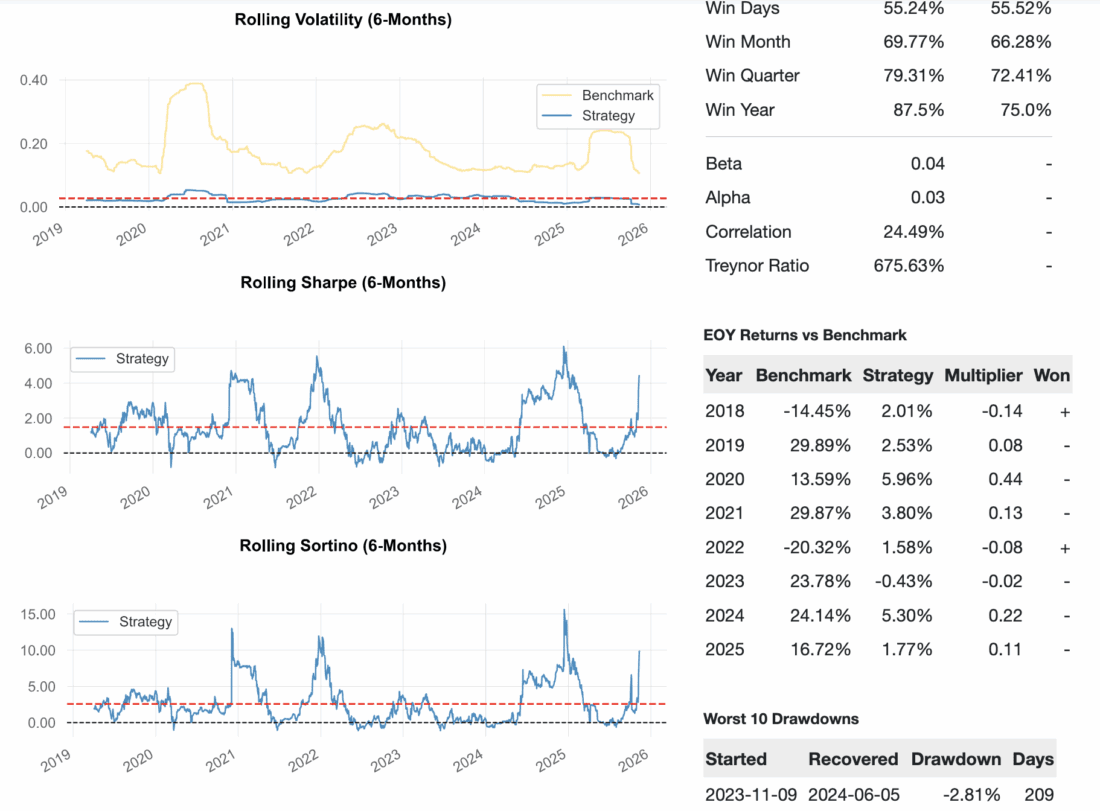
Source: MesoSim
Tip
The above implementation is a fairly complex Strategy Definition, with multiple adjustments (structures added dynamically), scaling rules, and risk checks. If you need help understanding the Strategy Definition elements you can paste the Strategy Definition to the MesoSim AI agent and ask for explanations. You can start here: Explain the Rhino Strategy Definition
A little detour to mention related trades we have first-hand experience with: A14 and BWB-Cal.
Because the A14 and BWB‑CD are proprietary trades, we won’t publish their MesoSim strategy definitions. We can provide them on request where the requester’s eligibility (e.g. active membership in the relevant service) can be verified.
The A14 Trade was developed by Amy Meissner and can be obtained (for a fee) from Aeromir. We got to know A14 before the Rhino and it influenced how MesoSim adjustments were designed.
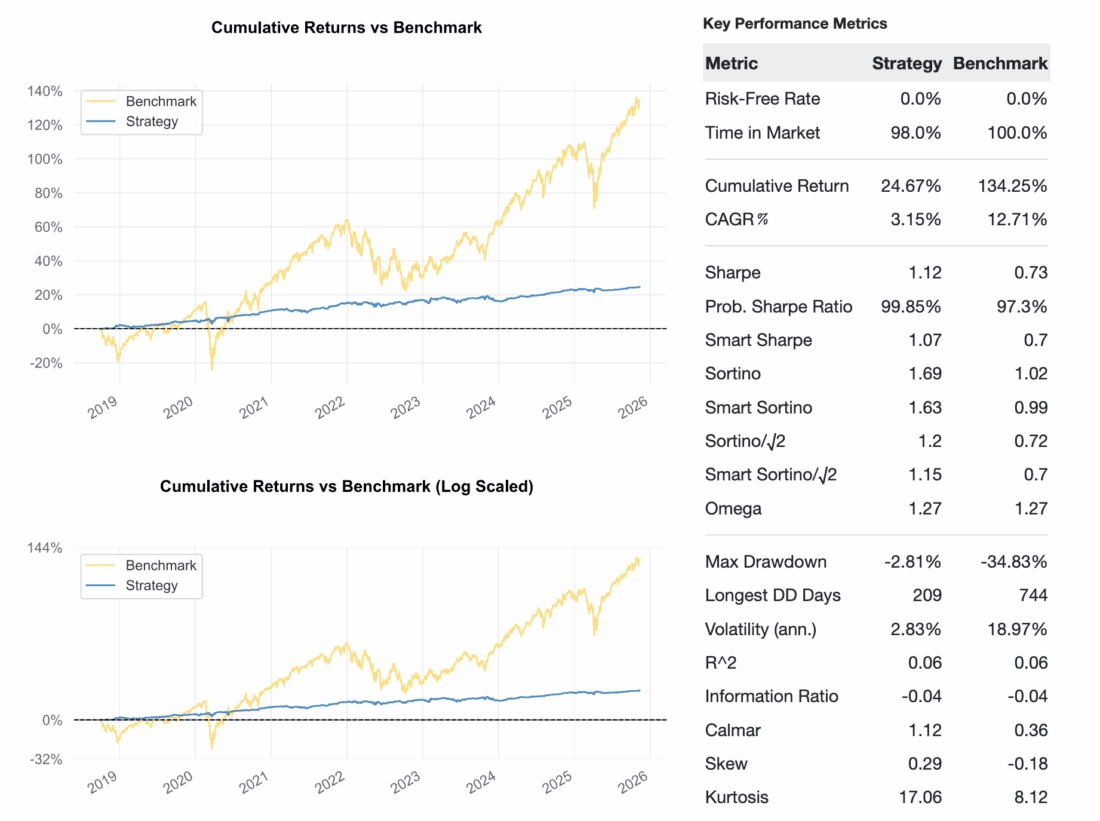
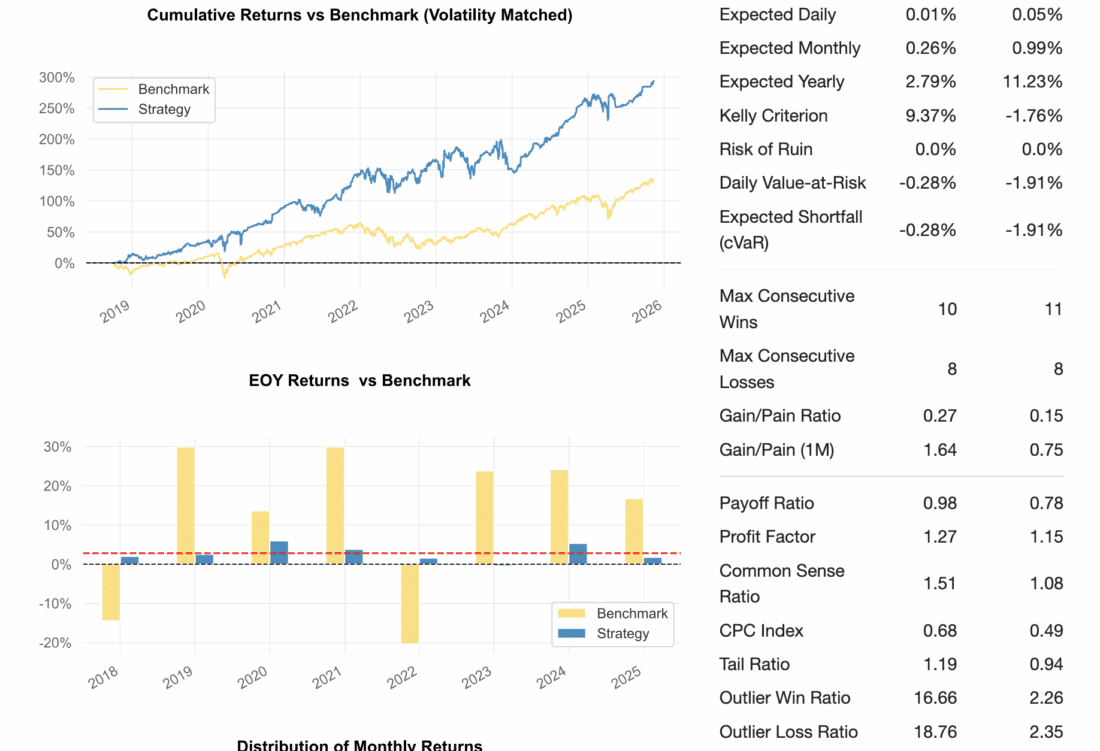
Our live trading experience showed that the volatility of the strategy is beyond our comfort zone and we stopped trading it after a few cycles.

Source: MesoSim

Source: MesoSim
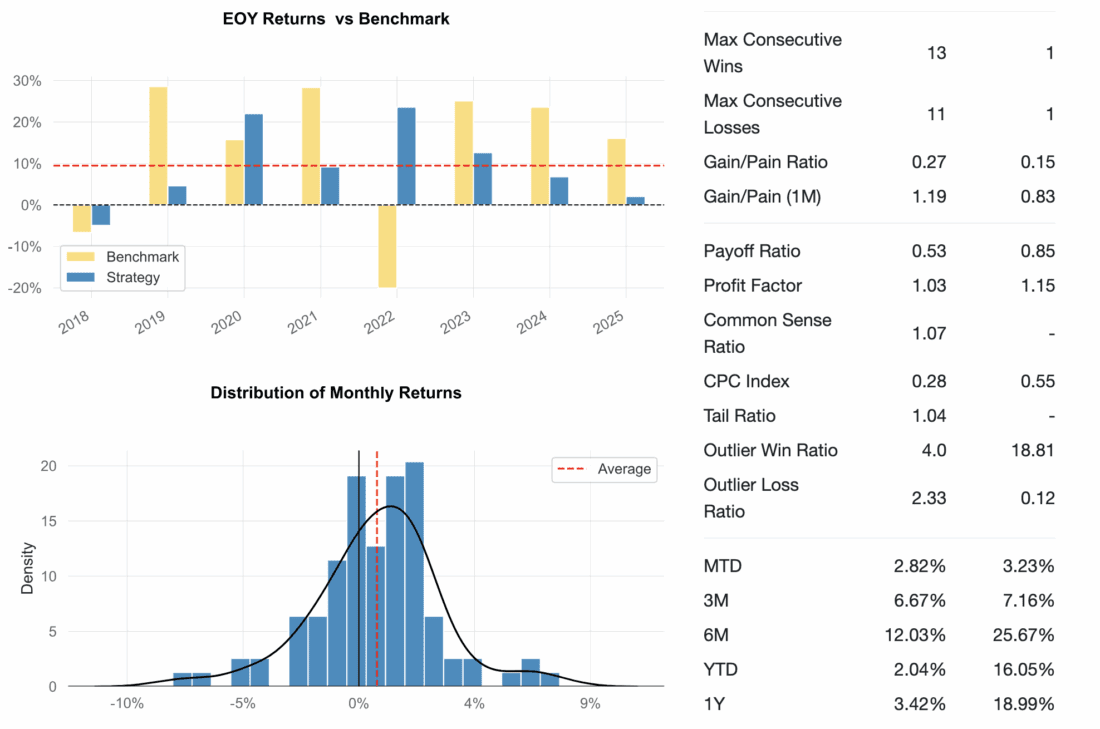
Source: MesoSim
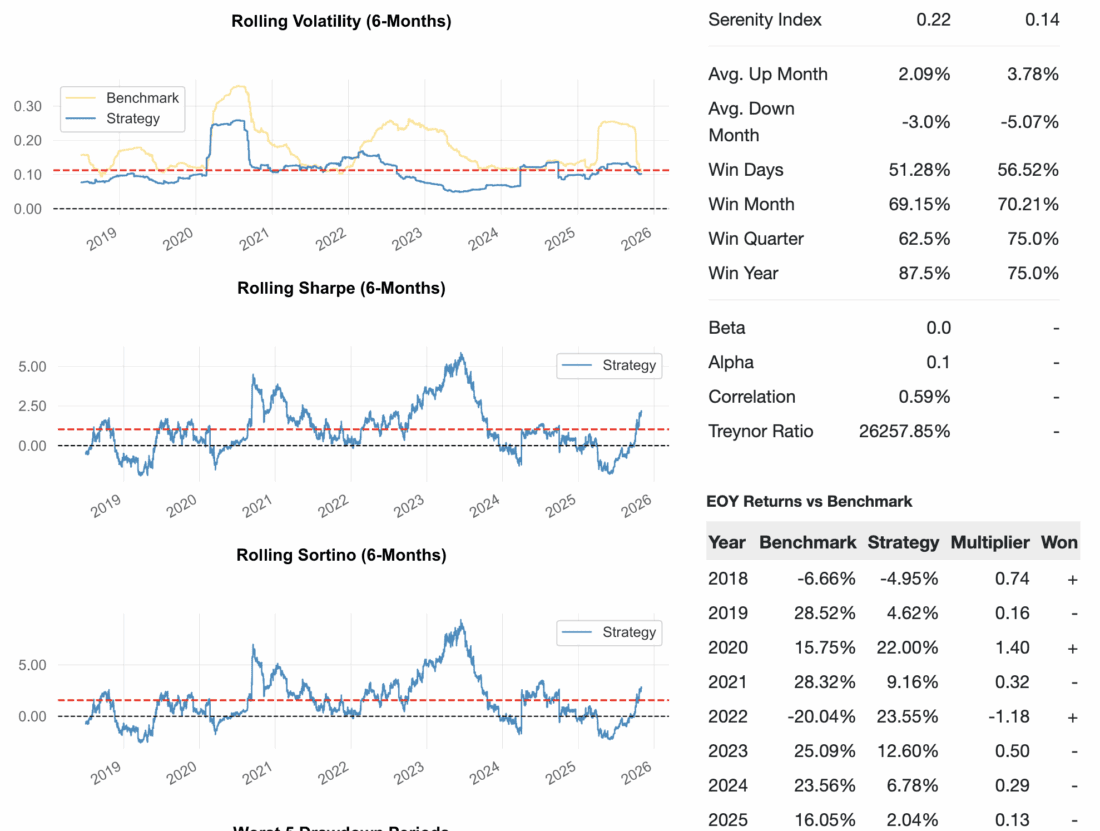
Source: MesoSim
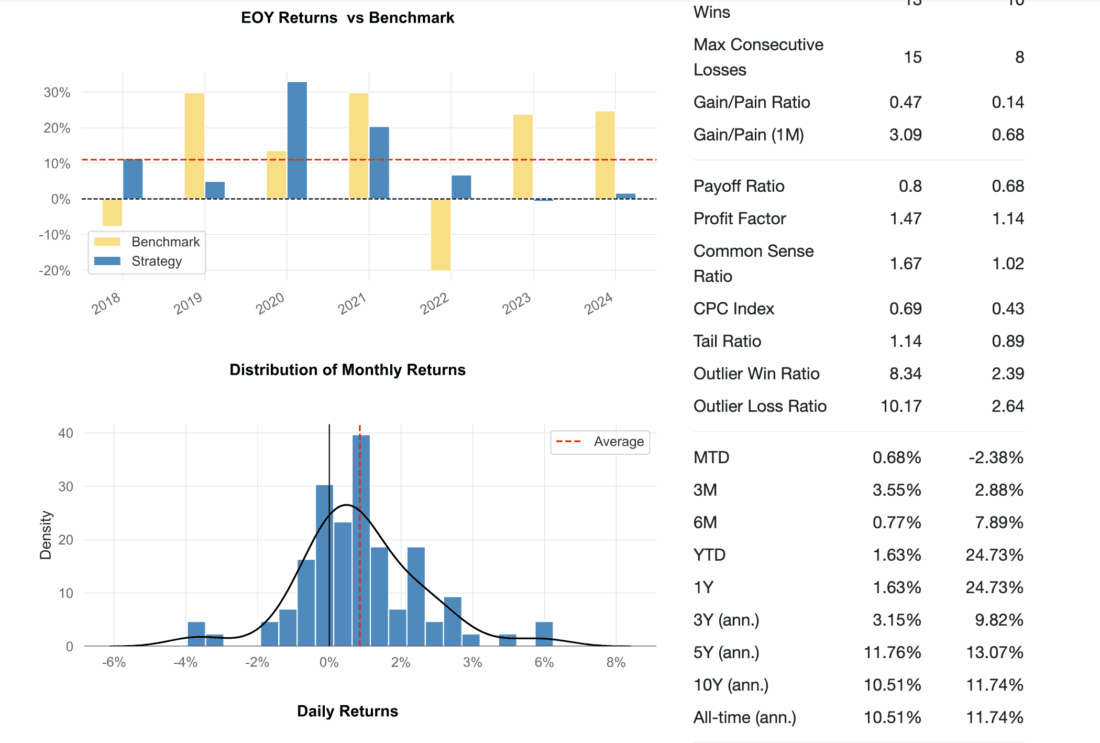
The BWB-Cal trade was developed by Ron Bertino from Trading Dominion and the trade plan is available in the MasterMind service. This strategy uses longer-dated tenors and does not contain any adjustments. The strategy we traded had additional hedges (2LPs in a third expiration cycle), which were added to mitigate the drawdowns observed during COVID.

Source: MesoSim

Source: MesoSim
Source: MesoSim

Source: MesoSim
We traded this strategy live between 2022. June and 2023. March. The 2022 performance was convincing but the 2023 performance wiped the previous year’s profits. Other MasterMind members at the time achieved similar live-trading performance. To quote Brad: “IV up and Skew up. Double whammy”
The two years of sideways performance confirm that it was the right choice to stop this trade. We attribute the lack of performance to changes in the market dynamics, similarly as we saw it with the NetZero Trade.
We believe that optimization and re-optimization is an essential part of every trade lifecycle and, as researchers, our goal is to come up with better performing variant. When it comes to optimization – manual or automated – overfitting is always a risk, but we believe that with proper precautions it can be mitigated. We will use a Genetic Algorithm to find a good-enough solution in a reasonable time-frame. As the name of this section implies: we suggest redoing this optimization at least quarterly.
The original Rhino is a fairly dynamic trade: structures (BWB, PDS, Calendars) are added and removed. This dynamism comes with costs:
Therefore, we apply the following simplifications of the trade before optimizing:
Taking the above into consideration we’re tasked with obtaining the optimal settings for the trade. Our decision space is defined as follows:
| Numerical Parameter | Minimum | Maximum | Step |
|---|---|---|---|
| expiration_front_dte | 7 | 100 | 4 |
| expiration_front_to_back_distance | 7 | 30 | 1 |
| max_days_in_trade | 1 | expiration_front_dte | 2 |
| lower_long_delta | 3 | 10 | 1 |
| short_put_delta | lower_long_delta | 30 | 1 |
| upper_long_delta | short_put_delta | 50 | 1 |
| short_cal_delta | 15 | 50 | 1 |
| delta_adj_threshold_lower (a1) | 5 | 20 | 5 |
| delta_adj_threshold_upper (a2) | -5 | -20 | -5 |
| delta_cutoff | max(a1, a2) + 5 | max(a1, a2) + 15 | 1 |
| Categorical Parameter | Values |
|---|---|
| adjustment_leg_name_lower | short_put / lower_long_put / upper_long_put |
| adjustment_leg_name_upper | short_call / long_call |
| lower_cutoff_leg_name | short_put / lower_long_put / upper_long_put |
| upper_cutoff_leg_name | short_call / long_call |
The dumbest (and most thorough) approach is to simply brute-force the expirations, deltas, adjustment thresholds and exit rules. Even with the simplified setup, the total number of combinations are enormous:
648 × 24 × 6440 × 36 × 4 × 4 × 11 × 3 × 2 × 3 × 2 = 22,844,927,508,480 combinations.
We can’t tackle this using brute-force, but we can use Genetic Algorithms to find a good-enough solution in a reasonable time-frame.
MesoMiner is our latest addition to the FundPro offering which is built to tackle exactly this type of problem:
MesoMiner was inspired by Google’s AlphaEvolve and blends AI models with evolutionary algorithms to efficiently explore large decision spaces.
As with any optimization (and trade development) process, there is a risk of overfitting. We mitigate this risk by:
You can read more about the IS / OOS split and DSR below.
While doing the IS / OOS split, we take the approach of optimizing in the most recent period (2022-2025) and validating in the older period (2018-2022). Both periods contain market turmoils (e.g. 2020 Covid crash, 2024 VolZilla), sideways and trending markets.
Researchers often set the OOS period is to the most recent period, but our experience is that the benefits of having a recently optimized strategy outweight the drawbacks. Using the older data in the OOS period results in a trade optimized (IS) for the most recent period. It’s easy to see that an optimized trade performance will likely be better tomorrow, than 1 or 10 years from now. Since there is no overlap between the two periods, the validation is valid either way.
Introduced by Marcos López de Prado and David H. Bailey in The Deflated Sharpe Ratio: Correcting for Selection Bias, Backtest Overfitting and Non-Normality (2014), the Deflated Sharpe Ratio provides a principled way to account for optimization processes.
It adjusts a strategy’s Sharpe ratio for the two forces that typically inflate backtest results: selection bias from testing many configurations, and the non-normal shape of real-world returns.
The key idea is that when a researcher runs a large number of trials, the best-performing Sharpe ratio is almost always upwardly biased. The DSR corrects this by replacing the usual zero-Sharpe benchmark with the expected maximum Sharpe produced purely by chance, a value derived from the distribution of Sharpe ratios across all trials
The Deflated Sharpe Ratio (DSR) is a metric similar to Sharpe, whereas the DSR Probability is the final output of the DSR computation: the probability that the strategy’s Sharpe ratio is truly positive after accounting for multiple trials and the skew and kurtosis of the actual return series.
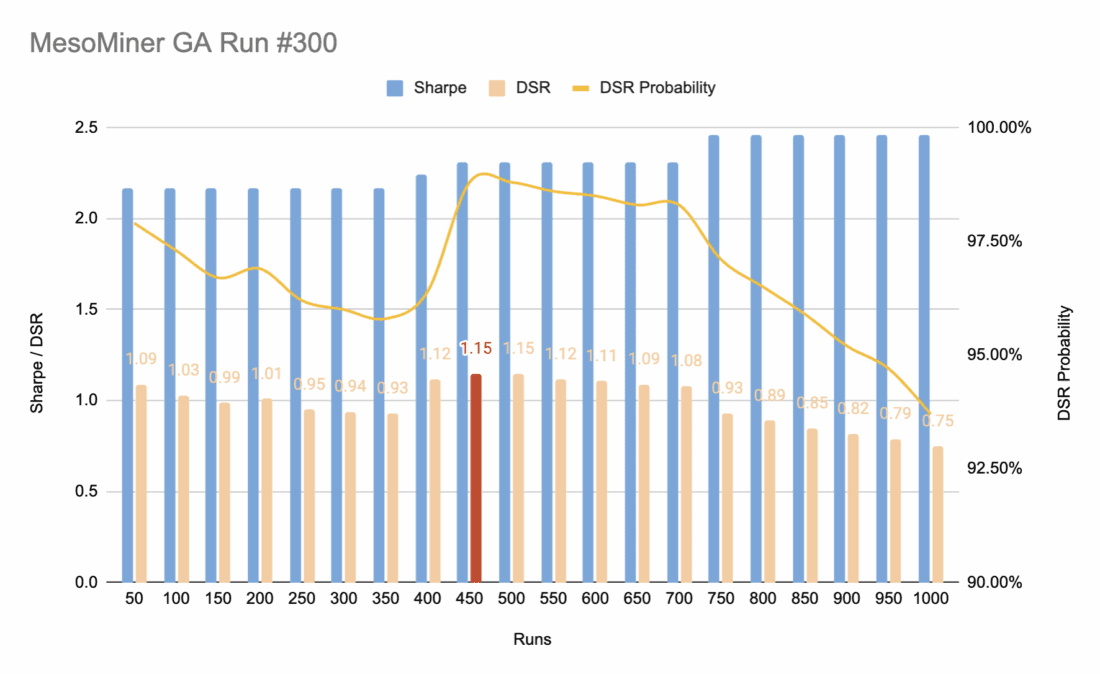
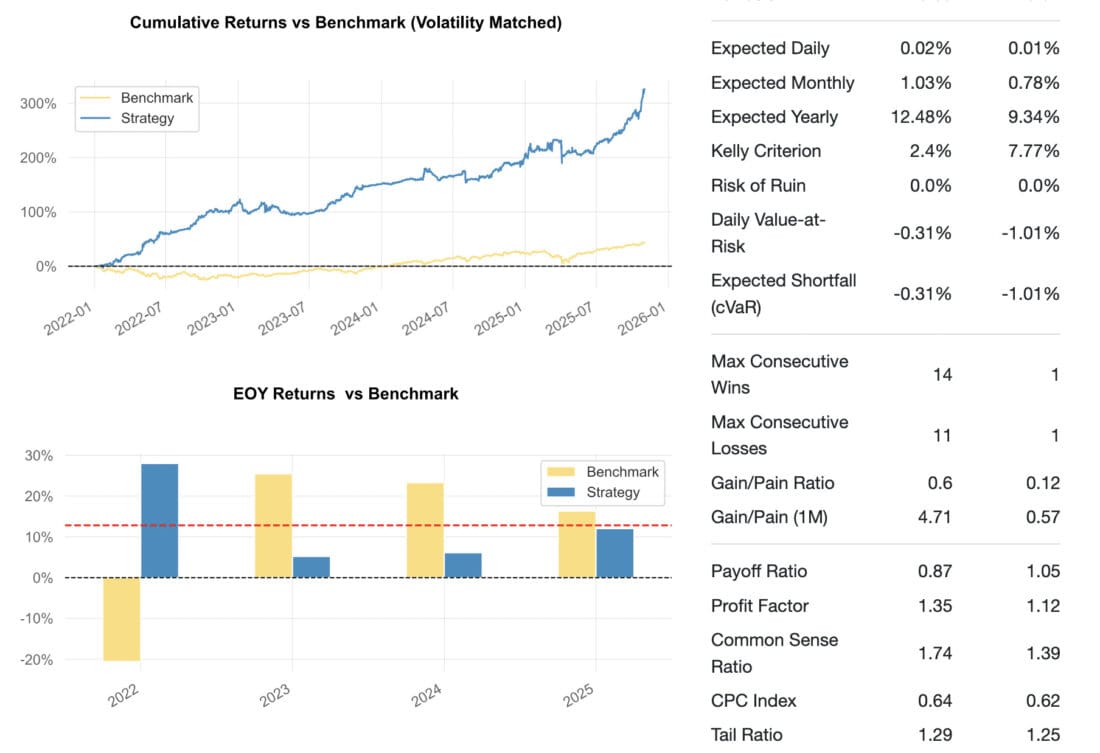
MesoMiner was run with a population size of 50 for 20 generations on the In-Sample period 2022-01-01 to 2025-11-11. The best results (in terms of Sharpe) is reported, whenever a population reaches new highs. We accept the fact that the Sharpe ratio will be optimistically biased / inflated. As the trials grow, the Deflated Sharpe Ratio decreases until a new “best result” is found.
Source: MesoSim
| Runs | Best Run In Population | CAGR | MaxDD | Sharpe | DSR | DSR Probability |
|---|---|---|---|---|---|---|
| 50 | 780b6ad8-… | 12.2% | -4.2% | 2.17 | 1.09 | 97.9% |
| 400 | da8721df-… | 10.1% | -5.2% | 2.24 | 1.12 | 96.4% |
| 450 | 7fb14ac4-… | 13.1% | -4.2% | 2.31 | 1.15 | 98.8% |
| 750 | bbb95eb2-… | 12.5% | -4.4% | 2.46 | 0.93 | 97.1% |
Source: MesoSim
Source: MesoSim
Source: MesoSim
Source: MesoSim
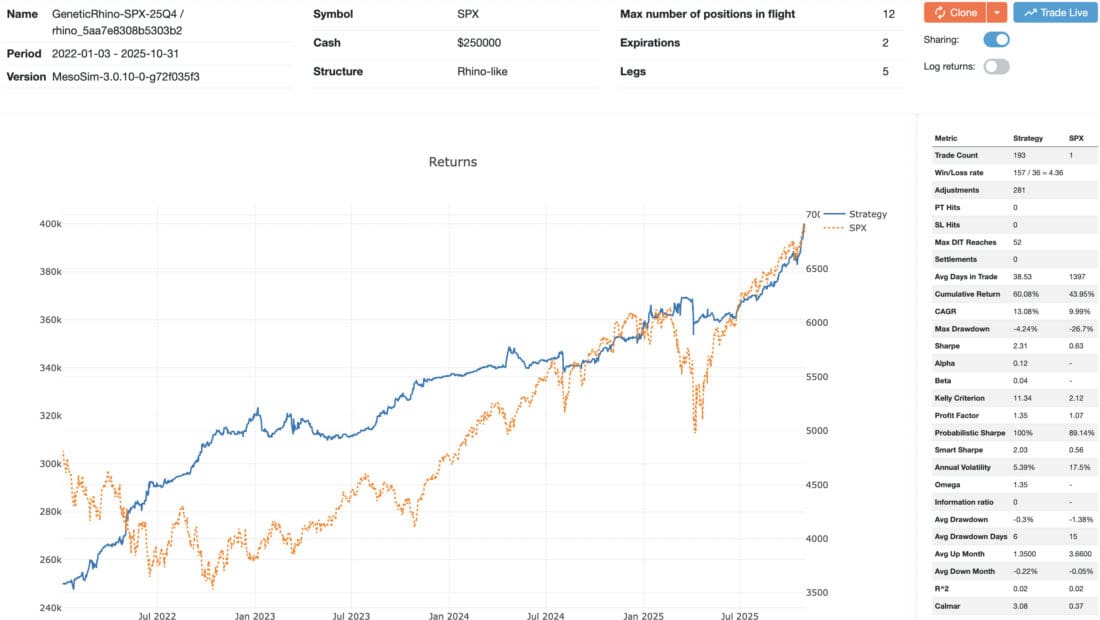
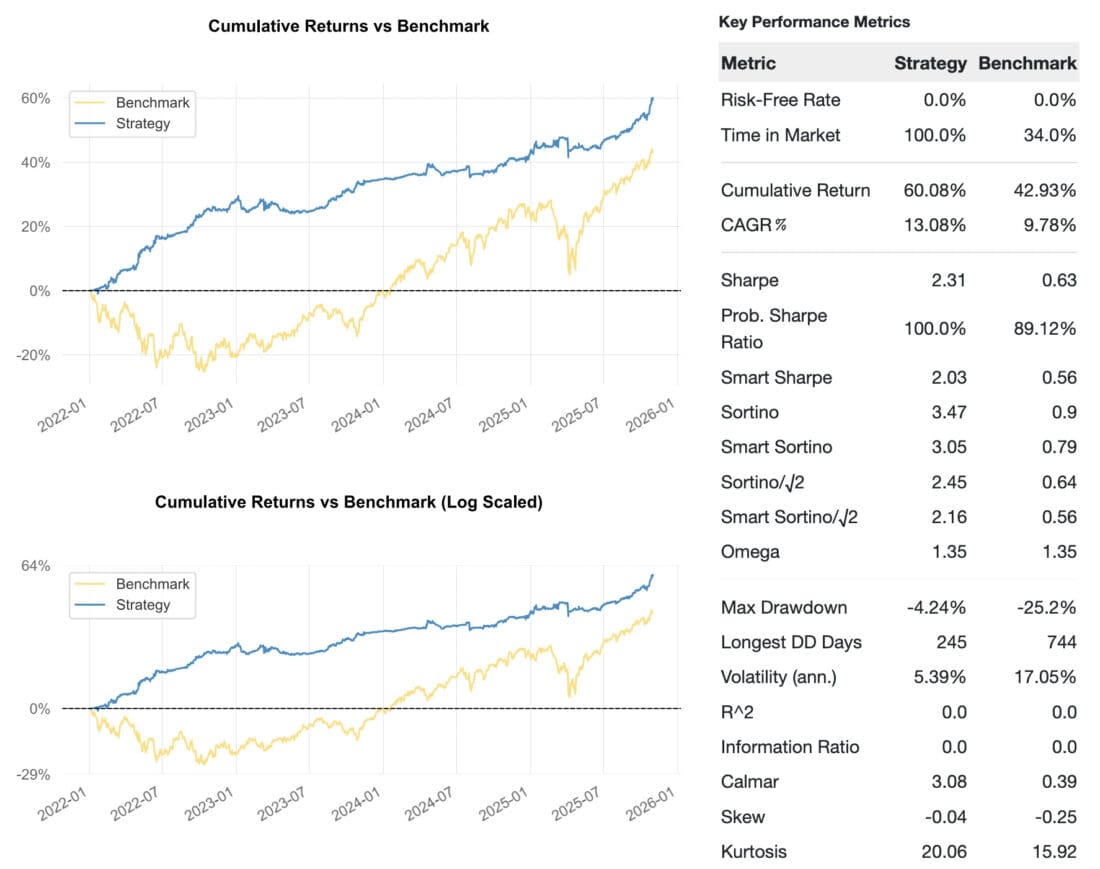
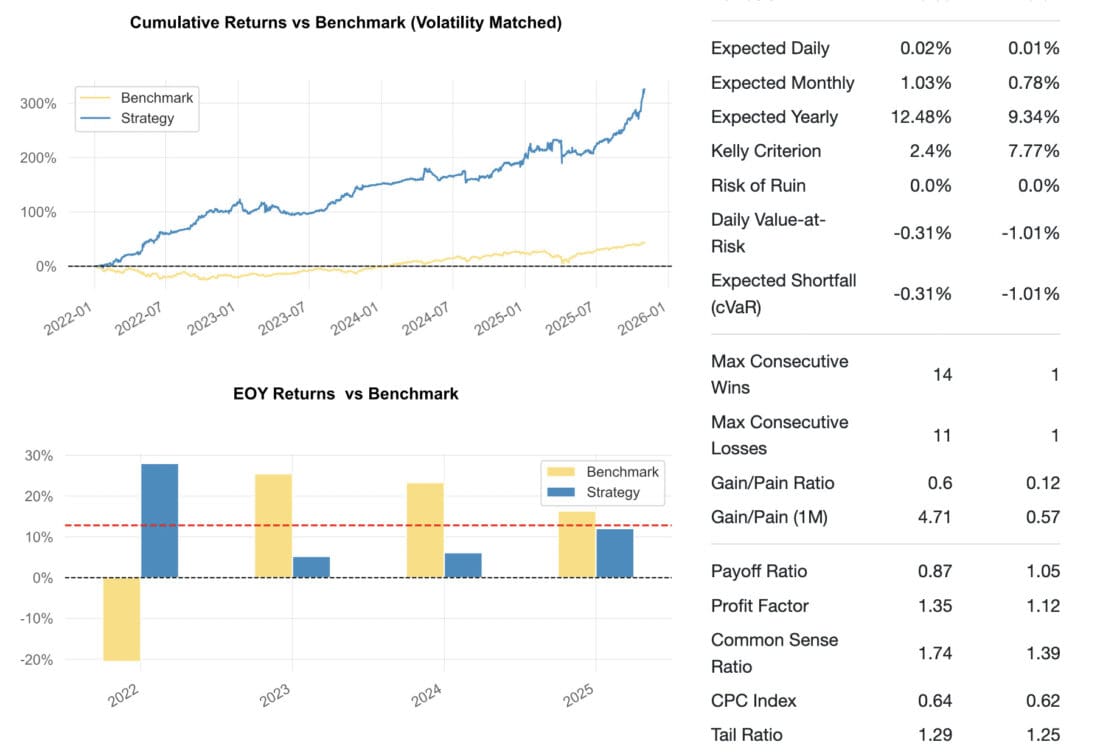
Besides monitoring the DSR we also track the DSR Probability and aims to pick runs where there is high confidence that the Sharpe is truly positive: cutoff at 95%. Considering the DSR and DSR Probability we pick the best run at the 450 runs mark and we validate this using the withheld, 2018 – 2022 period.
| Period | Run | CAGR | MaxDD | Sharpe |
|---|---|---|---|---|
| IS | 7fb14ac4-… | 13.1% | -4.2% | 2.31 |
| OOS | 07763433-… | 9.21% | -6.74% | 2.2 |
The Out-of-Sample results confirm that the optimized trade performs well on unseen data, with a Sharpe ratio similar to the In-Sample period. Our expectation is that the trade will perform well in the near future, but re-optimization will be needed as market conditions change.
You can study the Strategy Definition in the MesoSim Portal or you can use MesoSim AI Agent.
Here is a brief summary of the optimized trade plan:
Underlying: SPX.
Expirations:
Structure:
Entry: Daily, 30 min after open. Up to 12 simultaneous positions, with 6-day entry staggering → campaign deployment to smooth path risk. No gating conditions.
Adjustments: Daily, 60 min after close. Delta guardrails with surgical rolls:
pos_delta > 5: move upper_long_put (front-month wing) to a new strike as such that the position delta becomes 0.pos_delta < −5: move short_call similarly, re-setting position delta to 0 by shifting the short call’s strike.Exit: Daily, 30 min before close. Max Days in Trade: 53. Hard exit conditions (any hit → close):
abs(pos_delta) > 16Do you have other ideas or suggestions?
Please leave a comment below!
Rhino is a family of related broken‑wing butterfly income trades that have evolved over nearly a decade. The latest rules of the original trade (from 2023) still hold up in today’s market, providing reasonable performance.
We hope our GeneticRhino-SPX-25Q4 implementation will hold up and provide good performance for the next few months. We are sure, however, that re-optimization is an integral part of trade development process and the trade can benefit from it as market conditions are changing.
Both trade plans are readily available for live and paper trading in MesoLive and can be further customized in MesoSim.
Some of the historical variants shown later in this article have not performed well in the recent markets. That’s not a criticism of their original designers; it just illustrates what Bruno Voisin keeps repeating:
Adapt or die.
We would like to thank Bruno Voisin for his pioneering work on the Rhino trade and for making much of his material publicly available. His support throughout the development of this article has been invaluable.
We also thank Claudio Valerio and Rafael Munhoz for their feedback on the drafts of this article
Information posted on IBKR Campus that is provided by third-parties does NOT constitute a recommendation that you should contract for the services of that third party. Third-party participants who contribute to IBKR Campus are independent of Interactive Brokers and Interactive Brokers does not make any representations or warranties concerning the services offered, their past or future performance, or the accuracy of the information provided by the third party. Past performance is no guarantee of future results.
This material is from Deltaray and is being posted with its permission. The views expressed in this material are solely those of the author and/or Deltaray and Interactive Brokers is not endorsing or recommending any investment or trading discussed in the material. This material is not and should not be construed as an offer to buy or sell any security. It should not be construed as research or investment advice or a recommendation to buy, sell or hold any security or commodity. This material does not and is not intended to take into account the particular financial conditions, investment objectives or requirements of individual customers. Before acting on this material, you should consider whether it is suitable for your particular circumstances and, as necessary, seek professional advice.
Options involve risk and are not suitable for all investors. For information on the uses and risks of options, you can obtain a copy of the Options Clearing Corporation risk disclosure document titled Characteristics and Risks of Standardized Options by going to the following link ibkr.com/occ. Multiple leg strategies, including spreads, will incur multiple transaction costs.










Join The Conversation
For specific platform feedback and suggestions, please submit it directly to our team using these instructions.
If you have an account-specific question or concern, please reach out to Client Services.
We encourage you to look through our FAQs before posting. Your question may already be covered!