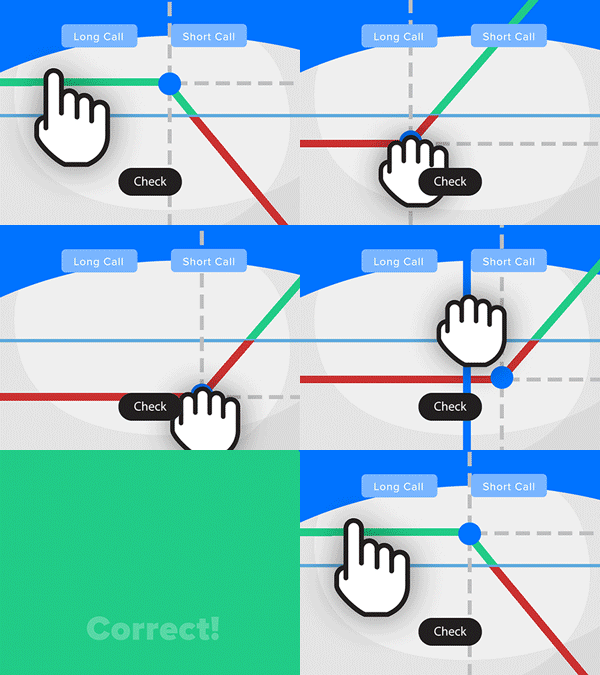
- Solve real problems with our hands-on interface
- Progress from basic puts and calls to advanced strategies
Interactive Options Course

Posted February 25, 2026 at 11:05 am
The article “Retail Investors and the Mispricing Puzzle” was originally published on Alpha Architect blog.
Institutional investors are frequently spoken of in the finance literature as “smart money” while retail investors are considered “noise traders” who suffer from a variety of behavioral biases and cognitive errors, and as less equipped to do meaningful research. Toomas Laarits and Marco Sammon, authors of June 2025 study “The Retail Habitat,” published in the October 2025 issue of the Journal of Financial Economics, investigated trading patterns among retail investors, specifically looking at stocks that are hard to value—those with significant intangible assets, long cash-flow durations, and a higher risk of pricing mistakes. Their analysis reveals a systematic pattern in which stocks attract retail trading and why this matters for markets.
What the Authors Examined
Laarits and Sammon set out to answer a fundamental question: Is there a consistent pattern in the types of stocks that retail investors prefer to trade? Using comprehensive data on retail trading activity, they examined whether retail investors cluster around certain types of stocks and, if so, what characteristics these stocks share.
The researchers analyzed stock-level data to measure the intensity of retail trading across different securities, carefully accounting for known biases in how retail trades are attributed. Their investigation went beyond simply identifying which stocks retail investors trade—they sought to understand the underlying economic characteristics that make certain stocks appealing to individual investors. Their data sample covers the period 2007-2023.
Key Findings
The study uncovered several striking patterns that paint a clear picture of the “retail habitat”:
1. Retail Investors Favor Hard-to-Value Stocks
The central finding is that retail investors consistently gravitate toward stocks that are inherently difficult to value. This preference is both large and persistent over time—roughly 90% of stocks in the top 20% of retail trading intensity at any given time remain in the top two quintiles of retail trading intensity 12 months later—creating distinct segments in the market based on trading intensity.
2. Specific Characteristics of Retail-Favored Stocks
Stocks with high retail trading intensity exhibit three key characteristics:
3. Reduced Sensitivity to Fundamental Information
Most importantly, retail-favored stocks show less sensitivity to earnings announcements. When companies release earnings, stocks with high retail participation react less strongly to this fundamental information. Instead, these stocks are more sensitive to retail order imbalances—meaning their prices are driven more by retail buying and selling pressure than by traditional fundamental news. The result is that high retail stocks have more volatile announcement news and returns, with a standard deviation of standardized unexpected earnings that is almost three times as large for high retail stocks than low retail stocks. Interestingly, they also found both that the dispersion in analysts’ forecasts for high retail stocks is roughly five times as large as for low retail stocks, and that analyst price and earnings forecasts are less accurate among stocks heavily traded by retail investors.
4. Strategic Segmentation by Informed Traders
The holdings of large institutional investors are negatively related to retail trading intensity. The authors developed a theoretical model explaining why this segmentation occurs. Informed investors face a trade-off: they can benefit from hiding their trades within the “noise” of retail investor activity, but this comes at a cost because producing information about hard-to-value stocks is more expensive and uncertain.
5. Mispricing of Retail Stocks
High retail stocks carry higher mispricing scores constructed by Robert Stambaugh and Yu Yuan in their 2017 study “Mispricing Factors.”
Key Takeaways for Investors
Summary
“The Retail Habitat” provides compelling evidence on why some stocks, especially those popular with retail investors, may diverge sharply from traditional valuation models and pose special challenges—or opportunities—for savvy investors (while noting that limits to arbitrage such as the high cost and risks of shorting can allow mispricings to persist).
Larry Swedroe is the author or co-author of 18 books on investing, including his latest Enrich Your Future. He is also a consultant to RIAs as an educator on investment strategies.
The views and opinions expressed herein are those of the author and do not necessarily reflect the views of Alpha Architect, its affiliates or its employees. Our full disclosures are available here. Definitions of common statistics used in our analysis are available here (towards the bottom).
This site provides NO information on our value ETFs or our momentum ETFs. Please refer to this site.
Information posted on IBKR Campus that is provided by third-parties does NOT constitute a recommendation that you should contract for the services of that third party. Third-party participants who contribute to IBKR Campus are independent of Interactive Brokers and Interactive Brokers does not make any representations or warranties concerning the services offered, their past or future performance, or the accuracy of the information provided by the third party. Past performance is no guarantee of future results.
This material is from Alpha Architect and is being posted with its permission. The views expressed in this material are solely those of the author and/or Alpha Architect and Interactive Brokers is not endorsing or recommending any investment or trading discussed in the material. This material is not and should not be construed as an offer to buy or sell any security. It should not be construed as research or investment advice or a recommendation to buy, sell or hold any security or commodity. This material does not and is not intended to take into account the particular financial conditions, investment objectives or requirements of individual customers. Before acting on this material, you should consider whether it is suitable for your particular circumstances and, as necessary, seek professional advice.
Short selling is an advanced trading strategy involving potentially unlimited risks and must be done in a margin account.
Trading on margin is only for experienced investors with high risk tolerance. You may lose more than your initial investment. For additional information regarding margin loan rates, see ibkr.com/interest











Join The Conversation
For specific platform feedback and suggestions, please submit it directly to our team using these instructions.
If you have an account-specific question or concern, please reach out to Client Services.
We encourage you to look through our FAQs before posting. Your question may already be covered!