
- Solve real problems with our hands-on interface
- Progress from basic puts and calls to advanced strategies
Interactive Options Course

Posted November 20, 2025 at 12:10 pm
The article “A Simple Guide to Using AI in Economic Analysis” was originally posted on Alpha Architect blog.
The guest article below was submitted via a friend (Sailesh Radha) who develops software that helps investors analyze data (Borealis). We have no affiliation/connection to the firm, but the founder’s son is currently serving in the military, and we like to support veterans and their families. What is interesting about this case study/tool is that it highlights—at a practical level—how AI can make analysis more efficient (but you still probably need a human to minimize hallucinations!).
Sentiment analysis is a common AI technique used in finance to automatically gauge the underlying “feeling” or “tone” of a piece of text. It is a foundational tool for understanding large volumes of information quickly.
In basic terms, sentiment analysis:
This technique can be surprisingly powerful. For instance, the AI firm Alexandria Technology created a sentiment index that tracked positive versus negative news coverage of the U.S. housing market. This index revealed a persistent decline in positive sentiment in the months leading up to the 2008 financial crisis, serving as a powerful early warning signal.
While useful for a quick read on market mood, this simple labeling has critical limitations when analyzing complex economic situations.
Labeling complex economic news as just ‘positive’ or ‘negative’ can be misleading because it often ignores the objective context of the information. The true impact of an economic event depends entirely on who is being affected.
Let’s consider a simple statement from a financial report: “The price of oil is expected to rise.”
A traditional sentiment analysis tool might label this as “positive” because “rise” is regularly associated with growth. However, the real economic impact is completely different depending on a country’s situation.
| Country (Economic Profile) | Real Economic Impact |
| Saudi Arabia (Oil-Exporting Economy) | This is positive news, as it benefits their economy. |
| India (Oil-Importing Economy) | This is negative news, as it harms their economy. |
As the table shows, a single event has opposite effects. Traditional sentiment analysis, by assigning a single label, completely misses the opposing macroeconomic implications for different countries. For serious financial and economic analysis, this lack of context is a major flaw.
To overcome this challenge, a more advanced method is needed—one that measures objective impact, not just subjective tone.
To address the shortcomings of simple sentiment analysis, Borealis Global Analytics developed an advanced method called Resonance Analysis©, which powers their Macro Pulse AI platform.
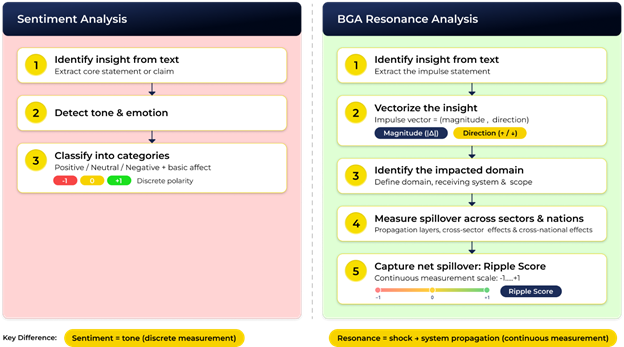
Instead of looking for a positive or negative tone, this approach treats each piece of news as a “macroeconomic impulse”—essentially a shock to the economic system. It then measures the ripple effects of that shock.
Resonance Analysis:
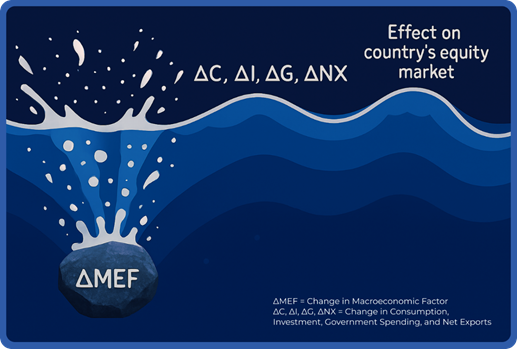
Fig. 1: Economic Ripple Score
The difference between the two methodologies is stark (see Fig. 2).
| Feature | Traditional Sentiment Analysis | Resonance Analysis (Macro Pulse AI) |
| What it Measures | Subjective tone (feeling) | Objective economic impact (spillover effects) |
| Output | A simple label (Positive, Negative, Neutral) | A nuanced score (-1 to +1 Economic Ripple Score) |
| Key Question Answered | “Is the tone of this news good or bad?” | “What will be the net economic effect of this event on a specific country?” |
This advanced approach provides a far more sophisticated and accurate picture of how economic events will truly play out across the globe.
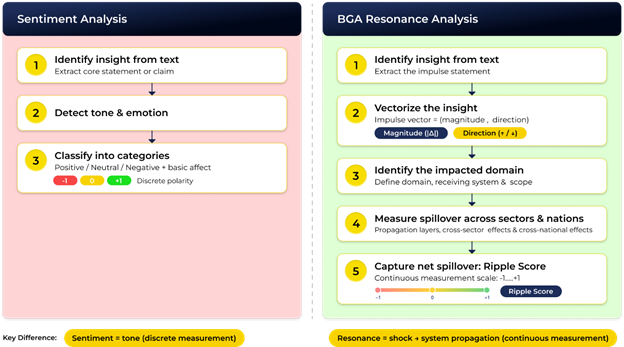
Fig. 2: Resonance Analysis, A New Framework Beyond Sentiments
The fundamental difference between these two AI methods is what they are designed to measure. Traditional sentiment analysis tells you about the feeling of a text, while the more advanced Resonance Analysis tells you about its predictable economic consequence.
For any student of finance or economics, understanding the benefits of the Macro Pulse AI approach is key to appreciating the future of data analysis:
A Six-Month Forward-Looking Analysis
To demonstrate how Macro Pulse AI transforms raw policy documents into structured, forward-looking intelligence, this case study examines three sequential Bank of Canada Monetary Policy Reports spanning October 2024 through April 2025—a period marked by escalating trade tensions and macroeconomic uncertainty.
The analysis illustrates how the platform’s Economic Ripple Score methodology captures not only current conditions but also anticipates downstream impacts before they materialize in hard economic data.
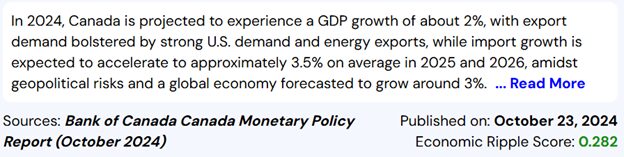
The October 2024 outlook reflects a balanced macroeconomic assessment, driven primarily by structural improvements in Canada’s energy export infrastructure. The platform identified three key positive drivers:
However, forward-looking risk signals tempered the outlook. With the U.S. presidential election weeks away, Macro Pulse AI detected nascent concerns regarding potential tariff implementation—a qualitative signal embedded in policy language that presaged subsequent disruptions. The resulting Economic Ripple Score of 0.282 reflected this mixed but cautiously positive environment.
Here’s the excerpt from our Macro Pulse AI platform
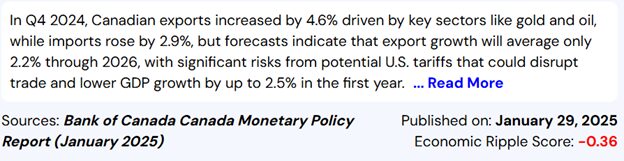
By January 2025, the macroeconomic narrative had shifted decisively. Although the Bank of Canada’s baseline scenario explicitly excluded tariff assumptions, Macro Pulse AI extracted forward-looking language indicating heightened probability of punitive trade measures—specifically, tariffs up to 25% and reciprocal Canadian retaliation.
Critically, the platform’s analysis occurred two months before “Liberation Day” tariff implementation, yet successfully captured the anticipated economic impact:
The Economic Ripple Score declined sharply to -0.36, reflecting the material deterioration in forward-looking expectations—despite tariffs not yet being enacted. This demonstrates the platform’s capacity to transform qualitative policy signals into quantified risk assessments ahead of realized outcomes.
Here’s the excerpt from our Macro Pulse AI platform
The April 2025 outlook validated the January forward-looking assessment. “Liberation Day” tariffs were implemented, triggering the anticipated trade conflict and supply chain fragmentation. Macro Pulse AI’s analysis captured the cascading economic effects:
The Economic Ripple Score further deteriorated to -0.55, reflecting the compounding nature of trade disruptions on consumption, investment, and net exports—core GDP components.
Here’s the excerpt from our Macro Pulse AI platform
Key Analytical Insights:
This six-month case study illustrates three critical capabilities of Macro Pulse AI:
By automating the extraction, contextualization, and scoring of forward-looking insights from central bank communications, Macro Pulse AI enables asset managers to incorporate macro intelligence into portfolio construction with greater speed, consistency, and foresight than traditional manual research workflows.
Please feel free to get a deep dive on Resonance Analysis and Economic Ripple Score here.
The views and opinions expressed herein are those of the author and do not necessarily reflect the views of Alpha Architect, its affiliates or its employees. Our full disclosures are available here. Definitions of common statistics used in our analysis are available here (towards the bottom).
This site provides NO information on our value ETFs or our momentum ETFs. Please refer to this site.
Information posted on IBKR Campus that is provided by third-parties does NOT constitute a recommendation that you should contract for the services of that third party. Third-party participants who contribute to IBKR Campus are independent of Interactive Brokers and Interactive Brokers does not make any representations or warranties concerning the services offered, their past or future performance, or the accuracy of the information provided by the third party. Past performance is no guarantee of future results.
This material is from Alpha Architect and is being posted with its permission. The views expressed in this material are solely those of the author and/or Alpha Architect and Interactive Brokers is not endorsing or recommending any investment or trading discussed in the material. This material is not and should not be construed as an offer to buy or sell any security. It should not be construed as research or investment advice or a recommendation to buy, sell or hold any security or commodity. This material does not and is not intended to take into account the particular financial conditions, investment objectives or requirements of individual customers. Before acting on this material, you should consider whether it is suitable for your particular circumstances and, as necessary, seek professional advice.











Join The Conversation
For specific platform feedback and suggestions, please submit it directly to our team using these instructions.
If you have an account-specific question or concern, please reach out to Client Services.
We encourage you to look through our FAQs before posting. Your question may already be covered!