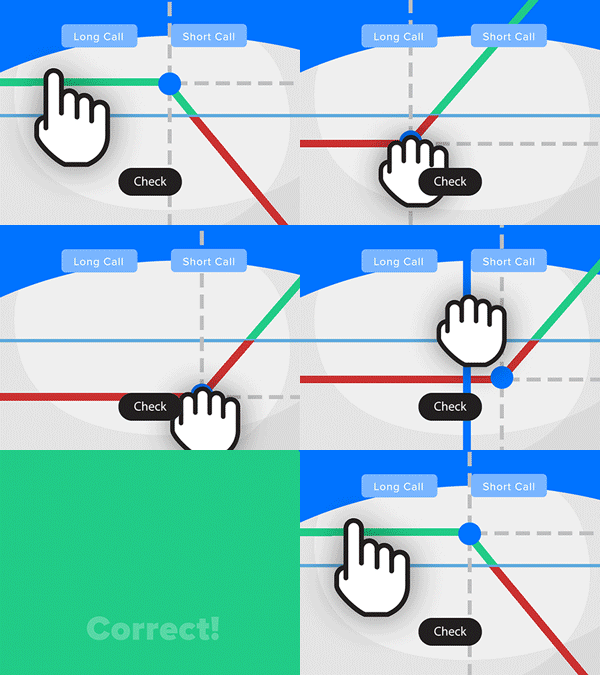
- Solve real problems with our hands-on interface
- Progress from basic puts and calls to advanced strategies
Interactive Options Course
Posted October 29, 2026 at 1:18 pm
Could China’s next generation of tech giants catch Wall Street off guard? From a resurgence in Chinese IPOs to breakthroughs in artificial intelligence, robotics, and semiconductors, a new wave of companies is drawing investor attention. Andrew Wilkinson sits down with Xiaolin Chen, Head of International at KraneShares, to explore what’s fueling China’s technology ambitions, why Hong Kong is reemerging as a major listing hub, and how improving US-China relations could reshape the investment landscape.
The following is a summary of a live audio recording and may contain errors in spelling or grammar. Although IBKR has edited for clarity no material changes have been made.
Welcome to today’s podcast edition from Interactive Brokers. I’m joined today by China expert Xiaolin Chen, who’s head of international at KraneShares in London. Xiaolin, always a pleasure to have you on the show. Welcome back.
Thank you, Andrew, for having me.
So very recently we had a meeting between President Trump and President Xi. What do you think was the most significant outcome from that meeting, Xiaolin?
A couple of things. First and foremost, this offers a reduced geopolitical risk premium between the two largest countries. And second, it offers more clarity on the policy front. They aligned on a lot of key topics. And third, which is most important to business, is more clarity on the supply chain side.
The reduced tariff, 30 billion on each side, that’s very sizable. Promising to buy more US agricultural products is more beneficial for the US economy. The talk on AI, let’s set up a channel, let’s set up a committee to discuss AI issues rather than avoiding it, right? I don’t want to sell to you, you don’t want to talk to me.
No, this is the most important topic centered around the world today, and the number one and number two economies are talking, saying, “Let’s work on this together. Let’s focus on regulation, safety,” and so on. “Let’s exchange feedback on training AI going forward.” Those are huge positives.
And the sectors benefiting from this meeting are technology, clean energy for sure, and China more broadly. It’s now more confirmed that we can look at working more closely with the United States.
The United States is still number one. There’s still a lot of things for China to learn. I think it removes a lot of geopolitical issues and concerns, particularly if you see all the social videos posted by the US side or the Chinese side. The two were walking along, talking to each other. Trump a few times patted Xi Jinping’s shoulder, and Xi’s wife, Mrs. Peng, she speaks English. She’s talking to Americans first.
Those small details, the dynamics from us watching all these things come out, show us clearly, I think Trump is right. They have a great relationship between the two of them, and now they are talking constructively, having very planned next steps. I think it’s going to help on both sides for sure.
So you’d say we’re entering a more stable phase in US-China relations?
I’d say so. Compared to the first Trump administration, compared to a few years under Biden’s governance to now, this is probably the most stable period between the US and China for a couple of reasons. Issues are clear, issues are discussed. A framework to resolve the issues is set up, is established.
They need to talk more, agree on more. Andrew, both sides will not solve the disagreements overnight. You want them to sit down and have a framework, have a process which they can follow to resolve issues along the way. That’s the best you can expect from number one and number two, right?
And they are doing exactly that. I think the market hugely underestimates how they have progressed the relationship between the US and China, how both the business and policy sides have come to the table and are aligning, agreeing to disagree, but then let’s move forward together.
And that’s important, obviously, for the relationship between Washington and Beijing, to boost Chinese business confidence and in the capital markets, right?
Absolutely, yes. Foreign investment, particularly from China to the US, is probably among the lowest, right? At pre-pandemic levels, among other countries, China was probably one of the top, and there’s definitely talks happening.
Chinese direct investment into US businesses, even more collaborations between them, we should expect that to increase over time after this period. And also for US companies to go to China, having a more open financial market, which China has promised, and so on and so forth, for US companies to also benefit the other way around. That’s also expected to happen in the coming quarter.
What’s then driving the recent resurgence of Chinese IPOs, Xiaolin?
Great question. During the pandemic period, China almost halted the entire IPO market in China. And then what was supposedly coming to the market was centered around maybe energy-focused companies and so on and so forth.
And then, for a period of time, China was really, I’d say, rebalancing heavily from those traditional industrial sectors to the new sectors.
What are the new sectors? In that period of time, they were building, catching up, building and catching up. At some point, research on the Street was showing China had 168 unicorn companies, with $1 billion US valuations and over a five-year track record.
That means all those companies are actually ready for IPO, but they are not doing IPOs, right? For multiple reasons, with geopolitical uncertainties and also global investor sentiment towards Chinese assets, right? All became a bit more watch-and-see, conservative.
Now, given the improved geopolitical situation, China versus the US versus the rest of the world, more stable, more clear guidance from the Chinese government to support the economy, the interest from global investors in Chinese assets has increased.
And during this period, they also kept the gate shut for a period of time. Now the companies come forward with more interesting assets that we don’t normally have in the United States or everywhere else, Andrew, such as hardware, semiconductors, robot companies.
Unitree, the largest robot company in the world by shipments, is private. Now they’re public. You can buy that company.
And also, like DeepSeek. Remember 2025, the DeepSeek moment? They have filed for an IPO in the first quarter of next year.
All these new names of Chinese unicorns that can potentially drive China’s next phase of growth are all coming to the market.
So I’d say a period of pause, now also a period allowing good unicorns to accumulate and be ready for IPOs, is now opening up investor interest.
So how healthy is the IPO pipeline today compared with prior cycles?
Two things. One, I’d say in terms of numbers, it’s definitely a lot more because of the accumulated queue. But then I’d say the second one, which is more interesting to your audience, is it’s a lot more diversified.
In the past, I get another industrial company, I get another bank, I get another financial company. You have those in the US. Why do you need to buy another financial company elsewhere? But now I’m telling you, this is not true. You’re going to have a data center coming. You’re going to have a large language model coming. You’re going to have another robotics company coming. You’re going to have another semiconductor company coming, another chip company coming.
It’s more interesting, more diversified. It’s also relatively easier for our audience to understand what your business nature is, because your business nature is similar to my business nature in the US, which I can compare and contrast and evaluate whether you’re worth my dollar or not. This is the key part. So the sectors and industries become more like their US counterparts, right? That makes it more interesting. The subsectors become more diversified and broad, so investors should find a piece that they are interested in.
In terms of investor interest, which of the technology sectors are attracting the most attention, would you say?
Attention from global investors, Chinese domestic investors? Which part would you—
From Chinese investors.
Chinese investors, technology, technology. Any big tech company that comes to market. Because a lot of mainland investors, they’re kind of kept onshore to invest onshore. Even if they see SpaceX, they can’t access SpaceX and those equivalents.
In China, obviously, you don’t have a SpaceX equivalent. I’m just using that as an example to say any advancing, emerging frontier AI technology companies that go IPO in China today would attract a lot of investor interest because they hope those models will represent similar success to their US counterparts in the United States, but in mainland China.
Are we seeing a new generation then of deep tech companies emerge versus the consumer internet firms that dominated in the past?
The old brothers, they call them big brothers, right? Like Alibaba and all those big tech companies. They are not out of the picture. Anyone trying to guide direction that way is completely wrong.
The reason I say that is any startup in technology, these new emerging technology companies, they look for funding, they open for rounds, A, B, whatever you name them. The first company they go to is Alibaba.
Alibaba may have tens of thousands, if not more, of those investments in all these startups. MiniMax, the company that IPO’d in Hong Kong, Alibaba owns 10, 15% of that company.
So don’t underestimate those big giant tech companies, they called them in the past, those big brothers. Are they out of date? No. They’re actually owning more diversified startups at the earliest stage, so their revenue growth paths are multiples, those trajectories are multiples. So I’d say no, you should still own both. One, because those e-commerce tech companies are still servicing 1.4 billion customers today. That’s not going to go anywhere. They are there, they dominate the market. That will continue to be the case for several years into the future.
On top of that, they’re trying to—well, not trying to, the small tech startups come to them anyway for funding.
So if possible, client portfolios should own both. Size, up to you to talk to your advisor, but sector-wise, you should own both.
How important then are AI and robotics to this new wave of Chinese listings, would you say?
Very important. Very, very important. It’s a matter of whether China can win this new technology revolution or not. Not to say win, even catch up with the rest of the world. You know that on the hardware front, China was behind for many, many years. But thanks to the continued evolution and development in the AI world, not every AI and technology development requires the highest-end chip anymore to compute.
They can deal with a certain level of chip, not the top, but you can compute with a certain level of chip. That’s why you see, in large language models, they’re making a breakthrough.
In robotics, you have to notice, this whole world is built for humans. Humanoid robotics will be the most booming sector to come in AI, purely because the market demand for such robots to do certain work, to quickly commercialize, is enormous. Are we there yet? Maybe not yet, but this is the moment you look into this sector because they’re not as mature as, say, Nvidia today. You just buy Nvidia because you want to buy the most advanced chip.
In the humanoid robotics space, the advances in manufacturing the components, the actuator, the sensor, the bearing, the coil, all those things in China. You can go to Shenzhen, go to a tech company building. You go to one building, you can find the whole supply chain plus robotics companies in one place.
And then the robotics company says, “I want to design this robot, Andrew,” and they go through the whole building, they can get it in two, three days. That’s how quick, how superior the e-commerce system is in China today.
So I think in robotics, you’re going to see huge advances developing in hardware, obviously in software, and most importantly today, two things they need to overcome. One is data to train the robot to be smarter, to know the reasoning on how to react, and then more generalization. Then you may approach a ChatGPT moment for humanoid robotics.
Xiaolin, tell us a little bit about the reemergence of Hong Kong as an important listing venue for these IPOs.
Hong Kong has always served as a hub that connects the mainland and the rest of the world. I think Hong Kong continues to benefit as such. And this is the first year the Hong Kong government announced the first-ever five-year plan. Remember, Andrew, we discussed that in past episodes, China has a five-year plan every five years. This is their 15th five-year plan.
This is the first Hong Kong five-year plan, benefiting from mainland China trying to support Hong Kong even further financially, economically, policy-wise.
So now they have their own target to expand Hong Kong geographically. They have more land where they can build Hong Kong.
Hong Kong is only going to become more important financially, as a financial hub to mainland investors and also to international investors. They’re going to accommodate more possibilities beyond just financials because of all this support.
And then for IPOs, the market tends to think of them that way, as how they position themselves is, if they list in Hong Kong, they can not only accept mainland investors, they can also welcome international investors.
So a lot of Chinese unicorns are now choosing to list publicly on the Hong Kong Stock Exchange. But of course, there’s also a very easily managed Connect program to allow, if you list in Shanghai, you can be eligible for Connect. People can still buy them freely anyway. But you have to qualify for Connect. That may be one condition.
So I’d say both Hong Kong and the Shanghai Stock Exchange will become quite busy venues for all these AI and technology company listings.
So I think you’ve already answered this question, but looking ahead, and I’m thinking over the next year, what China technology trend should investors be watching most closely? Is it robotics?
Robotics is number one, purely because the hardware is ready, the mechanisms are ready to advance further.
The second one would be data centers. Every province and city has a quota, must build data centers to allow all these robots to learn in the real world. They may set up an office like yours and mine and let the robots work there.
I’ll tell you a true story. This is a friend of mine. Her friend teaches Spanish in China. She’s Spanish, she teaches Spanish in China. And she has a whole bunch of students in her classroom. And then for some period of time, she noticed a student looked a bit rigid, but then fine, she didn’t want to discriminate. She thought maybe she’s disabled, she’s not very common, but she’s a student, she comes to every lesson, so she taught her.
After a few months of teaching the whole class, this student included, Andrew, that’s a robot. It’s not a real human. It’s a robot. She then found out it’s a robot.
A robotics company sent this robot into real life to come and learn lessons, to interact with students. They paid for lessons, so you teach, but they didn’t tell her it’s a robot. She said, “I tell you, Xiaolin, she looks so real. She’s like a human. I haven’t even for a minute doubted she’s a human, okay? She looks so real. Maybe she’s a bit rigid when she moves, but not for a second did I think she’s not a human. I thought maybe she’s hurt, she’s somehow disabled, but I didn’t think she’s not a human.”
So that’s how everyone now in China is doing the data center training, training robots in the real world to make them smarter.
How did she do with her exams?
That I will need to ask. That’s a good question…
Brilliant. Xiaolin Chen, head of international for KraneShares over in London, thank you again for joining me today.
Pleasure.
And thank you to the audience. And if you want to keep up with us here at IBKR Campus, just look on the internet. Check us out for webinars, podcasts, all sorts of social media there, and learn about some of the things that we offer here at Interactive Brokers for investors globally to learn more about investing.
Thanks, everybody, and bye for now.
The analysis in this material is provided for information only and is not and should not be construed as an offer to sell or the solicitation of an offer to buy any security. To the extent that this material discusses general market activity, industry or sector trends or other broad-based economic or political conditions, it should not be construed as research or investment advice. To the extent that it includes references to specific securities, commodities, currencies, or other instruments, those references do not constitute a recommendation by IBKR to buy, sell or hold such investments. This material does not and is not intended to take into account the particular financial conditions, investment objectives or requirements of individual customers. Before acting on this material, you should consider whether it is suitable for your particular circumstances and, as necessary, seek professional advice.
The views and opinions expressed herein are those of the author and do not necessarily reflect the views of Interactive Brokers, its affiliates, or its employees.
Content on China Last Night is for informational purposes only and should not be construed as investment advice. This material represents an assessment of the market environment at a specific time and is not intended to be a forecast of future events or a guarantee of future results; material is as of the dates noted and is subject to change without notice. This information should not be relied upon by the reader as research or investment advice regarding the funds or any security in particular.
This material may not be suitable for all investors and is not intended to be an offer, or the solicitation of any offer, to buy or sell any securities. Investing involves risk, including possible loss of principal.
This material contains general information only and does not take into account an individual’s financial circumstances. This information should not be relied upon as a primary basis for an investment decision. Rather, an assessment should be made as to whether the information is appropriate in individual circumstances and consideration should be given to talking to a financial advisor before making an investment decision.
Forward-looking statements (including Krane’s opinions, expectations, beliefs, plans, objectives, assumptions, or projections regarding future events or future results) contained in this presentation are based on a variety of estimates and assumptions by Krane. These statements generally are identified by words such as “believes,” “expects,” “predicts,” “intends,” “projects,” “plans,” “estimates,” “aims,” “foresees,” “anticipates,” “targets,” “should,” “likely,” and similar expressions. These also include statements about the future, including what “will” happen, which reflect Krane’s current beliefs. These estimates and assumptions are inherently uncertain and are subject to numerous business, industry, market, regulatory, geo-political, competitive, and financial risks that are outside of Krane’s control. The inclusion of forward-looking statements herein should not be regarded as an indication that Krane considers forward-looking statements to be a reliable prediction of future events and forward-looking statements should not be relied upon as such. Neither Krane nor any of its representatives has made or makes any representation to any person regarding forward-looking statements and neither of them intends to update or otherwise revise such forward-looking statements to reflect circumstances existing after the date when made or to reflect the occurrence of future events, even in the event that any or all of the assumptions underlying such forward-looking statements are later shown to be in error. Any investment strategies discussed herein are as of the date of the writing of this presentation and may be changed, modified, or exited at any time without notice.
IPO investments carry substantial risks including extreme price volatility, limited operating history, lack of liquidity, potential for significant losses, and uncertainty regarding future performance.







Join The Conversation
For specific platform feedback and suggestions, please submit it directly to our team using these instructions.
If you have an account-specific question or concern, please reach out to Client Services.
We encourage you to look through our FAQs before posting. Your question may already be covered!