
- Solve real problems with our hands-on interface
- Progress from basic puts and calls to advanced strategies
Interactive Options Course

Posted August 3, 2026 at 1:09 pm
Stocks are starting the new month off with a bang. Oil futures are lower after the President called off a promised round of strikes on Iran, saying that, “There’s a deal on Hormuz, and then there will be a deal on the nuclear or you might call it the denuclearization of Iran.” Oil futures traded sharply lower, bringing bond yields along with them. The Japanese yen held at stronger levels after bilateral intervention by the US and Japan. And the rally in megacap tech, along with pretty much everything else, continued.
Oil traders seemed not to mind that Iran denied that any talks with the US were underway, with their Foreign Ministry spokesperson saying, “We currently do not have negotiations with America.” On the other hand, Iran acknowledged negotiations with Oman over a temporary safe route through the Strait of Hormuz. This is not a favorable development for the US, but commodity traders are less concerned about geopolitical advantages than they are about supply and demand dynamics. If a deal between Oman and Iran can get tankers flowing through the Strait, that will increase the global supply of crude oil – even if it may come with tolls on shipping that raise costs.
As for the yen, the joint intervention is the first concerted action since the 2011 Fukushima earthquake. There is a key difference between then and now, however. At that time, the two countries joined forces to weaken a rapidly appreciating yen; these recent moves were designed to bolster a sagging Japanese currency. As of now, the yen is holding at stronger levels, wiping out roughly three months of depreciation (remember, the yen/dollar rate is conventionally quoted as yen per dollar, so a lower number means a relatively stronger yen and weaker dollar for that pair).
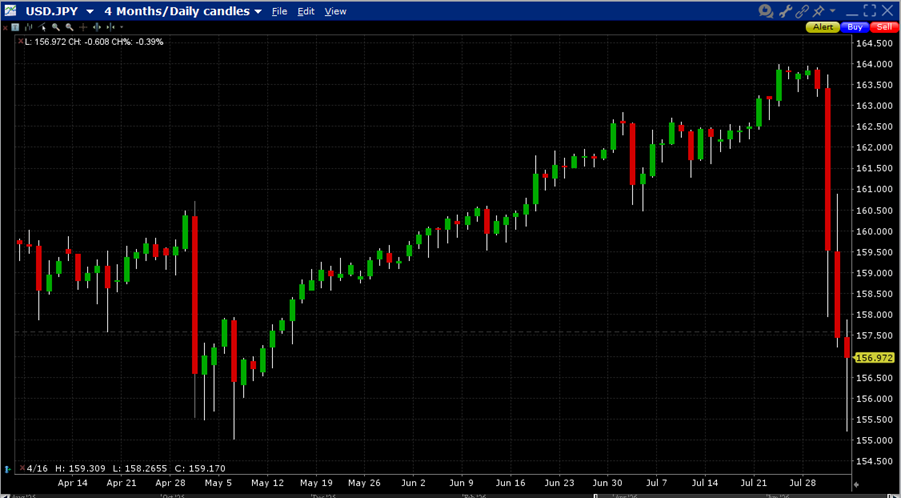
Source: Interactive Brokers
There was a fascinating aspect to the intervention: it was literally on the Treasury Secretary’s to-do list. A Reuters photographer snapped a picture of a notepad in front of Secretary Bessent at a cabinet meeting that read, “To Do Buy Japanese Yen $5-10 bil.” The Secretary is no stranger to large currency trades. He had a role in George Soros’ famous trade that forced the Bank of England (BOE) to devalue the British pound. The market clearly understands this, which is why the intervention appears to be holding, though he also must clearly understand the difficult dynamics of propping up a currency simply through intervention.
The important difference between 2011 and now is that the current move is designed to prop up a sinking currency rather than weaken a strengthening one. It is relatively easy for central banks and governments to attempt to suppress a rising currency. When markets are clearly demanding more assets in a specific currency, that country generally has no problem issuing more debt to meet at least some of that demand. Yet when markets are showing a clear preference for other countries’ currencies, that central bank has to buy assets to prop it up.
That was the crux of Soros’ trade. The BOE was facing a huge, concerted seller of pounds amidst a secular weakening trend and ran out of ammunition and/or the will to take the measures necessary to prop up its currency. The Bank of Japan (BOJ) and the US now find themselves on the same side of the trade as the BOE did, though there is not a single, obvious concerted seller at this point. Instead, it put the brakes, at least temporarily, on the carry trade and other market moves that hinge upon a weaker yen. The question is whether the recent move can hold without some action from either the BOJ (raising rates) or the Japanese government designed to improve the country’s monetary or fiscal appeal.
In the meantime, though, all eyes, and lots of investors’ dollars, are plunging back into large-cap tech stocks. Indeed, today’s rally is quite broad-based, with advancing stocks outpacing decliners by about 2.5:1 and up volume running about 4x that of down volume. But we can’t ignore another sizeable up day for some of the largest stocks in the market. Microsoft (MSFT) and Amazon (AMZN) are continuing last week’s rallies, with each up nearly 5%. Meta Platforms (META) is bouncing back nicely with a gain of 7%, while Alphabet (GOOG, GOOGL) has joined the party with a 5% rally of its own, but Apple (AAPL) is still marginally lower after last week’s plunge. NVDA is up 3%, but semiconductors are showing only marginal gains overall, showing that the “takers” are back in a big way. Heck, even beaten-down Oracle (ORCL) is up nearly 8% as the once-leading “makers” lag. Bottom line: if the hyperscalers are leading the party, the broader market has no choice but to dance along with them.
New to Interactive Brokers?
Open AccountAlready an Interactive Brokers Client?
Request Trading PermissionThe analysis in this material is provided for information only and is not and should not be construed as an offer to sell or the solicitation of an offer to buy any security. To the extent that this material discusses general market activity, industry or sector trends or other broad-based economic or political conditions, it should not be construed as research or investment advice. To the extent that it includes references to specific securities, commodities, currencies, or other instruments, those references do not constitute a recommendation by IBKR to buy, sell or hold such investments. This material does not and is not intended to take into account the particular financial conditions, investment objectives or requirements of individual customers. Before acting on this material, you should consider whether it is suitable for your particular circumstances and, as necessary, seek professional advice.
The views and opinions expressed herein are those of the author and do not necessarily reflect the views of Interactive Brokers, its affiliates, or its employees.
There is a substantial risk of loss in foreign exchange trading. The settlement date of foreign exchange trades can vary due to time zone differences and bank holidays. When trading across foreign exchange markets, this may necessitate borrowing funds to settle foreign exchange trades. The interest rate on borrowed funds must be considered when computing the cost of trades across multiple markets.
Futures are not suitable for all investors. The amount you may lose may be greater than your initial investment. Before trading futures, please read the CFTC Risk Disclosure. A copy and additional information are available at ibkr.com.
Spot currencies are not available at IBKR Singapore.
Related Articles
















Join The Conversation
For specific platform feedback and suggestions, please submit it directly to our team using these instructions.
If you have an account-specific question or concern, please reach out to Client Services.
We encourage you to look through our FAQs before posting. Your question may already be covered!