
- Solve real problems with our hands-on interface
- Progress from basic puts and calls to advanced strategies
Interactive Options Course

Posted June 3, 2026 at 10:30 am
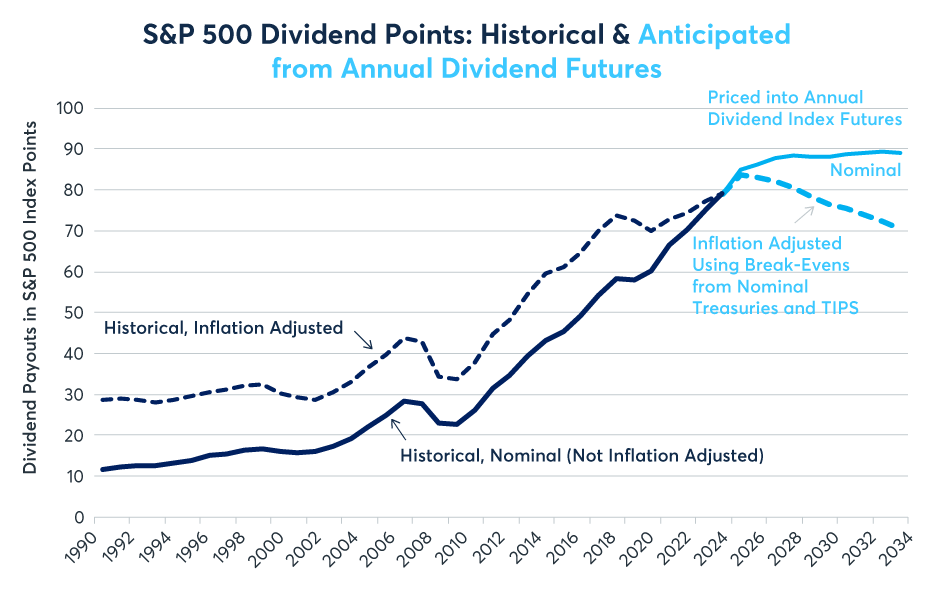
Why are expected dividend payouts at current net present values lagging far behind the surge in equities? Since 2016, the S&P 500 has grown by a staggering 275%. Yet over the same period, investors had priced dividends over the next decade in S&P 500 Annual Dividend Index futures to rise by just 76% (Figure 1). There’s more. When discounted using SOFR Overnight Index Swap (OIS) rates, the net present value (NPV) of the anticipated cash flows presents an even starker anomaly, growing just 56% (Figure 2).
The widening gap between price appreciation and implied dividend growth is not unique to the S&P 500; a similar divergence is currently playing out across the Russell 2000 and Nasdaq 100. Resolving this apparent contradiction requires looking beyond top-down macro assumptions to examine the shifting sector weights of the underlying indices.
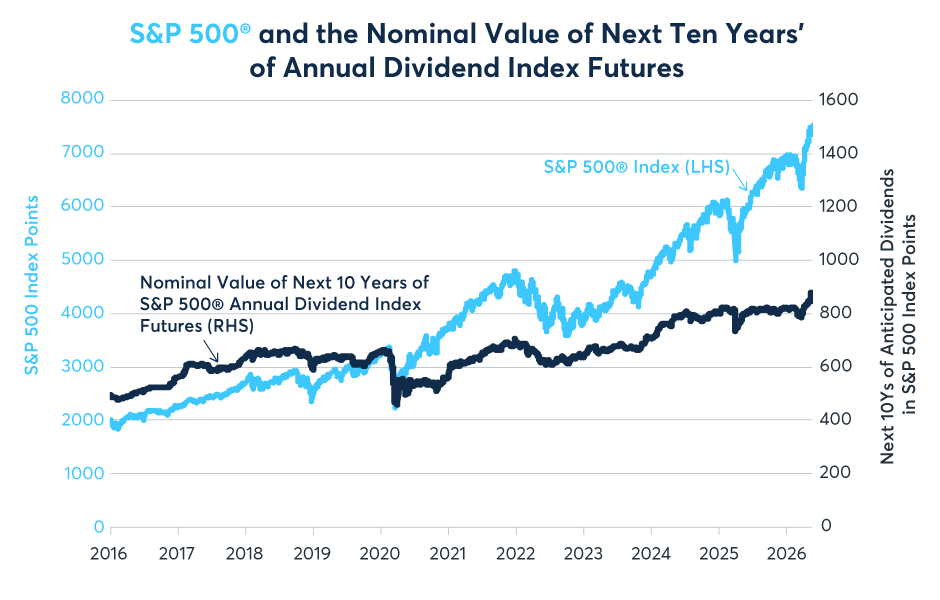
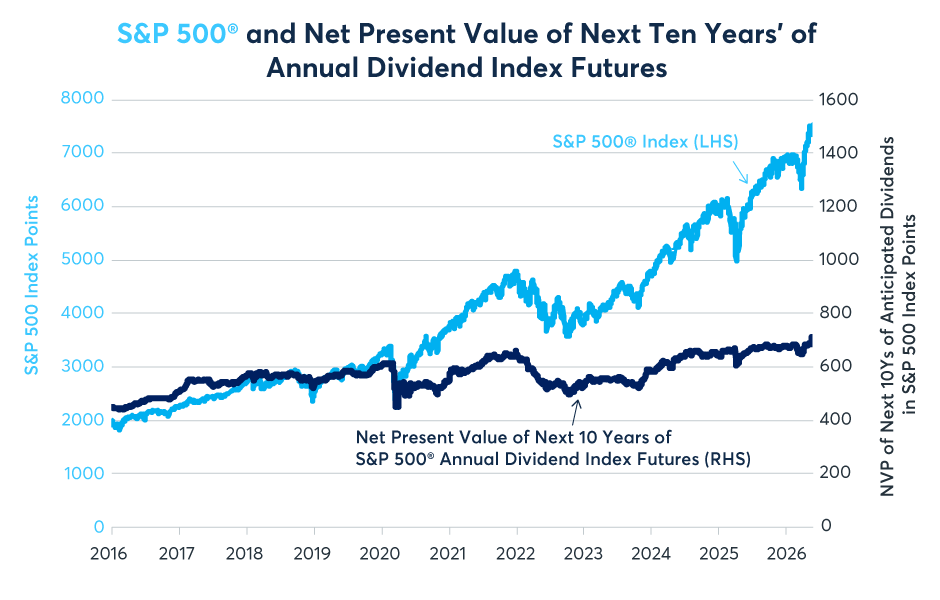
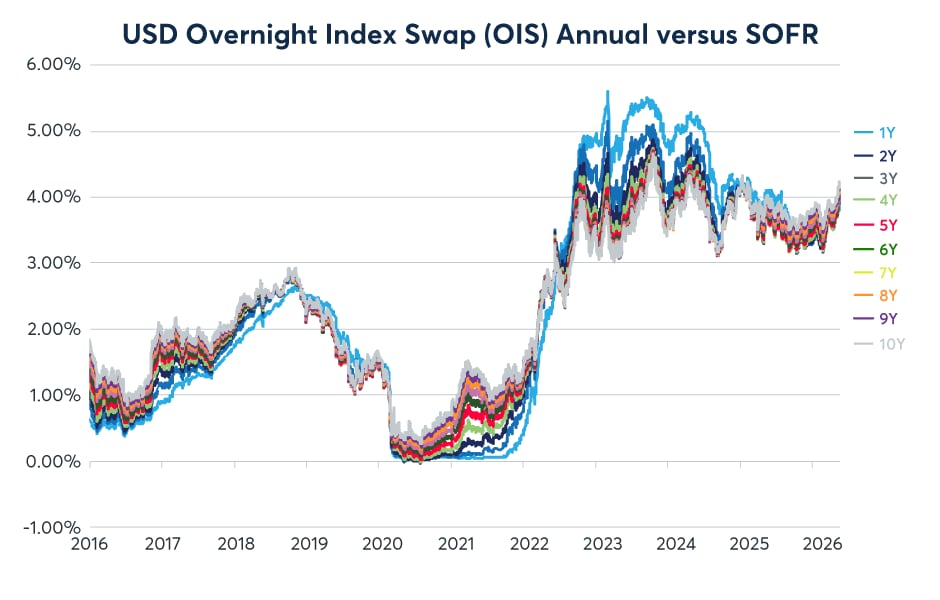
To understand how these index weights have shifted, one must first isolate the dual forces driving this valuation gap: the mathematical impact of rising discount rates and the structural dominance of low-yield growth sectors. The gap between the nominal and NPV growth rates directly reflects the rise in interest rates over the past decade (Figure 3). As interest rates rise, the present value of cash flows further in the future mechanically declines. For example, in early 2016, when 10Y swap futures traded at 1.83%, the discount factor for dividends paid 10 years in the future was:
1/(1+1.83%)10=0.83
Today, with 10Y swap rates hovering near 4.16%, that same discount factor has fallen to:
1/(1+4.16%)10=0.67
While a higher discount rate should theoretically suppress the current price of long-duration growth equities as well, the price indices have defied this gravitational pull. After all, a higher discount rate not only lowers the NPV of future dividends, but of future corporate cash flows by any measure—including profits and free cash flow to equity.
Yet, the rapid expansion of technology sector weights has completely overwhelmed this interest rate effect.
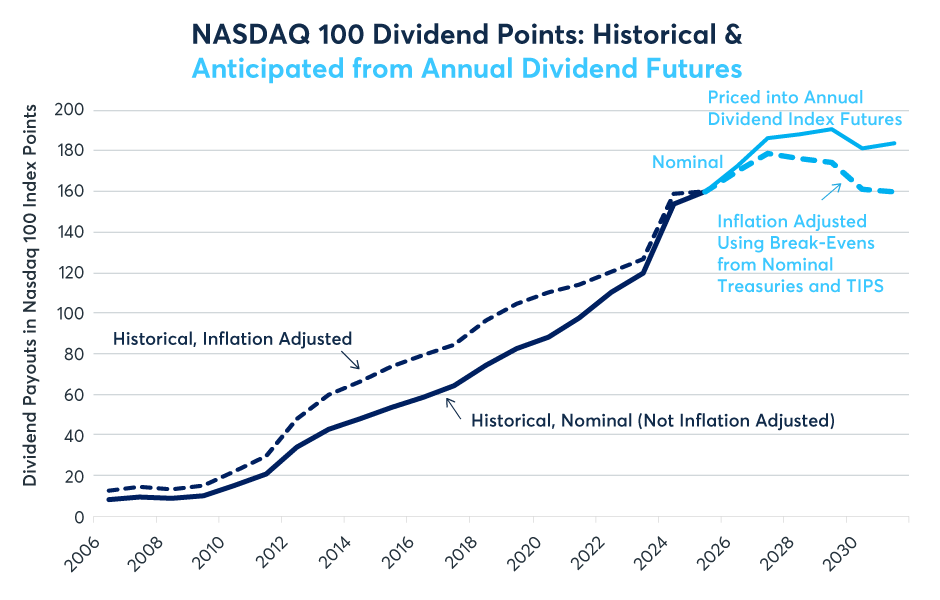
A similar phenomenon is underway across the broader equity landscape. While the historical data for Russell 2000 and Nasdaq 100 Annual Dividend Index futures is shorter—dating back to April 2022—the past four years confirm that the divergence between index prices and dividend aggregates is a systemic, cross-index reality rather than S&P 500 specific (Figures 4, 5, 6, and 7).
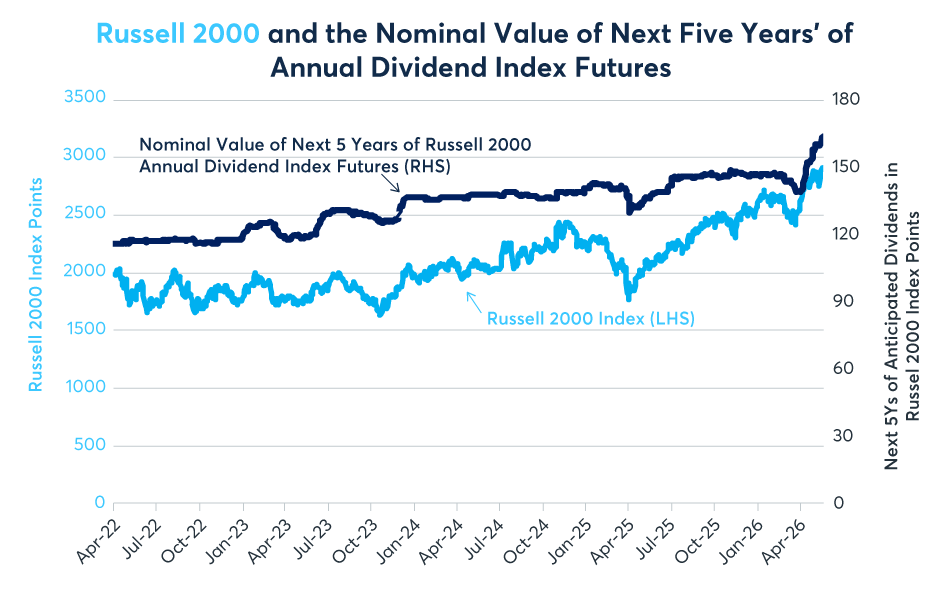
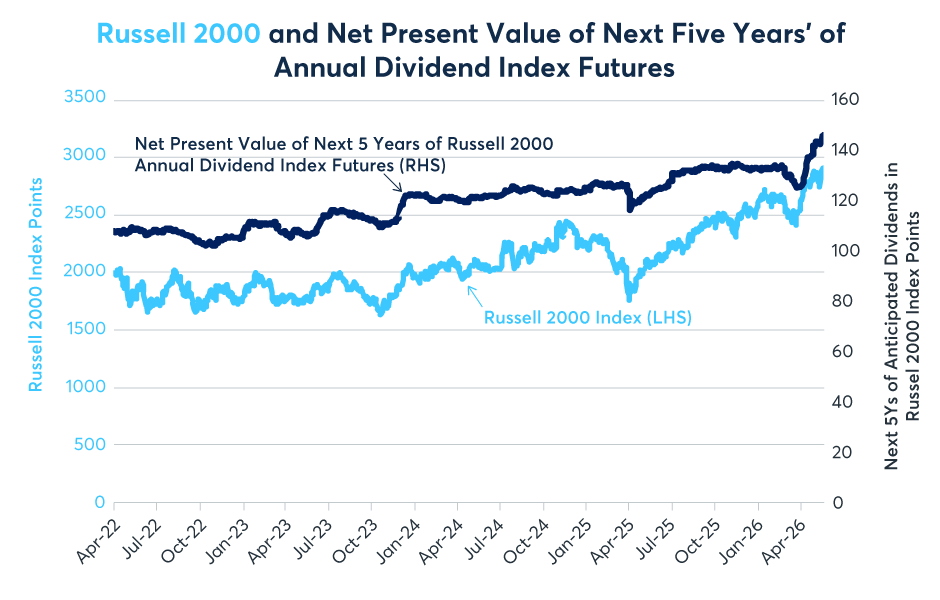
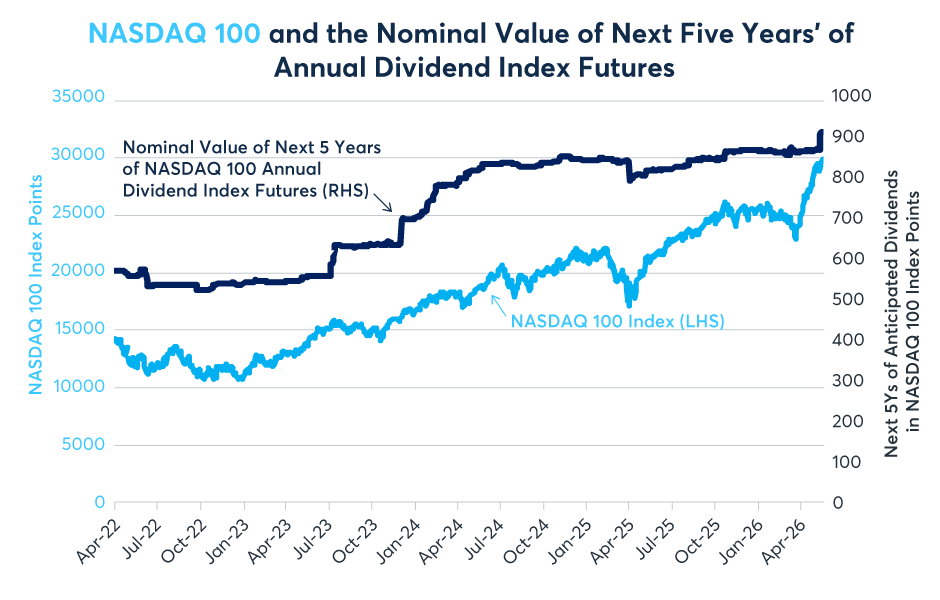
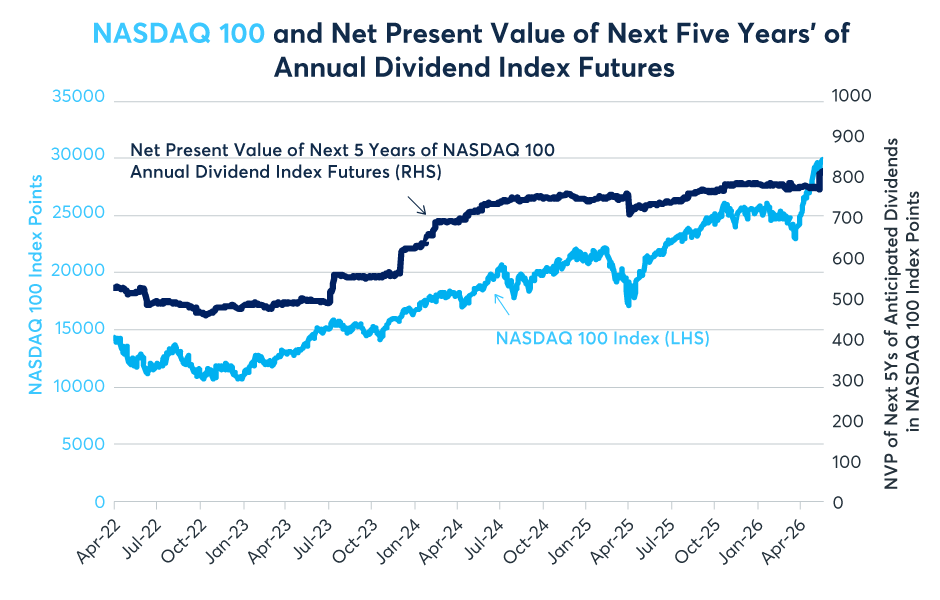
Since April 2022, the Russell 2000 index has climbed 44%, while its nominal anticipated dividends rose 38%, and their corresponding NPV increased by just 33%. The contrast is even more pronounced in the large-cap growth space: Nasdaq 100 has surged 105% since April 2022, while its expected five-year dividend aggregate grew 59% in nominal terms and a mere 53% in NPV terms.
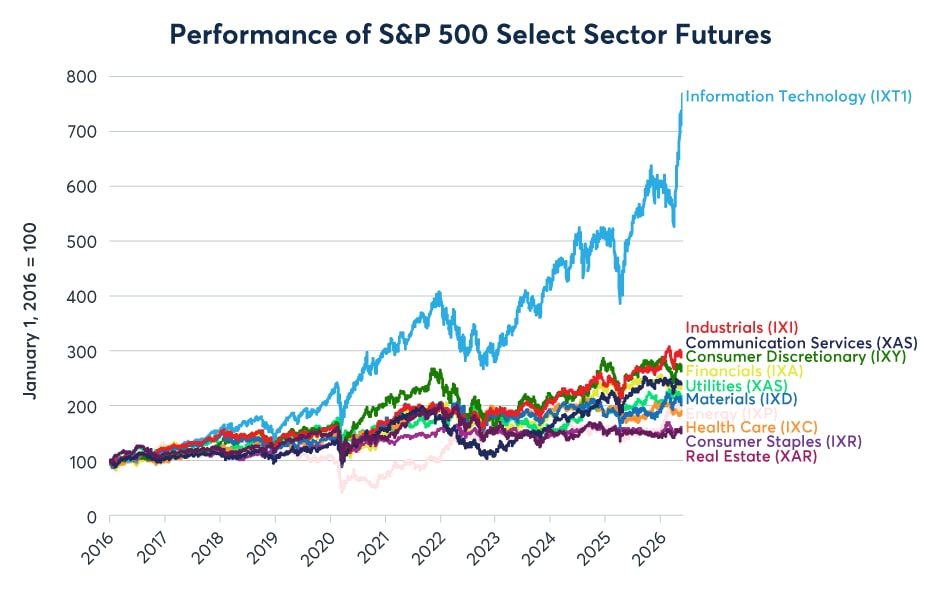
What explains this uniform tendency for equity index prices to outpace both nominal and discounted dividend expectations? The answer lies in shifts in sector concentration—specifically, the outperformance of the information technology sector.
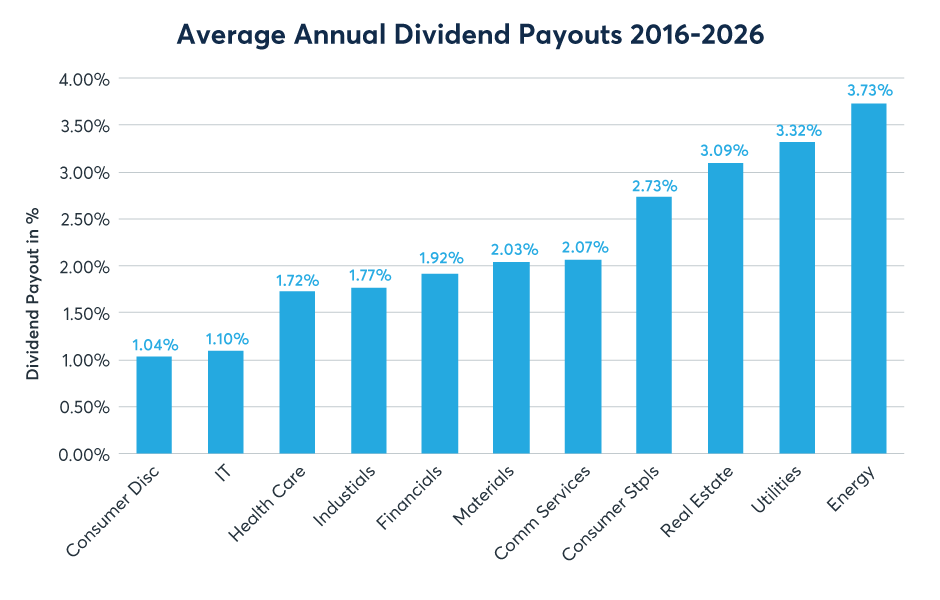
As shown in Figure 1, the S&P 500 index began significantly detaching from expected dividends around April 2020. This is the exact moment the technology sector’s price performance separated from all other industry groups (Figure 8). This price surge created a mathematical drag on aggregate dividend metrics because, over the past decade, technology stocks have maintained some of the lowest dividend yields of any S&P 500 sector (Figure 9). As the market-cap weight of these low-yielding tech titans expanded, the overall index price detached from its historical dividend anchor.
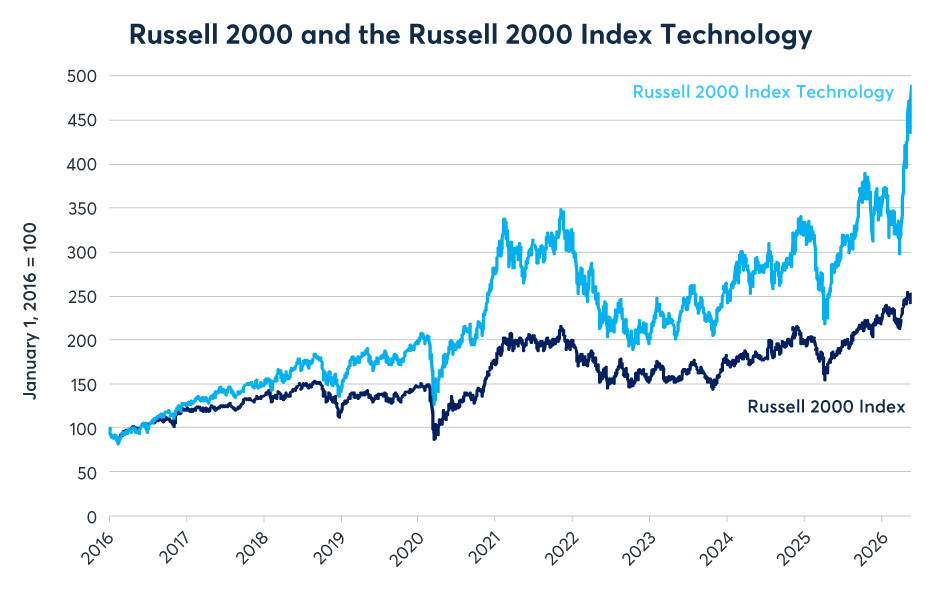
A parallel dynamic has driven small-cap equities. Among Russell 2000 companies, technology stocks have outpaced the broader index while continuing to distribute far less cash to shareholders than the index average (Figure 10). Since April 2022, the Russell 2000 Technology Index has risen by 76%, easily eclipsing the 46% gain achieved by the benchmark Russell 2000 index. During that time the Russell 2000 Index as a whole paid dividends of 1.58% per annum while the Russell 2000 Index Technology had dividends of just 0.2% per annum.
The divergence between surging equity benchmarks and comparatively stagnant dividend expectations highlights the dual nature of holding the S&P 500, Nasdaq 100 and Russell 2000. On one hand, the price indices have transformed into concentrated expressions of asset-light, tech-driven growth, where infinite-duration earnings expectations overwhelm the gravitational pull of a higher SOFR discount curve. On the other hand, the annual dividend futures market continues to price these indices as if they were traditional, old-economy baskets bound by rigid payout constraints. Either equity index valuations have become fundamentally overextended on AI-driven optimism, or the dividend futures market is suffering from a severe structural under-pricing of corporate resilience as per our previous paper on the subject.
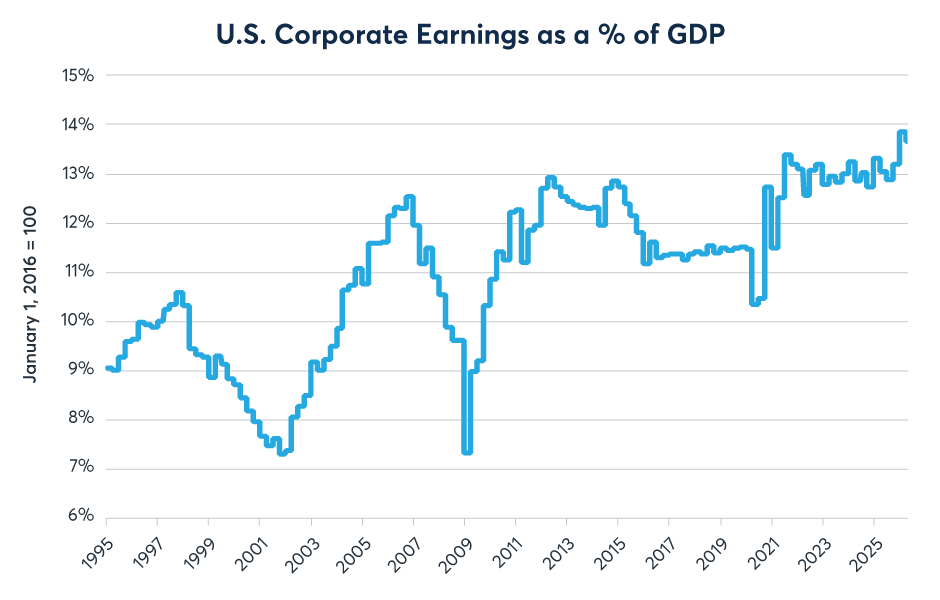
With aggregate corporate profit shares near historic highs (Figure 11) and mega-cap technology titans increasingly initiating—rather than avoiding—shareholder distributions, this stark disconnect raises several critical questions for asset allocators:
While it is impossible to predict the outcome today, the coming years will likely provide the answer as the tension between a potentially overextended equity market and a potentially underpriced dividend curve inevitably resolves itself.
—
Originally Posted May 28, 2026 – The Growing Divide Between Equity Indices and Dividend Futures
© [2023] CME Group Inc. All rights reserved. This information is reproduced by permission of CME Group Inc. and its affiliates under license. CME Group Inc. and its affiliates accept no liability or responsibility for the information contained herein, including but not limited to the currency, accuracy and/or completeness of this information, and delays, interruptions, errors or omissions. This information is an unofficial copy and may not reflect the official and accurate version. For the definitive and up-to-date version of any of this information, please see cmegroup.com.
Information posted on IBKR Campus that is provided by third-parties does NOT constitute a recommendation that you should contract for the services of that third party. Third-party participants who contribute to IBKR Campus are independent of Interactive Brokers and Interactive Brokers does not make any representations or warranties concerning the services offered, their past or future performance, or the accuracy of the information provided by the third party. Past performance is no guarantee of future results.
This material is from CME Group and is being posted with its permission. The views expressed in this material are solely those of the author and/or CME Group and Interactive Brokers is not endorsing or recommending any investment or trading discussed in the material. This material is not and should not be construed as an offer to buy or sell any security. It should not be construed as research or investment advice or a recommendation to buy, sell or hold any security or commodity. This material does not and is not intended to take into account the particular financial conditions, investment objectives or requirements of individual customers. Before acting on this material, you should consider whether it is suitable for your particular circumstances and, as necessary, seek professional advice.
Futures are not suitable for all investors. The amount you may lose may be greater than your initial investment. Before trading futures, please read the CFTC Risk Disclosure. A copy and additional information are available at ibkr.com.
Related Articles


















Join The Conversation
For specific platform feedback and suggestions, please submit it directly to our team using these instructions.
If you have an account-specific question or concern, please reach out to Client Services.
We encourage you to look through our FAQs before posting. Your question may already be covered!