
- Solve real problems with our hands-on interface
- Progress from basic puts and calls to advanced strategies
Interactive Options Course
Posted April 21, 2026 at 11:15 am
Markets are jittery about tariffs, oil prices, and the health of the US consumer. But company results and guidance will sort out what’s real and what’s not. Here’s what to watch.
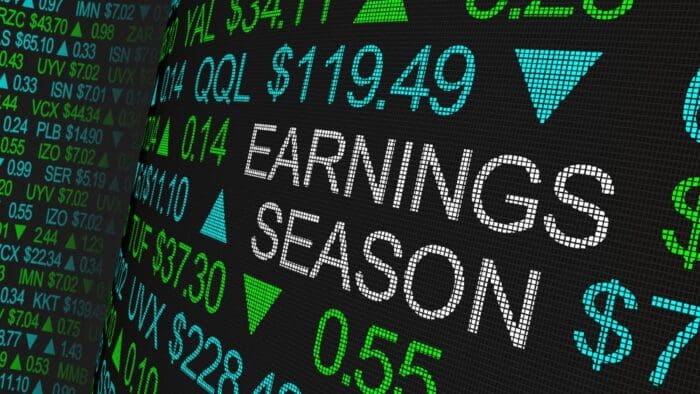
Earnings season is when your market assumptions either hold up or fall apart. It’s when we find out how the big themes – tariffs, energy prices, AI – are really affecting companies.
So before we get swept up in the beats, the misses, and all the other earnings headlines, let’s talk about what matters: why expectations look the way they do, what investors are really listening for, and what it could mean for portfolios.
Let’s not sugarcoat it: 2026 hasn’t been the year investors wanted. The S&P 500 fell 5% last quarter, and the mood has swung between cautious and downright nervous. And a couple of big forces are largely to blame.
First, tariffs. America’s new trade measures – the biggest tax increase as a share of economic output since 1993 – have created the kind of uncertainty that messes with CEOs and consumers alike. Estimates suggest that the average US household is staring at $1,500 a year in added costs, and business investment has largely flatlined as companies wait for policy to settle.
Second, Iran. In late February, joint US-Israeli airstrikes helped spark a conflict that jolted global energy markets. The closure of the Strait of Hormuz – a major chokepoint for oil and gas – triggered a supply shock that markets really don’t like. The benchmark Brent crude price jumped in the weeks that followed, hitting levels not seen since 2022.
Put it together, and you get the classic nasty combo: slow growth and hot, sticky inflation. Estimates for US economic expansion have now fallen to just 2.2% for the year, while inflation expectations have been heading in the other direction. And now, traders are betting there won’t be an interest rate cut until December – at the earliest.

Energy and Materials stocks have been strong outperformers so far this year. Source: KoyFin.
Here’s the really interesting part. Even with all that big-picture mess, the bar for first-quarter earnings is still pretty high. The S&P 500 is expected to post earnings-per-share (EPS) growth of 13% compared to a year ago, marking a sixth-straight quarter of double-digit improvement. Revenue is forecast to rise 9.7% – which is higher than the 8.2% analysts expected at the start of the year. Overall, eight of the 11 sectors are still expected to show positive earnings growth.
Tech is the big-hitter, naturally. Analysts are looking for 45% EPS growth – the strongest of any sector – driven by AI infrastructure spending that still looks strong. Semiconductors, cloud platforms, and enterprise software are all expected to post good numbers.
Materials is next at around 24%, helped by commodity tailwinds and steady industrial demand. Financials, in third place, sit at about 15%, with insurance as the standout. Reinsurers in particular are expected to post huge growth – roughly 90% – repricing after catastrophic winter claims, while the broader insurance industry is expected to grow around 34%.
On the weaker side, healthcare is expected to decline by about 10%, but that’s mostly because of a one-time acquisition charge at Merck. Without that, the sector would still be growing by nearly 3%.
Energy has been the biggest roller coaster. It was tracking 13% growth just two weeks ago, before production disruptions and hedging losses caused ExxonMobil to revise down its guidance, pulling the sector back to roughly flat. Exclude Exxon, though, and the rest of the sector is still on track for 12.5% growth.

Tech is expected to have had the fastest earnings per share (EPS) growth last quarter, and valuations already are reflecting that. *Estimated earnings projections. Source: FactSet.
Results are one thing. But what investors will really be listening for is guidance – the forward-looking comments from management teams that tell you whether the next quarter is likely to be better… or worse. Four themes are expected to dominate this earnings season’s investor conference calls.
The Iran conflict and oil sustainability.
This is the defining variable of 2026 so far. With the Strait of Hormuz closure still reverberating through energy markets and Brent crude sitting close to $100 a barrel, any company with meaningful fuel exposure is going to get grilled. For energy producers, the windfall is obvious, but investors will be trying to figure out whether current prices are sustainable or whether a ceasefire or reopening of the Strait could unwind things in a hurry. For chemical, logistics, or manufacturing names (not to mention airlines), elevated fuel costs are a margin headache that could overshadow otherwise decent results. The World Economic Forum has warned that a sustained conflict scenario could shave 0.6 percentage points off global economic growth in the first half of this year alone. And that’s a lot.
Tariff pass-through.
For consumer-facing companies, the central question is whether they’re raising prices or taking the hit through lower margins. Analysts will be listening closely – especially for consumer discretionary and industrial companies.
AI spending confirmation.
The hyperscalers – Microsoft, Alphabet, Amazon, Meta – are still expected to spend big on AI infrastructure. And any sign of hesitation will send shockwaves through the tech sector and its suppliers. On the flip side, a doubling down on AI capital expenditures (capex) could spark a relief rally in a sector that’s been under pressure. So watch those capex numbers: they could set the tone for the rest of the year.
The American consumer.
Tariffs are squeezing household budgets, oil is driving up energy bills, and confidence surveys have been soft. Results from retail and consumer discretionary names will give the most real-time read on whether spending has actually buckled – or whether folks are grumbling but still shopping.
Earnings season is famously less about the numbers themselves and more about people’s reaction to them. Investors react to surprises – so the key question is always whether a stock‘s current price already reflects the good news or the bad.
That matters a lot right now, because some of the obvious winners already look pretty crowded. Energy stocks, for example, have had a huge run this year, and for good reason: higher oil prices have been a major tailwind. But that also means a lot of the good news is already factored into the price.
That’s why the best defensive opportunities might not be the most obvious ones. Take healthcare, for instance. The sector’s expected earnings decline is almost entirely a Merck accounting story – the underlying sector is growing, and AI-driven drug discovery is a genuine long-term money-maker. Similarly, the consumer discretionary earnings bar has been cut sharply (from nearly 7% growth expectations to below 2%), so the sector doesn’t need to perform brilliantly to beat. Utilities are another great example. They might not be exciting, but in a market like this, boring can be beautiful. They still have defensive appeal and a structural advantage from rising electricity demand and grid investment.
Tech is the hardest call. Expectations are still extremely high, and investors no longer have infinite patience for AI spending unless there’s some sign of a payoff. That doesn’t mean the sector is broken. It just means the bar is high – really high. If the biggest players deliver and convince investors that the spending is still worth it, tech could bounce. If not, there is room for more disappointment. And that tension has already been showing up in markets.
The bigger takeaway is that this probably isn’t the moment for big, heroic bets on a single theme. Too much can still change – tariffs, oil, inflation, interest rates. A more balanced approach makes sense here: some exposure to areas with earnings momentum, some exposure to steadier defensive pockets, and a willingness to avoid parts of the market where the narrative already feels fully priced.
Information posted on IBKR Campus that is provided by third-parties does NOT constitute a recommendation that you should contract for the services of that third party. Third-party participants who contribute to IBKR Campus are independent of Interactive Brokers and Interactive Brokers does not make any representations or warranties concerning the services offered, their past or future performance, or the accuracy of the information provided by the third party. Past performance is no guarantee of future results.
This material is from Finimize and is being posted with its permission. The views expressed in this material are solely those of the author and/or Finimize and Interactive Brokers is not endorsing or recommending any investment or trading discussed in the material. This material is not and should not be construed as an offer to buy or sell any security. It should not be construed as research or investment advice or a recommendation to buy, sell or hold any security or commodity. This material does not and is not intended to take into account the particular financial conditions, investment objectives or requirements of individual customers. Before acting on this material, you should consider whether it is suitable for your particular circumstances and, as necessary, seek professional advice.
Related Articles















Join The Conversation
For specific platform feedback and suggestions, please submit it directly to our team using these instructions.
If you have an account-specific question or concern, please reach out to Client Services.
We encourage you to look through our FAQs before posting. Your question may already be covered!