
- Solve real problems with our hands-on interface
- Progress from basic puts and calls to advanced strategies
Interactive Options Course

Posted March 17, 2026 at 11:41 am
In economic terms, durable goods are items designed to last three years or more. Think cars, appliances, computers, machinery, and aircraft. Because these products are expensive and long‑lasting, people and businesses usually don’t buy them on impulse—they plan ahead.
That planning makes durable goods especially useful to economists and investors. When orders rise, it often signals confidence: consumers feel secure enough to make big purchases, and businesses are willing to invest in equipment and expansion. When orders fall, it can suggest caution or uncertainty about the economic outlook.
Durable goods orders are reported monthly by the US Census Bureau as part of the Manufacturers’ Shipments, Inventories, and Orders report. The data is considered a leading economic indicator, meaning it can offer clues about where economic activity may be headed next.
Markets pay close attention for a few key reasons:
Because some categories, especially aircraft and defense, can swing sharply from month to month, economists often focus on “core” measures such as orders excluding transportation or non‑defense capital goods excluding aircraft.
In the most recent report, new orders for US manufactured durable goods were essentially flat in January, totaling about $321 billion. This followed a decline in December and came in weaker than expectations for a rebound.
At first glance, a flat reading may look uninspiring, but the details matter.
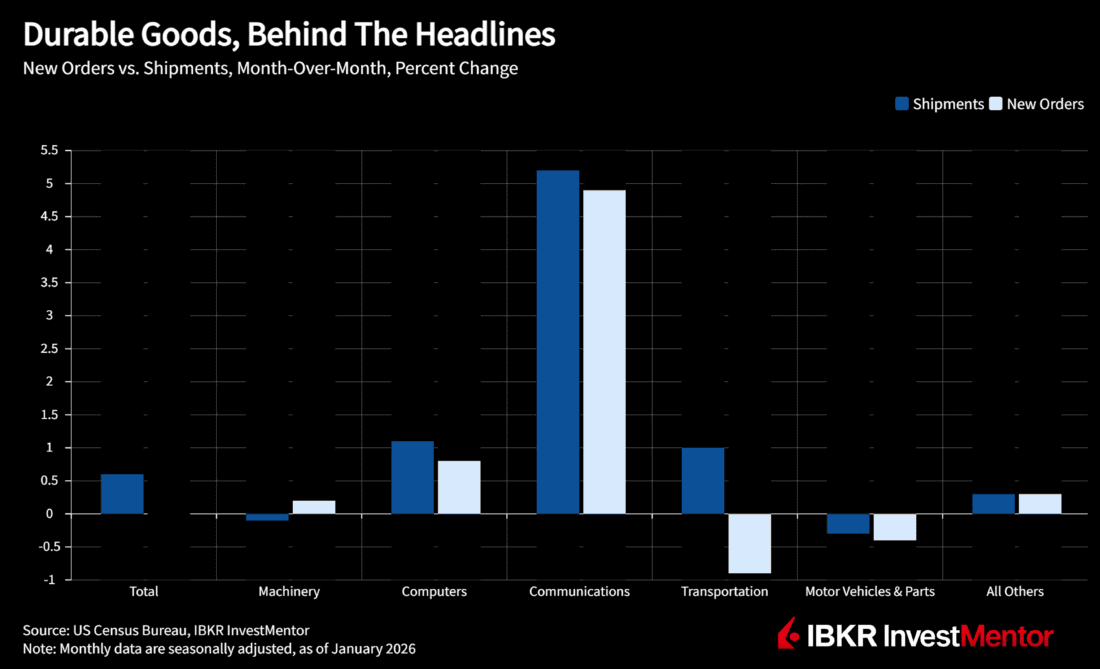
The lack of growth in the headline number was largely driven by transportation equipment, which declined during the month. Aircraft orders, in particular, tend to be lumpy and can distort the overall picture.
Outside of transportation, several categories showed resilience:
One of the most closely watched components, non‑defense capital goods excluding aircraft, often viewed as a proxy for business investment, was unchanged after rising the prior month. That suggests companies are still investing, but not accelerating their spending.
The latest durable goods report points to an economy that is cooling, but not stalling.
Businesses appear cautious, choosing to maintain current investment levels rather than expand aggressively. Consumers and firms continue to spend selectively, particularly on essential or productivity‑enhancing equipment.
In other words, confidence hasn’t disappeared, but it also hasn’t surged. For markets, this kind of data supports a wait‑and‑see environment, where growth continues at a measured pace rather than reaccelerating sharply.
To learn mor about how economic indicators impact you, download the IBKR InvestMentor App!
IBKR InvestMentor (dba “InvestMentor”) is a service of Interactive Academy LLC, an affiliate of IB LLC and majority-owned by IBG LLC. All content provided by InvestMentor is for informational and educational purposes only and should not be interpreted as implying any sponsorship, partnership, endorsement, recommendation, or approval by IB LLC or its affiliates.
Information posted on IBKR Campus that is provided by third-parties does NOT constitute a recommendation that you should contract for the services of that third party. Third-party participants who contribute to IBKR Campus are independent of Interactive Brokers and Interactive Brokers does not make any representations or warranties concerning the services offered, their past or future performance, or the accuracy of the information provided by the third party. Past performance is no guarantee of future results.
This material is from InvestMentor, an affiliate of Interactive Brokers LLC, and is being posted with its permission. The views expressed in this material are solely those of the author and/or InvestMentor and Interactive Brokers is not endorsing or recommending any investment or trading discussed in the material. This material is not and should not be construed as an offer to buy or sell any security. It should not be construed as research or investment advice or a recommendation to buy, sell or hold any security or commodity. This material does not and is not intended to take into account the particular financial conditions, investment objectives or requirements of individual customers. Before acting on this material, you should consider whether it is suitable for your particular circumstances and, as necessary, seek professional advice.
Related Articles















Join The Conversation
For specific platform feedback and suggestions, please submit it directly to our team using these instructions.
If you have an account-specific question or concern, please reach out to Client Services.
We encourage you to look through our FAQs before posting. Your question may already be covered!