
- Solve real problems with our hands-on interface
- Progress from basic puts and calls to advanced strategies
Interactive Options Course

Posted February 12, 2026 at 10:45 am
Crypto’s next phase is not about survival or price discovery. It is about implementation.
As we head into 2026, the edge no longer comes from spotting the next narrative. It comes from treating crypto as a portfolio allocation: accessed cleanly, sized deliberately and governed with discipline.
For investors who approach it this way, crypto is increasingly less exotic and more usable.
Why this matters now
Crypto has moved on from its retail-led, boom-bust adolescence. Infrastructure largely works, regulation is tightening rather than retreating and capital is behaving more like institutional capital.
This changes the rules of engagement.
The key shift is subtle but decisive as the debate has moved from “Should we own crypto?” to “How do we implement it responsibly?”
This matters in today’s macro context, where traditional diversification is under strain: inflation risk has proven persistent, fiscal dominance is re-emerging, equity–bond correlations have become unreliable, and investors lack differentiated return drivers.
Three themes shaping institutional crypto allocations
1. Institutional normalisation accelerates
Crypto is becoming more predictable in how it is accessed and governed.
Figure 1: As bitcoin ownership consolidates into institutional hands, its realised volatility compresses

| Category | Number of bitcoins | Per cent of total bitcoin supply |
|---|---|---|
| ETPs | 1,502,560 | 7.2% |
| Public companies | 1,108,080 | 5.3% |
| Governments | 647,042 | 3.1% |
| Decentralised finance (DeFi) | 372,377 | 1.8% |
| Private companies | 288,012 | 1.4% |
| Exchanges/custodians | 145,993 | 0.7% |
| Total | 4,064,064 | 19.4% |
Source: Bitcoin Treasuries, Artemis Terminal. 19 January 2026. Bitcoin total supply is 21,000,000. Historical performance is not an indication of future performance, and any investment may go down in value.
This is what happens as asset classes mature: narrative gives way to function, while access and governance begin to matter as much as upside.
Allocator takeaway: implementation quality increasingly drives outcomes, not just asset selection.
2. Income moves to centre stage
The long-standing ‘no yield’ objection to crypto is fading.
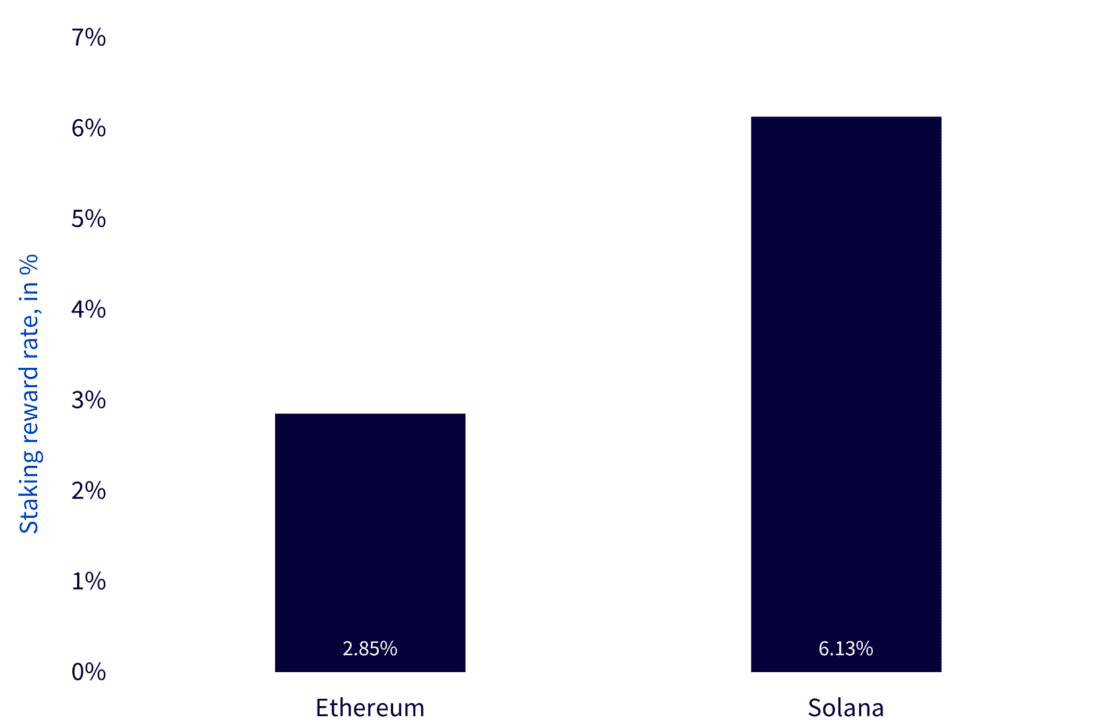
Staking has turned parts of the market from pure beta exposure into total return assets. Crucially, this income is protocol-native rather than leverage-driven or credit-dependent.
Figure 2: Staking reward comparison
Source: Staking Rewards. 20 January 2026. Historical performance is not an indication of future performance, and any investment may go down in value.
Portfolio implication: layered crypto income. Ethereum anchors on depth and institutional maturity, while Solana introduces cyclical, higher-beta income exposure. Income does not eliminate volatility, but it changes the return profile and the investor behaviour around it.
3. Portfolio integration deepens
Crypto is migrating out of the ‘alternatives’ bucket and into mainstream asset-allocation discussions, alongside gold, commodities and other diversifiers.
A growing body of academic and practitioner research suggests that small, disciplined allocations can improve portfolio efficiency over full cycles. Outcomes remain regime-dependent and implementation-sensitive, but the diversification case is no longer theoretical.
Figure 3: Small bitcoin allocations have historically improved portfolio risk/return metrics
| 60/40 Global Portfolio | 1% Bitcoin Portfolio | 3% Bitcoin Portfolio | 5% Bitcoin Portfolio | 10% Bitcoin Portfolio | MSCI AC World | Bloomberg Multiverse | Bitcoin | |
|---|---|---|---|---|---|---|---|---|
| Annualised Return | 6.40% | 7.01% | 8.23% | 9.44% | 12.43% | 9.83% | 1.01% | 48.75% |
| Volatility | 8.76% | 8.83% | 9.12% | 9.57% | 11.30% | 13.90% | 4.99% | 65.30% |
| Sharpe Ratio | 0.52 | 0.59 | 0.70 | 0.80 | 0.94 | 0.58 | -0.16 | 0.72 |
| Information Ratio | 0.93 | 0.93 | 0.92 | 0.92 | ||||
| Sortino Ratio | 0.63 | 0.71 | 0.86 | 0.98 | 1.20 | 0.68 | -0.22 | 0.97 |
| Beta | 69% | 71% | 73% | 75% | 80% | 100% | 24% | 178% |
Source: Bloomberg, WisdomTree. From 31 December 2013 to 31 December 2025. Based on daily USD returns. The 60/40 Global Portfolio is composed of 60% MSCI All Country World and 40% Bloomberg Multiverse. You cannot invest directly in an index. Historical performance is not an indication of future performance, and any investment may go down in value.
Crypto rewards allocators, not traders.
Beyond single tokens: why structure is overtaking selection
As governance scrutiny increases, portfolio construction is overtaking token selection.
Rules-based crypto basket ETPs directly address two persistent investor errors:
Crypto baskets introduce index discipline, diversification and systematic rebalancing. They sacrifice lottery outcomes in exchange for repeatable, risk-adjusted participation.
This mirrors the evolution of equity investing itself, from stock picking to structured exposure, and reflects where crypto is heading as it integrates into portfolios.
Risks and reality checks
None of this removes risk. Crypto remains volatile, sentiment-driven at times and exposed to regulatory and technological uncertainty, with correlations rising sharply in stress regimes and staking returns not guaranteed.
The case for crypto in 2026 is not maximal exposure, but optimal exposure.
The key takeaway
Crypto in 2026 is increasingly defined by integration. The objective is not to maximise exposure, but to allocate at a level that is meaningful while remaining consistent with overall portfolio risk.
For investors focused on access, sizing and governance, crypto is becoming an asset class that can be held, monitored and rebalanced within a broader portfolio framework.
The opportunity is therefore less about belief and more about disciplined implementation.
—
Originally Posted February 12, 2026 – Crypto in 2026: from a narrative trade to an institutional portfolio allocation
This material is prepared by WisdomTree and its affiliates and is not intended to be relied upon as a forecast, research or investment advice, and is not a recommendation, offer or solicitation to buy or sell any securities or to adopt any investment strategy. The opinions expressed are as of the date of production and may change as subsequent conditions vary. The information and opinions contained in this material are derived from proprietary and non-proprietary sources. As such, no warranty of accuracy or reliability is given and no responsibility arising in any other way for errors and omissions (including responsibility to any person by reason of negligence) is accepted by WisdomTree, nor any affiliate, nor any of their officers, employees or agents. Reliance upon information in this material is at the sole discretion of the reader. Past performance is not a reliable indicator of future performance.
Please click here for our full disclaimer.
Jurisdictions in the European Economic Area (“EEA”): This content has been provided by WisdomTree Ireland Limited, which is authorised and regulated by the Central Bank of Ireland.
Jurisdictions outside of the EEA: This content has been provided by WisdomTree UK Limited, which is authorised and regulated by the United Kingdom Financial Conduct Authority.
Information posted on IBKR Campus that is provided by third-parties does NOT constitute a recommendation that you should contract for the services of that third party. Third-party participants who contribute to IBKR Campus are independent of Interactive Brokers and Interactive Brokers does not make any representations or warranties concerning the services offered, their past or future performance, or the accuracy of the information provided by the third party. Past performance is no guarantee of future results.
This material is from WisdomTree Europe and is being posted with its permission. The views expressed in this material are solely those of the author and/or WisdomTree Europe and Interactive Brokers is not endorsing or recommending any investment or trading discussed in the material. This material is not and should not be construed as an offer to buy or sell any security. It should not be construed as research or investment advice or a recommendation to buy, sell or hold any security or commodity. This material does not and is not intended to take into account the particular financial conditions, investment objectives or requirements of individual customers. Before acting on this material, you should consider whether it is suitable for your particular circumstances and, as necessary, seek professional advice.
Cryptocurrency based Exchange Traded Products (ETPs) are high risk and speculative. Cryptocurrency ETPs are not suitable for all investors. You may lose your entire investment. For more information please view the RISK DISCLOSURE REGARDING COMPLEX OR LEVERAGED EXCHANGE TRADED PRODUCTS.
Any discussion or mention of an ETF is not to be construed as recommendation, promotion or solicitation. All investors should review and consider associated investment risks, charges and expenses of the investment company or fund prior to investing. Before acting on this material, you should consider whether it is suitable for your particular circumstances and, as necessary, seek professional advice.
Trading in digital assets, including cryptocurrencies, is especially risky and is only for individuals with a high risk tolerance and the financial ability to sustain losses. Eligibility to trade in digital asset products may vary based on jurisdiction.
TRADING IN BITCOIN FUTURES IS ESPECIALLY RISKY AND IS ONLY FOR CLIENTS WITH A HIGH RISK TOLERANCE AND THE FINANCIAL ABILITY TO SUSTAIN LOSSES. More information about the risk of trading Bitcoin products can be found on the IBKR website. If you're new to bitcoin, or futures in general, see Introduction to Bitcoin Futures.
For specific platform feedback and suggestions, please submit it directly to our team using these instructions.
If you have an account-specific question or concern, please reach out to Client Services.
We encourage you to look through our FAQs before posting. Your question may already be covered!
Related Articles
















Добавил в избранное, очень нравится ваш сайт!!!
If you wish for to take much from this post then you
have to apply such strategies to your won website.