
- Solve real problems with our hands-on interface
- Progress from basic puts and calls to advanced strategies
Interactive Options Course

Posted February 6, 2026 at 12:17 pm
The world’s largest technology companies have entered a new phase of the AI race where they seem to compete on the most shocking spending guidance.
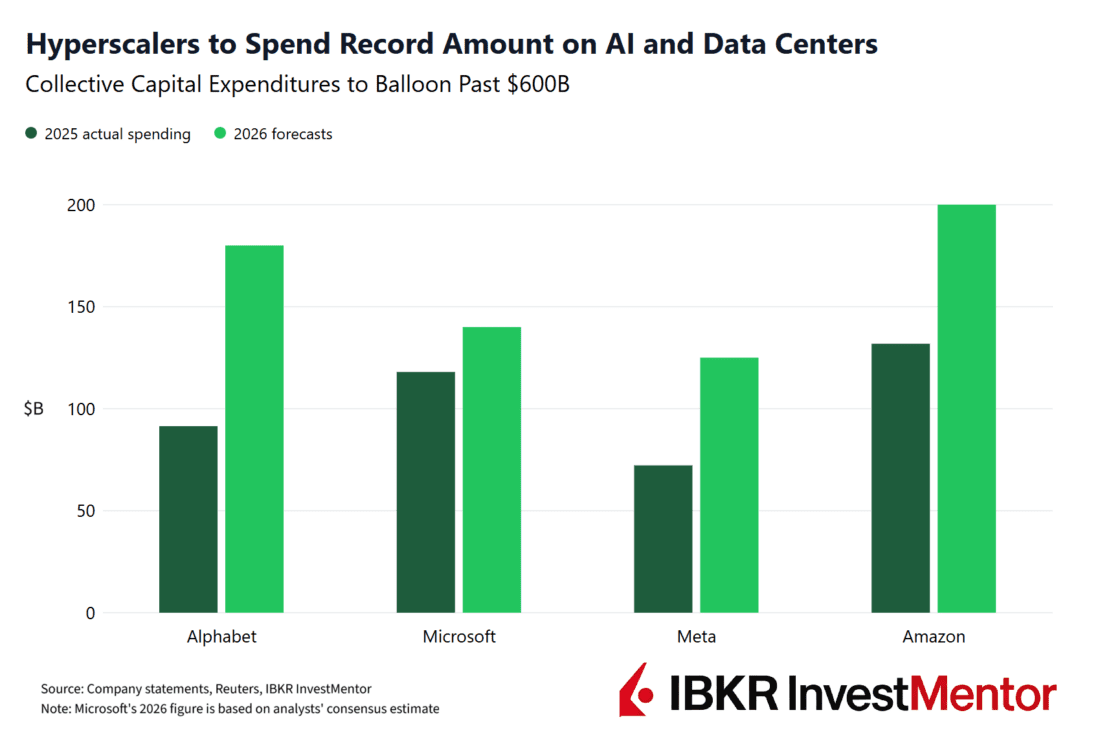
In the span of 48 hours, Amazon and Alphabet unveiled such huge capital expenditure plans that they rattled markets, overshadowed earnings, and forced investors to confront the uncomfortable question: how much will artificial intelligence really cost?
So far, the answer seems to be far more than analysts expect.
Meanwhile, Apple is investing in AI, but on a much smaller scale. Its quarterly capital spending decreased from a year earlier to just $2.4 billion. It doesn’t seem to be interested in becoming one of the hyperscalers — big cloud providers pouring money in data centers and high-end chips.
Behind every generative model is physical infrastructure that is expanding faster than most forecasts anticipated. Training and running AI systems requires:
Microsoft disclosed that two‑thirds of its record capex last quarter went into “short‑lived assets” — mainly Nvidia’s chips. These components depreciate quickly, meaning the spending cycle is not only large but continuous.
The industry is also running into real‑world constraints. Data centers already consume roughly 1.5% of global electricity, and demand is rising. Power availability, land use, and water consumption are becoming limiting factors in several regions. Even with cleaner energy sources, growth may slow unless operators redesign facilities or secure new power deals.
This pressure is driving more experimental ideas too. Elon Musk’s SpaceX–xAI merger aims to explore orbital data centers, while others are betting on breakthroughs like fusion power to keep future AI systems running.
Whether these materialize or not, they highlight the scale of the challenge: AI’s growth is colliding with physical limits.
While the deep-pocketed tech giants accelerate spending on hardware and infrastructure, the biggest plunges are happening amid software companies that can’t afford or don’t want to become hyperscalers.
The S&P 500 Software Index has fallen more than 18% since the start of 2026, with business and legal software firms hit particularly hard. A recent catalyst was Anthropic’s expansion of Claude Cowork, which introduced plugins capable of automating tasks across legal, sales, marketing, and data analysis.
US-listed companies like ServiceNow, Thomson Reuters, Oracle, Figma, and Atlassian have seen sharp declines. In Europe, names like SAP, LSEG, and Capgemini are under pressure. Investors are questioning whether traditional software models can maintain pricing power when AI tools increasingly automate the workflows they sell.
At the moment, the AI boom doesn’t seem to be about who builds the smartest model (there’s a new favorite out every few months), but who can afford the infrastructure to keep those models running. The costs are enormous, the timelines wobbly, and the demand uncertain.
The AI revolution was sold as software magic. It’s turning out to be a capital‑intensive, resource‑hungry industrial revolution. The winners will be the firms that can turn their massive investments into a durable advantage, not just headlines. In a market defined by ambition and burn rates, discipline may end up being the rarest and most valuable asset of all.
To learn more about tech stocks and everything else related to investing, download IBKR InvestMentor.
Information posted on IBKR Campus that is provided by third-parties does NOT constitute a recommendation that you should contract for the services of that third party. Third-party participants who contribute to IBKR Campus are independent of Interactive Brokers and Interactive Brokers does not make any representations or warranties concerning the services offered, their past or future performance, or the accuracy of the information provided by the third party. Past performance is no guarantee of future results.
This material is from IBKR InvestMentor, an affiliate of Interactive Brokers LLC, and is being posted with its permission. The views expressed in this material are solely those of the author and/or IBKR InvestMentor and Interactive Brokers is not endorsing or recommending any investment or trading discussed in the material. This material is not and should not be construed as an offer to buy or sell any security. It should not be construed as research or investment advice or a recommendation to buy, sell or hold any security or commodity. This material does not and is not intended to take into account the particular financial conditions, investment objectives or requirements of individual customers. Before acting on this material, you should consider whether it is suitable for your particular circumstances and, as necessary, seek professional advice.
Related Articles




















Join The Conversation
For specific platform feedback and suggestions, please submit it directly to our team using these instructions.
If you have an account-specific question or concern, please reach out to Client Services.
We encourage you to look through our FAQs before posting. Your question may already be covered!