
- Solve real problems with our hands-on interface
- Progress from basic puts and calls to advanced strategies
Interactive Options Course
Posted December 23, 2025 at 12:38 pm
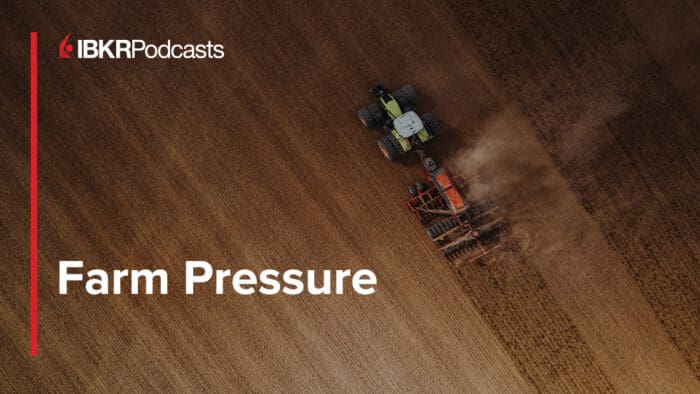
As 2025 winds down, host Andrew Wilkinson is joined by Dan Basse, President of AgResource, to break down a turbulent year in grain markets and what it meant for U.S. farmers. From China’s soybean demand to global oversupply and tight farm margins, they explore whether relief is coming or if 2026 brings more of the same.
The following is a summary of a live audio recording and may contain errors in spelling or grammar. Although IBKR has edited for clarity no material changes have been made.
Welcome to the week’s episode as 2025 stutters to an end here. With me to discuss food commodity prices and a year in the grain markets is Dan Basse, President of AgResource in Chicago, Illinois. Welcome back to the show, Dan. How are you?
I am really good, uh, Andrew. Glad to be back. And, uh, boy, did the year go fast already. It seems like, uh, how did we get to, uh, December? But we’re..
I know. Well, how would you characterize 2025, Dan? What sort of a year has it been for the U.S. farmer, all in all?
You know, we in agriculture think a lot about fences, obviously, because fences, uh, uh, give us, uh, the ability to keep livestock on one side of a pasture or extreme to the other. You know, as I think about the fence this year in ag, in agriculture, I mean, the grain, the row crop farmer did not have a good year. But the livestock farmer, whether he be in cattle or maybe even pork or poultry, did very well. So it depends on which side of the fence you sit on. You know, the grain farmer is just getting some help from the Trump administration. He just approved $12 billion of additional aid. Uh, this will be doled out in the first quarter of next year. We don’t have the specifics yet, but $11 billion go to the row crop farmer, whether he is cotton, corn, soybeans, or wheat. And so that will be helpful. He is suffering. The row crop farmer has endured his third year of losses, and so, uh, he’s looking for somehow to mend those losses in 2026 through either higher prices or a lower cost of production.
Now this, as you kind of alluded to there, this is—this has been a year all about trade talks, tariffs, and all the rest of it. Um, China, since we last spoke, has resumed soybean imports from the United States following trade talks, successful trade talks, in the late summer. How successful were U.S. talks really, Dan?
Well, you know, as you look at them, um, we did see China come back as a buyer of size and substance for U.S. soybeans. Twelve million metric tons is what, uh, President Trump and the presidency agreed to in their October 30th meeting. However, that pales in comparison to last year’s 21 and a half million tons, and 2023’s was, uh, going to be up around 24 and a half. So it is—it is something, but the soybean market, uh, has not rallied, uh, uh, once the announcement came out. China has been relatively aggressive in buying these soybeans. By my count here at the end of December, we’re up about 9 million metric tons, so there’s another 3 million metric tons to buy. That being said, the soybean market is nearly back to where the announcement first came out, which is at $10.50 a bushel before Trump and Z got together. We’re sitting at around $10.30, so we’re a little better, but it’s not providing profitability for the soybean farm.
What’s the outlook now over the winter for the farmer?
Well, if—if—if I can just, uh, use a little bit of the Chinese, uh, to start with, and then we’ll migrate southward to South America. You know, China, according to the White House, has pledged to buy 25 million tons of soybeans in 2026, similar amount in ’27 and ’28. Yet as I talk to the Chinese, uh, they are telling me that China has not fully agreed to that. And so if we don’t get that agreement, we kind of end up to where we all started from, which is the Chinese again holding soybeans as a trade lever against the United States, maybe during the late summer or early autumn, as U.S. farmers get to harvest another crop next year. So I’m concerned about diminished Chinese demand for U.S. soybeans and further falls in U.S. soybean exports, putting a lot of reliance on biofuels and crush in the United States. Outside of that, uh, we’ve got a monster crop that is being planted, or has been planted, is now developing and soon to be harvested in Brazil. A lot of people are looking for the Brazilian soybean crop to be, you know, somewhere in the vicinity of 180 million metric tons. That compares to last year’s record 171 million metric tons. So there’s no shortage of, uh, soybeans or corn or wheat in exportable positions. From my perch, unless we have a weather problem, Andrew, or unless China changes its way in terms of its buying of U.S. soybeans, prices, at least for the grain markets, uh, look to be sideways to lower as we look to the first half of 2026.
Thereafter, it’s all about the U.S. growing season, what U.S. farmers do. But from now until then, I don’t have a lot of excitement to offer the listeners in terms of soybeans, corn, or wheat, or U.S. farm profitability.
Dan Basse, President of AgResource over in Chicago, Illinois. Thank you for joining me on today’s episode.
Thank you, Andrew. It’s been a pleasure to be with you, and—and—and happy holidays to all the listeners, and I look forward to 2026.
Thank you very much, Dan, and thanks to the audience for listening. And please remember to like and subscribe to this channel wherever you download your podcast from. Thanks, Dan.
The analysis in this material is provided for information only and is not and should not be construed as an offer to sell or the solicitation of an offer to buy any security. To the extent that this material discusses general market activity, industry or sector trends or other broad-based economic or political conditions, it should not be construed as research or investment advice. To the extent that it includes references to specific securities, commodities, currencies, or other instruments, those references do not constitute a recommendation by IBKR to buy, sell or hold such investments. This material does not and is not intended to take into account the particular financial conditions, investment objectives or requirements of individual customers. Before acting on this material, you should consider whether it is suitable for your particular circumstances and, as necessary, seek professional advice.
The views and opinions expressed herein are those of the author and do not necessarily reflect the views of Interactive Brokers, its affiliates, or its employees.
Futures are not suitable for all investors. The amount you may lose may be greater than your initial investment. Before trading futures, please read the CFTC Risk Disclosure. A copy and additional information are available at ibkr.com.









Join The Conversation
For specific platform feedback and suggestions, please submit it directly to our team using these instructions.
If you have an account-specific question or concern, please reach out to Client Services.
We encourage you to look through our FAQs before posting. Your question may already be covered!