
- Solve real problems with our hands-on interface
- Progress from basic puts and calls to advanced strategies
Interactive Options Course

Posted April 10, 2026 at 9:48 am
Intuition Behind Skew and Fat Tails
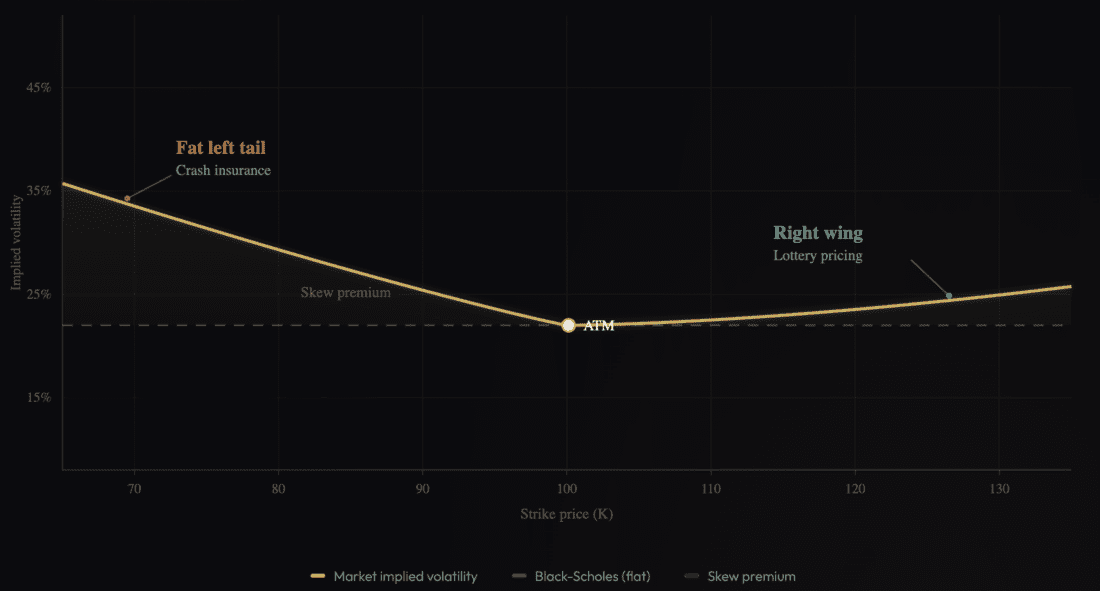
The volatility surface is a forward-looking representation of the market’s risk-neutral probability distribution of the underlying asset.
While the Black–Scholes model assumes a lognormal distribution of returns and a flat volatility surface, empirical observations consistently show pronounced skew and kurtosis, often described as the “volatility smile.”
Under risk-neutral pricing, option values can be expressed as discounted expectations of payoffs:

Risk-neutral pricing representation
where C(K,T) is the call price at strike K and maturity T. Differentiating twice with respect to strike yields the risk-neutral density:

Extracting risk-neutral density
where qT(K) is the implied probability density of ST. Thus, the curvature of the option price surface reveals the underlying distribution.
Two stylized cases highlight the connection:
Stock A: 50% probability of doubling to 200, 50% probability of going to 0. This symmetric distribution around 100 generates moderate option prices and relatively flat skew.
Stock B (biotech case): 90% probability of going to 0, 10% probability of surging to 1000. Despite the same expected value (100), option prices differ dramatically. Deep out-of-the-money calls are highly valued, producing a strongly right-skewed implied distribution.
Both assets have identical spot prices, yet their option surfaces encode distinct higher moments (skewness and kurtosis).
Empirically, equity index options display downside skew:
The volatility smile is therefore not a model failure, but an adjustment: markets systematically assign greater probability mass to tail outcomes than a lognormal distribution would imply.
Information posted on IBKR Campus that is provided by third-parties does NOT constitute a recommendation that you should contract for the services of that third party. Third-party participants who contribute to IBKR Campus are independent of Interactive Brokers and Interactive Brokers does not make any representations or warranties concerning the services offered, their past or future performance, or the accuracy of the information provided by the third party. Past performance is no guarantee of future results.
This material is from Quant Insider and is being posted with its permission. The views expressed in this material are solely those of the author and/or Quant Insider and Interactive Brokers is not endorsing or recommending any investment or trading discussed in the material. This material is not and should not be construed as an offer to buy or sell any security. It should not be construed as research or investment advice or a recommendation to buy, sell or hold any security or commodity. This material does not and is not intended to take into account the particular financial conditions, investment objectives or requirements of individual customers. Before acting on this material, you should consider whether it is suitable for your particular circumstances and, as necessary, seek professional advice.
Options involve risk and are not suitable for all investors. For information on the uses and risks of options, you can obtain a copy of the Options Clearing Corporation risk disclosure document titled Characteristics and Risks of Standardized Options by going to the following link ibkr.com/occ. Multiple leg strategies, including spreads, will incur multiple transaction costs.












Join The Conversation
For specific platform feedback and suggestions, please submit it directly to our team using these instructions.
If you have an account-specific question or concern, please reach out to Client Services.
We encourage you to look through our FAQs before posting. Your question may already be covered!