
- Solve real problems with our hands-on interface
- Progress from basic puts and calls to advanced strategies
Interactive Options Course

Posted September 16, 2025 at 12:00 pm
For the next installment of the Risks of Shorting Series, we will dive into how another type of corporate action can influence traders on the short side. Part III detailed the mechanics of dividend distributions for short holders and the impact they can have on borrow fees. Next up we will look at what happens when a spinoff takes place.
A spinoff occurs when a company decides to separate an existing division of the parent firm into its own entity. The once-consolidated firm breaks off the division to function on its own, resulting in two independent entities. As a shareholder of the parent firm, owners will receive shares of the spinoff through a special stock dividend and hold both companies in their portfolio.
Take for example the hypothetical company ABC Auto, an automotive manufacturer which produces engines and tires. Management is struggling to maintain both production lines and decides to separate the two divisions. ABC will create a new and separate entity for the tire business called XYZ Tires. The company makes the news public and announces that shareholders will receive one share of spinoff XYZ for every five they own of parent ABC. But what happens to short holders of ABC?
The same transaction would apply to the short side as the long, but in reverse. The short holder is “held liable” to the lender. The lender is entitled to receive the long shares of the spinoff, and these shares are provided by the short holder. The short holder will in turn be short the newly spun-off shares. In the example above of a shareholder receiving one share of the new entity for every five they own of the parent, the opposite would occur for the shorts. If short 5 shares of ABC, a short of 1 XYZ Tire will be reflected in the portfolio upon processing.
In July of 2023, Johnson & Johnson (NYSE:JNJ) announced they would be spinning off consumer health company Kenvue Inc. (NYSE:KVUE). JNJ would sell over 80% of their holding in the firm and deliver a maximum of ~8 shares of KVUE common stock at a 7.53% discount in exchange for 1 share of tendered JNJ common stock. JNJ holders had the right, but not the obligation, to tender their JNJ shares to receive KVUE stock. This is called a “voluntary” corporate action because JNJ holders could choose not to participate. If too many JNJ shares would be tendered, the tendered shares would become subject to “proration.” Proration means that JNJ would accept only some of the tendered shares in exchange for KVUE and would return the others. KVUE would become a fully independent company after the separation with JNJ.
The results of the deal were a proration of 23% and a final exchange ratio of 8.055 KVUE for every JNJ share accepted. Long holders who did not tender JNJ kept their JNJ shares. JNJ accepted only 23 shares of every 100 JNJ tendered. Therefore, long holders who tendered 100 JNJ received 185 shares of KVUE and were returned 77 shares of JNJ. Short holders of 100 shares of JNJ would be held liable for 185 shares of KVUE if the lender tendered 100 shares. Operationally, their account would reflect a new short position of –185 KVUE. The short holder can continue holding the short position and does not need to buy back KVUE as long as their broker can maintain the borrow.
The short holder would be subject to borrow fees on KVUE, which may or may not be higher than JNJ. This is a risk for short sellers. Firstly, the short seller was making a bet against JNJ, not KVUE. The new entity will trade of its own accord and not rely on JNJ for performance. Investors would have to evaluate KVUE separately to assess its value. Secondly, there is a risk of KVUE becoming a popular short and the borrow fee significantly increasing.
The announcement for the spinoff was made on July 24th and the short market was immediately impacted. The week prior on July 17th, KVUE had a Utilization of 13% and On-Loan Quantity of 11 million shares. Both figures immediately increased with the news and continued rising to 90% and 218 million shares, respectively, on the date of the spinoff.
Kenvue Inc. (NYSE:KVUE) On-Loan Quantity and Utilization (July 2023-Aug 2023)

Source: Interactive Brokers Securities Lending Dashboard. Data is provided by Orbisa.
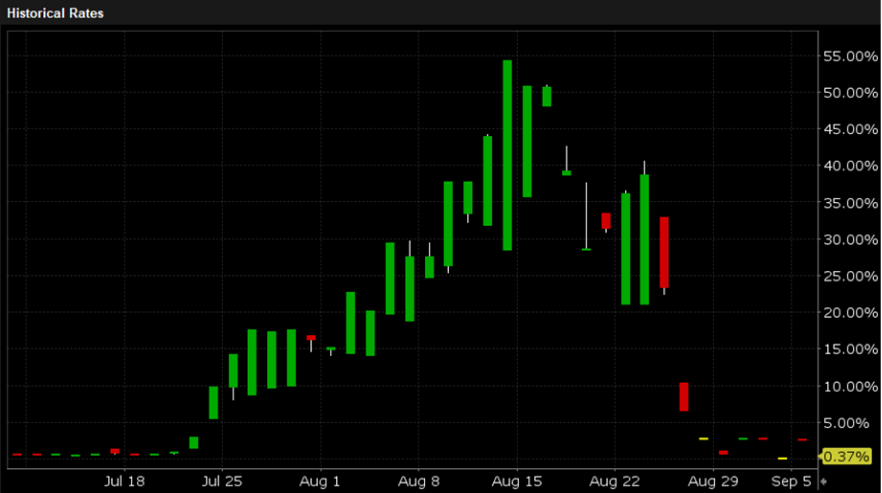
The borrow fee followed the same trend. Prior to the spinoff news, KVUE’s borrow fee was 0.37%. The rate began ticking up each day as the payment date approached, ultimately reaching a peak of 55%. The increase coincides with the Utilization and On-Loan Quantity as more traders were shorting KVUE prior to the distribution of the spinoff shares.
KVUE Historical Fee Rates (July 2023-Sept 2023)
Source: IBKR Trader Workstation – SLB Rates
Why did the borrow fee and short demand increase gradually from the announcement up to the date of the spinoff? Traders look to take advantage of an arbitrage opportunity. One complex strategy to capture the discount on KVUE shares involves buying $100 of JNJ, tendering JNJ, and selling short $108 KVUE. The KVUE short will be collapsed by the shares received from the tender. The trader would capture $8 (not taking proration into account).
Some traders may believe that KVUE shares flooding the market will depress KVUE’s stock price. That belief proved to be prescient.
After the announcement of the spinoff and up to the date of its completion, the shorting demand for KVUE gradually rose before going back down to pre-announcement levels. When the announcement was made on 7/24/2023, KVUE was trading at $24.12. When the spinoff was made effective on 8/21/2023, the stock price decreased to $23.02, almost a 5% loss.
This strategy could have netted short sellers a profit should they have entered the short at $24.12 and bought back at $23.02. A 100 share short position would provide a $110 profit before commissions and fees. But borrow fees should be considered to determine the profitability of a short trade, particularly with the sharp rise in the rate. Based on the previous chart with the KVUE borrow rate from end of July to early September 2023, let’s say that the average rate was 30%. With a short position value of $2,412, a 30% fee would come out to $2.01 per day. Holding the short for 28 days would cost $56.28. The once $110 profit is now halved with the trader walking away with $53.72.
This example shows that short position holders of both JNJ and KVUE took on extra risk due to a corporate action. The JNJ shorts were held liable for a KVUE short with the quantity dependent on whether the lender tendered, continuing to pay borrow fees (unless they bought to cover it). And KVUE shorts were charged higher borrow fees as demand outstripped supply. Short sellers need to understand how corporate actions can affect their P&L.
Information posted on IBKR Campus that is provided by third-parties does NOT constitute a recommendation that you should contract for the services of that third party. Third-party participants who contribute to IBKR Campus are independent of Interactive Brokers and Interactive Brokers does not make any representations or warranties concerning the services offered, their past or future performance, or the accuracy of the information provided by the third party. Past performance is no guarantee of future results.
This material is from IBKR Securities Lending Desk, an affiliate of Interactive Brokers LLC, and is being posted with its permission. The views expressed in this material are solely those of the author and/or IBKR Securities Lending Desk and Interactive Brokers is not endorsing or recommending any investment or trading discussed in the material. This material is not and should not be construed as an offer to buy or sell any security. It should not be construed as research or investment advice or a recommendation to buy, sell or hold any security or commodity. This material does not and is not intended to take into account the particular financial conditions, investment objectives or requirements of individual customers. Before acting on this material, you should consider whether it is suitable for your particular circumstances and, as necessary, seek professional advice.
Short selling is an advanced trading strategy involving potentially unlimited risks and must be done in a margin account.
Trading on margin is only for experienced investors with high risk tolerance. You may lose more than your initial investment. For additional information regarding margin loan rates, see ibkr.com/interest
Day Trading can be extremely risky and may not be appropriate for individuals with limited resources, investment experience or low risk tolerance. Please review the Day Trading Risk Disclosure Statement before deciding whether Day Trading is appropriate for you.
Related Articles















Join The Conversation
For specific platform feedback and suggestions, please submit it directly to our team using these instructions.
If you have an account-specific question or concern, please reach out to Client Services.
We encourage you to look through our FAQs before posting. Your question may already be covered!