Close Navigation
FinTech Credit and Entrepreneurial Growth

FinTech Credit and Entrepreneurial Growth

Posted October 29, 2024 at 11:56 am

Elisabetta Basilico, Ph.D., CFA
Alpha Architect

The article “FinTech Credit and Entrepreneurial Growth” first appeared on Alpha Architect blog.

This paper examines the impact of FinTech credit on the growth of small firms in China’s e-commerce sector. By leveraging a regression discontinuity design, the study provides causal evidence that access to automated online credit boosts sales, transactions, and customer capital for firms, particularly in regions underserved by traditional banks.

FinTech Credit and Entrepreneurial Growth

  • Harald Hau, Yi Huang, Chen Lin, Hongzhe Shan, Zixia Sheng, Lai Wei
  • Journal of Finance, 2024
  • A version of this paper can be found here
  • Want to read our summaries of academic finance papers? Check out our Academic Research Insight category

What are the Research Questions?

The main research questions addressed in this paper can be summarized as follows:

  1. What is the causal impact of FinTech credit on entrepreneurial growth?
  2. Can FinTech credit alleviate the credit constraints faced by small firms, particularly in emerging economies like China?
  3. What are the mechanisms through which FinTech credit fosters firm growth?
  4. How do factors like the cost of loan distribution and the quality of the legal environment affect the growth benefits of FinTech credit?

What are the Academic Insights?

By analysing data from Alibaba’s Taobao platform, the authors find:

  1. The causal impact of FinTech credit on entrepreneurial growth is significant. Firms that gain access to FinTech credit experience notable growth in their business performance. In fact, the study finds that firms with access to FinTech credit see an 18% increase in sales and a 13% rise in transaction volumes in the average month following credit approval. Additionally, firms with credit access receive higher customer ratings for product quality, service, and consignment (logistics), reflecting improved customer satisfaction and loyalty. These ratings increase by around 0.05 points on a standardized scale, demonstrating enhanced customer relationships and long-term value. Finally, firms use FinTech credit to invest in advertising, expand product offerings, and improve conversion rates from webpage visitors to customers, thus driving further growth.
  2. Yes, the paper provides evidence that FinTech credit can alleviate the credit constraints faced by small firms, particularly in emerging economies like China. Specifically, the study shows that:
    • FinTech credit compensates for the shortage of traditional bank credit, particularly in regions where state-owned enterprises (SOEs) dominate and crowd out small private firms from accessing bank loans
    • FinTech lenders, such as Ant Group, use real-time transaction data and automated credit evaluations to provide loans more efficiently and at lower cost, allowing small firms to access much-needed capital
    • FinTech credit helps integrate China’s fragmented credit market by providing uniform access to credit across different regions. This is particularly important for small e-commerce vendors operating on platforms like Alibaba’s Taobao, who may otherwise be constrained by local banking practices
  3. FinTech credit fosters firm growth through several key mechanisms. First, firms use the credit to invest in essential business activities such as increasing advertising and expanding product offerings, which help attract more customers and boost sales. Additionally, access to credit enables firms to enhance customer service and improve customer experiences, leading to higher customer ratings and stronger loyalty, which are crucial for long-term growth. This improvement in customer capital supports sustainable business expansion. Firms with access to FinTech credit are also better at converting webpage visitors into paying customers and retaining them for future purchases. The credit helps firms meet short-term working capital needs, particularly during seasonal spikes in demand, ensuring they can maintain operations smoothly. Furthermore, FinTech lenders like Ant Group can monitor and enforce loan agreements in real time, reducing loan risks by relying less on external legal systems. Finally, FinTech lenders have lower loan distribution costs than traditional banks, making it more feasible for them to offer credit to smaller firms that banks might overlook, further promoting firm growth
  4. The growth benefits of FinTech credit are enhanced by lower loan distribution costs and less reliance on the legal environment. Traditional banks face high costs in lending to small firms, while FinTech lenders operate more efficiently online, allowing them to serve smaller firms at lower costs. In regions with weak legal systems, FinTech credit has a greater impact, as it relies on real-time monitoring and alternative enforcement, making it more accessible where traditional banks may avoid lending due to higher risks. Thus, FinTech credit is particularly beneficial where traditional credit constraints are more severe

Why does this study matter?

This study matters because it provides empirical evidence on how FinTech credit can significantly alleviate credit constraints for small firms, especially in emerging economies like China, where traditional banking systems often fail to serve small businesses effectively. By using advanced data-driven credit evaluations and automated lending processes, FinTech platforms offer an alternative to conventional bank loans, enabling small firms to access capital, grow their businesses, and improve customer relationships. The findings have broader implications for economic development, as they show how FinTech innovations can promote entrepreneurship and economic growth in regions where credit access is traditionally limited. Furthermore, the study contributes to a deeper understanding of the relationship between finance and firm growth, offering a model that could be applied in other emerging markets globally.
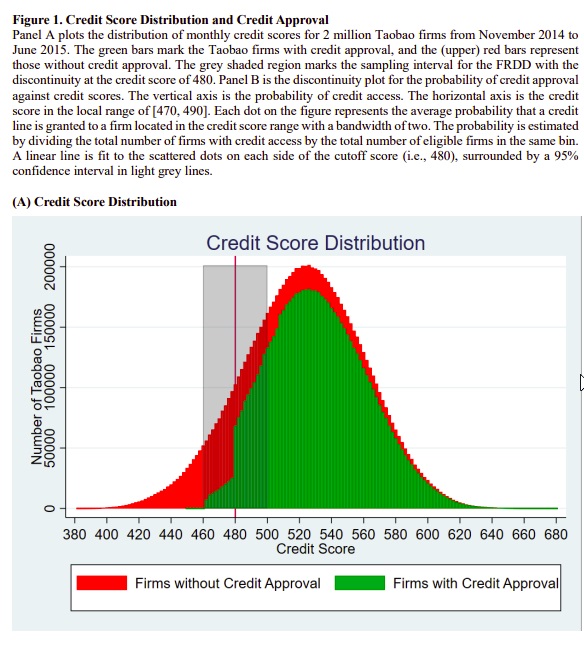
The Most Important Chart from the Paper:

Abstract

Based on automated credit lines to about two million vendors trading on Alibaba’s online retail
platform, and a discontinuity in the credit decision algorithm, we document that a vendor’s
access to FinTech credit boosts its sales growth, transaction growth, and the level of customer
satisfaction gauged by product, service, and consignment ratings. These effects are more
pronounced for vendors with (1) sparse credit information; (2) less collateral; (3) higher
distribution costs; and (4) weaker debt contract enforceability in local regions, all of which
reveal a FinTech advantage over traditional credit technology.

Join The Conversation

For specific platform feedback and suggestions, please submit it directly to our team using these instructions.

If you have an account-specific question or concern, please reach out to Client Services.

We encourage you to look through our FAQs before posting. Your question may already be covered!

Leave a Reply

Disclosure: Alpha Architect

The views and opinions expressed herein are those of the author and do not necessarily reflect the views of Alpha Architect, its affiliates or its employees. Our full disclosures are available here. Definitions of common statistics used in our analysis are available here (towards the bottom).

This site provides NO information on our value ETFs or our momentum ETFs. Please refer to this site.

Disclosure: Interactive Brokers Third Party

Information posted on IBKR Campus that is provided by third-parties does NOT constitute a recommendation that you should contract for the services of that third party. Third-party participants who contribute to IBKR Campus are independent of Interactive Brokers and Interactive Brokers does not make any representations or warranties concerning the services offered, their past or future performance, or the accuracy of the information provided by the third party. Past performance is no guarantee of future results.

This material is from Alpha Architect and is being posted with its permission. The views expressed in this material are solely those of the author and/or Alpha Architect and Interactive Brokers is not endorsing or recommending any investment or trading discussed in the material. This material is not and should not be construed as an offer to buy or sell any security. It should not be construed as research or investment advice or a recommendation to buy, sell or hold any security or commodity. This material does not and is not intended to take into account the particular financial conditions, investment objectives or requirements of individual customers. Before acting on this material, you should consider whether it is suitable for your particular circumstances and, as necessary, seek professional advice.


IBKR Campus Newsletters

This website uses cookies to collect usage information in order to offer a better browsing experience. By browsing this site or by clicking on the "ACCEPT COOKIES" button you accept our Cookie Policy.