
- Solve real problems with our hands-on interface
- Progress from basic puts and calls to advanced strategies
Interactive Options Course

Posted August 1, 2024 at 11:12 am
Recursive functions in Python are valuable for solving complex problems by calling themselves during execution and by breaking problems into smaller parts. In this blog, we will explore different types of recursive functions, their construction, and their problem-solving benefits. Efficient recursive functions are crucial in trading for performance and memory management.
We will examine their applications in trading, such as market data analysis and risk management, while addressing challenges like memory usage and debugging. Advanced topics like tail recursion and nested recursion will also be briefly covered. This knowledge enables traders to develop advanced strategies, enhance performance, and manage market complexities.
As Ken Thompson once said:
“One of my most productive days was throwing away 1000 lines of code.”
This is partially achievable with the help of “Recursive Functions in Python”!
Let us find out how with this blog that covers:
A recursive function in Python programming is a function that calls itself during its execution. This allows the function to repeat itself until it reaches a base case, which is a condition that stops the recursion. Recursive functions are often used to solve problems that can be broken down into smaller, similar subproblems.
Next, let us see an example of recursive functions in Python to learn about them in detail.
Here is a simple example to illustrate a recursive function:
def factorial(n):
   if n == 0:  # Base case
       return 1
   else:
       return n * factorial(n - 1)  # Recursive call

# Testing the function
print(factorial(5))
Recursive_example.py hosted with ❤ by GitHub
Output:
120
In this example, the factorial function calculates the factorial of a non-negative integer n. The base case is when n is 0, which returns 1. For other values of n, the function calls itself with n-1 and multiplies the result by n, thus building up the factorial value through recursive calls. ⁽¹⁾
Now we can move to the types of recursive functions in Python to learn how each type works.
In Python, recursive functions can be categorised into different types based on their structure and how they make recursive calls.⁽²⁾
The main types are:
A function directly calls itself within its own body.
Example:
def factorial(n):
   if n == 0:  # Base case
       return 1
   else:
       return n * factorial(n - 1)  # Recursive call

# Testing the function
print(factorial(5))
Recursive_example.py hosted with ❤ by GitHub
Output:
120
A function calls another function which, in turn, calls the first function creating a cycle.
Example:
def functionA(n):
    if n > 0:
        print(n)
        functionB(n - 1)

def functionB(n):
    if n > 0:
        print(n)
        functionA(n - 1)

# Testing the functions
functionA(3)
Indirect_recursion.py hosted with ❤ by GitHub
Output:
3
2
1
Let us now check the advanced topics in recursion.
The two advanced topics in recursion are –
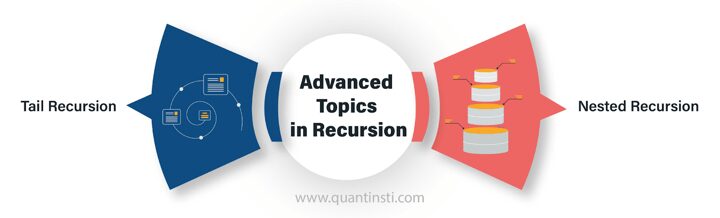
Tail recursion occurs when the recursive call is the last operation performed by the function before returning a result. In other words, the recursive call is in the tail position, and there are no further operations to perform after the recursive call returns.
Tail recursion is significant because it allows some programming languages to optimise recursive calls, known as tail call optimisation (TCO). In languages that support TCO, like Scheme or some functional programming languages, tail-recursive functions can execute with constant stack space, avoiding the risk of stack overflow. However, it is essential to note that Python does not perform automatic tail call optimisation.
Nested recursion refers to a scenario where a recursive function calls itself with a parameter that is the result of another recursive call. In other words, the function’s parameter includes a recursive call within its expression. This recursive call can occur within the function’s arguments or within the function’s return statement.
Nested recursion can result in a more complex recursive process where each level of recursion contains its own set of recursive calls. Understanding and managing nested recursion can be challenging due to its nested nature and the potential for multiple levels of recursion.
Moving forward, we will discuss how to call a recursive function to make it useful.
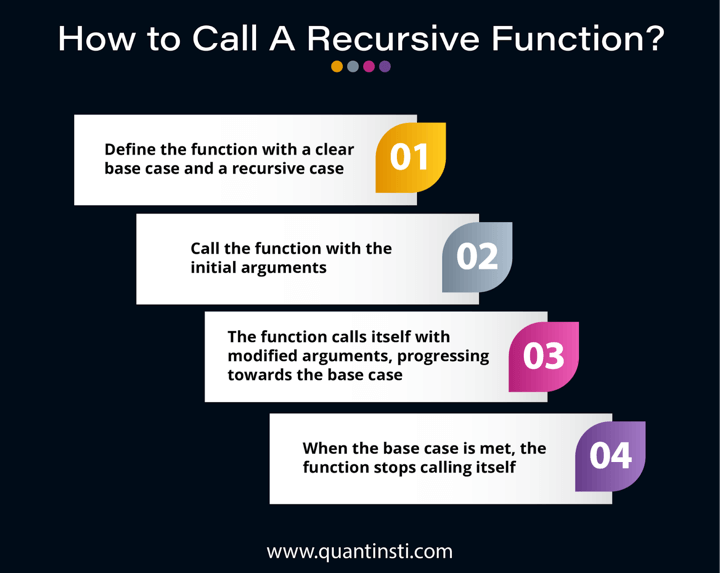
Below are the steps to call a recursive function.
Now we will find out the difference between recursive functions and iterative functions in Python.
Below you will see the difference between recursive and iterative functions in Python with each aspect classifying the difference and making it clearer to understand. ⁽³⁾
| Aspect | Recursive Functions | Iterative Functions |
| Definition | A function that calls itself to solve a problem. | A function that uses loops to repeat a set of instructions until a condition is met. |
| Advantages | Simplicity and clarity for naturally recursive problems.A natural fit for problems that break down into smaller subproblems.Leads to more concise and readable code. | Efficiency in memory and speed.No risk of stack overflow.Predictable performance and easier to optimise. |
| Disadvantages | Risk of stack overflow with deep recursion.Performance overhead due to function call management.Higher memory usage due to additional stack frames. | Can be more complex and harder to understand for naturally recursive problems.May require more boilerplate code for managing loops and state. |
| Example | def factorial_recursive(n): if n == 0: return 1 else: return n * factorial_recursive(n – 1) print(factorial_recursive(5)) Output: 120 | def factorial_iterative(n): result = 1 for i in range(1, n + 1): result *= i return result print(factorial_iterative(5)) Output: 120 |
| When to Use | – When the problem is naturally recursive (e.g., tree/graph traversal, combinatorial problems). – When the recursive solution is significantly simpler and more readable. – When the problem size is small enough to avoid stack overflow issues. | – When performance and memory usage are critical. – When the problem can be easily and straightforwardly solved with loops. – When dealing with large input sizes where recursion depth could be problematic. |
Next, we can find out how to write efficient recursive functions.
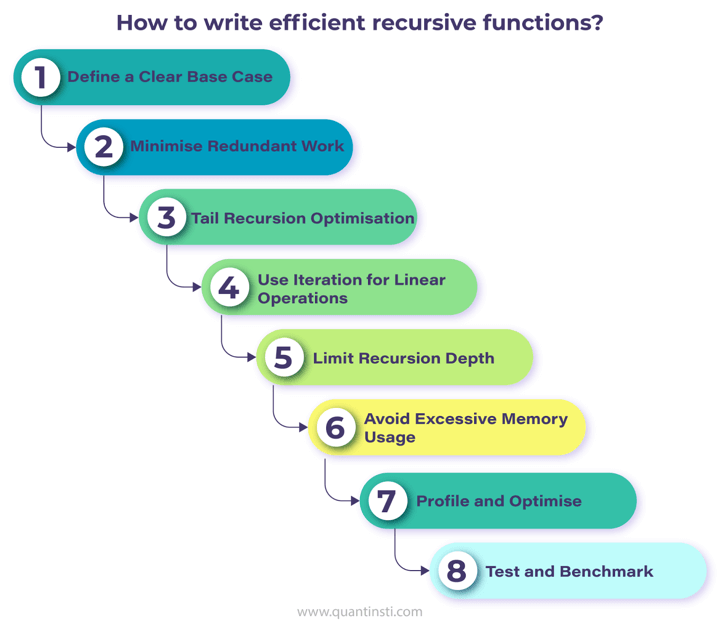
Writing efficient recursive functions involves optimising both the algorithmic approach and the implementation details. ⁽⁴⁾
Here are some tips for writing efficient recursive functions in Python:
By following these tips and considering the specific characteristics of your problem, you can write efficient recursive functions that balance performance with readability and maintainability.
There are certain use cases of recursive functions in Python which we will discuss as we move to the next section.
Stay tuned to learn about applications of recursive functions in trading.
Originally posted on QuantInsti blog.
Author: Chainika Thakar (Originally written by Prachi Joshi)
Information posted on IBKR Campus that is provided by third-parties does NOT constitute a recommendation that you should contract for the services of that third party. Third-party participants who contribute to IBKR Campus are independent of Interactive Brokers and Interactive Brokers does not make any representations or warranties concerning the services offered, their past or future performance, or the accuracy of the information provided by the third party. Past performance is no guarantee of future results.
This material is from QuantInsti and is being posted with its permission. The views expressed in this material are solely those of the author and/or QuantInsti and Interactive Brokers is not endorsing or recommending any investment or trading discussed in the material. This material is not and should not be construed as an offer to buy or sell any security. It should not be construed as research or investment advice or a recommendation to buy, sell or hold any security or commodity. This material does not and is not intended to take into account the particular financial conditions, investment objectives or requirements of individual customers. Before acting on this material, you should consider whether it is suitable for your particular circumstances and, as necessary, seek professional advice.












Join The Conversation
For specific platform feedback and suggestions, please submit it directly to our team using these instructions.
If you have an account-specific question or concern, please reach out to Client Services.
We encourage you to look through our FAQs before posting. Your question may already be covered!