
- Solve real problems with our hands-on interface
- Progress from basic puts and calls to advanced strategies
Interactive Options Course

Posted May 18, 2022 at 12:17 pm
I apologize in advance for trying to thread together some disparate market themes today. I’m taking a couple of days off and there are simply too many topics that warrant discussion today. So here goes…
Veteran traders loath the phrase “worst day since 1987”. Anyone who experienced the ’87 crash will never forget the abject fear and carnage of Black Monday, and the even worse debacle of the following morning that prompted the hasty creation of the Fed’s so-called “plunge protection team.” I was a newly minted graduate of the famed Salomon Brothers training program[i], and it was a true baptism under fire.[ii] I had a slight twinge of post-traumatic shock when I learned that yesterday’s 11% drop in Wal-Mart (WMT) was its worst since 1987.
That was bad, but today’s 24% drop in Target (TGT) is even worse – its own worst drop since 1987. Like WMT, TGT is seeing margin pressures that reflect their inability to fully pass along rising input prices to their customers and an inventory imbalance. WMT is currently down over 5%, and the dual misses in TGT and WMT are pressuring other big-box retailers of consumer staples. Costco (COST) and BJ’s Wholesale (BJ), are currently down about 11% and 15% respectively. Amazon (AMZN), which you should remember IS A RETAILER, is down 5% after conveniently acting like a tech stock that ignored WMT’s miss to rise 4% yesterday.
Here are my takeaways:
On a somewhat different note, I was asked yesterday why some historical volatility measures rose even on such a strongly positive day. It is important to remember that historical volatility doesn’t care if moves are up or down, just the absolute value of the moves of the product in question. A day that is up 2% counts just the same as a day that is down 2%. Implied volatility is determined by traders’ demand for options. Traders tend to pay relatively more for options on down days than they do on up days, which is why we tend to see VIX – an implied volatility-based index – move inversely with the broad market. This article more fully explains the differences between historical and implied volatility.
Finally, we get into what I like to call “Socially Acceptable Volatility.”[iii] Yesterday is what we would consider a bout of socially acceptable volatility. No one seemed to mind when major US indices rose 2% or more. That’s what they’re supposed to do, right? But there is a feeling that something is wrong when we decline by a similar amount. That’s fair – most investors are long, and equity markets usually go up over time. I’ll leave you with a chart that highlights the distinction:
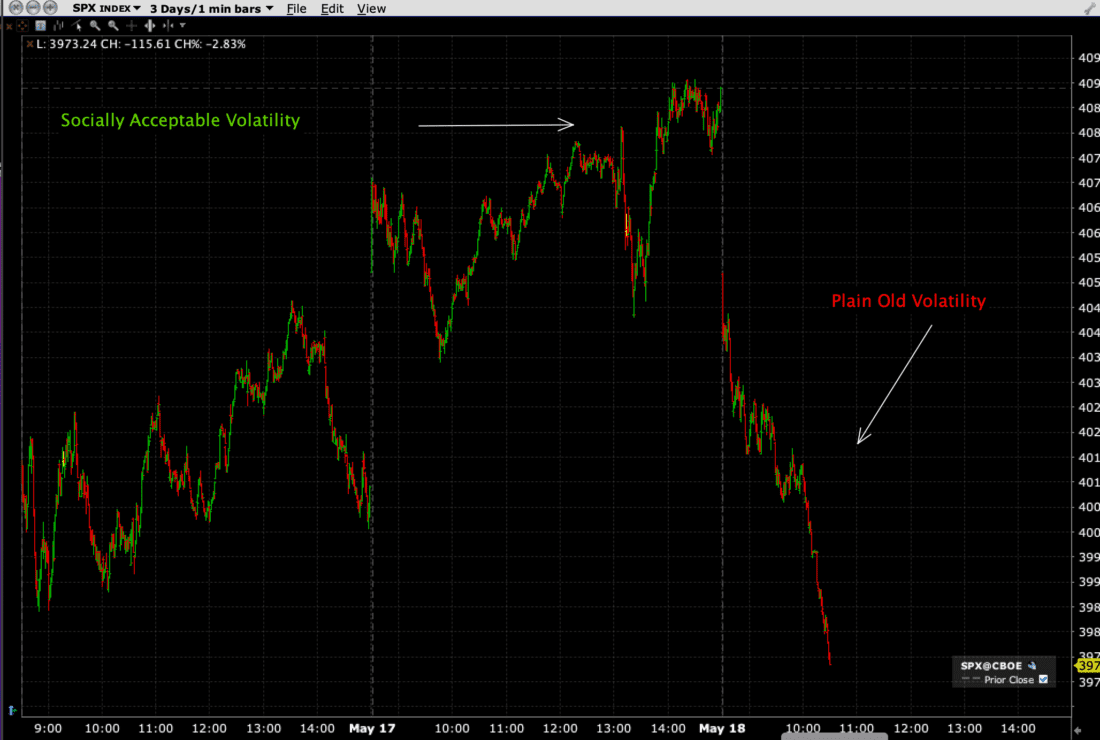
Source: Interactive Brokers
[i] The year after Michael Lewis’ training class
[ii] Attention reporters – this year will be the 35th anniversary of the crash. I would be glad to discuss my recollections, particularly surrounding the following day – which was actually worse
[iii] A term coined by my friend Steve Sears that I liberally appropriate and literally footnote
New to Interactive Brokers?
Open AccountAlready an Interactive Brokers Client?
Request Trading PermissionThe analysis in this material is provided for information only and is not and should not be construed as an offer to sell or the solicitation of an offer to buy any security. To the extent that this material discusses general market activity, industry or sector trends or other broad-based economic or political conditions, it should not be construed as research or investment advice. To the extent that it includes references to specific securities, commodities, currencies, or other instruments, those references do not constitute a recommendation by IBKR to buy, sell or hold such investments. This material does not and is not intended to take into account the particular financial conditions, investment objectives or requirements of individual customers. Before acting on this material, you should consider whether it is suitable for your particular circumstances and, as necessary, seek professional advice.
The views and opinions expressed herein are those of the author and do not necessarily reflect the views of Interactive Brokers, its affiliates, or its employees.
Related Articles
















Join The Conversation
For specific platform feedback and suggestions, please submit it directly to our team using these instructions.
If you have an account-specific question or concern, please reach out to Client Services.
We encourage you to look through our FAQs before posting. Your question may already be covered!