- Solve real problems with our hands-on interface
- Progress from basic puts and calls to advanced strategies
Interactive Options Course
Lesson 5 of 8
Already an Interactive Brokers Client?
New to Interactive Brokers?
While corporate bond investors should conduct their own due diligence on a proposed debt instrument, and its issuer, in large part by closely analyzing a company’s financial health, operational risks, interest-rate environment, and impacts from central bank policies, they may also take into account third-party analysis from credit ratings agencies.
You may recall that investors in this asset class are more concerned with income generation and capital preservation rather than on growth, and, as such, are primarily focused on the return of their principal when the bond matures, as well as their timely receipt of interest payments as long as the debt is held.
By analyzing credit risk, a corporate bond investor is essentially evaluating the likelihood a company may default on its debt obligations – which is the primary objective of credit ratings agencies such as Moody’s Investors Service, S&P Global Ratings, and Fitch Ratings, among others.
The level of credit risk posed by a specific corporate bond, as well as by its issuer, generally indicates the severity of default risk an investor assumes.
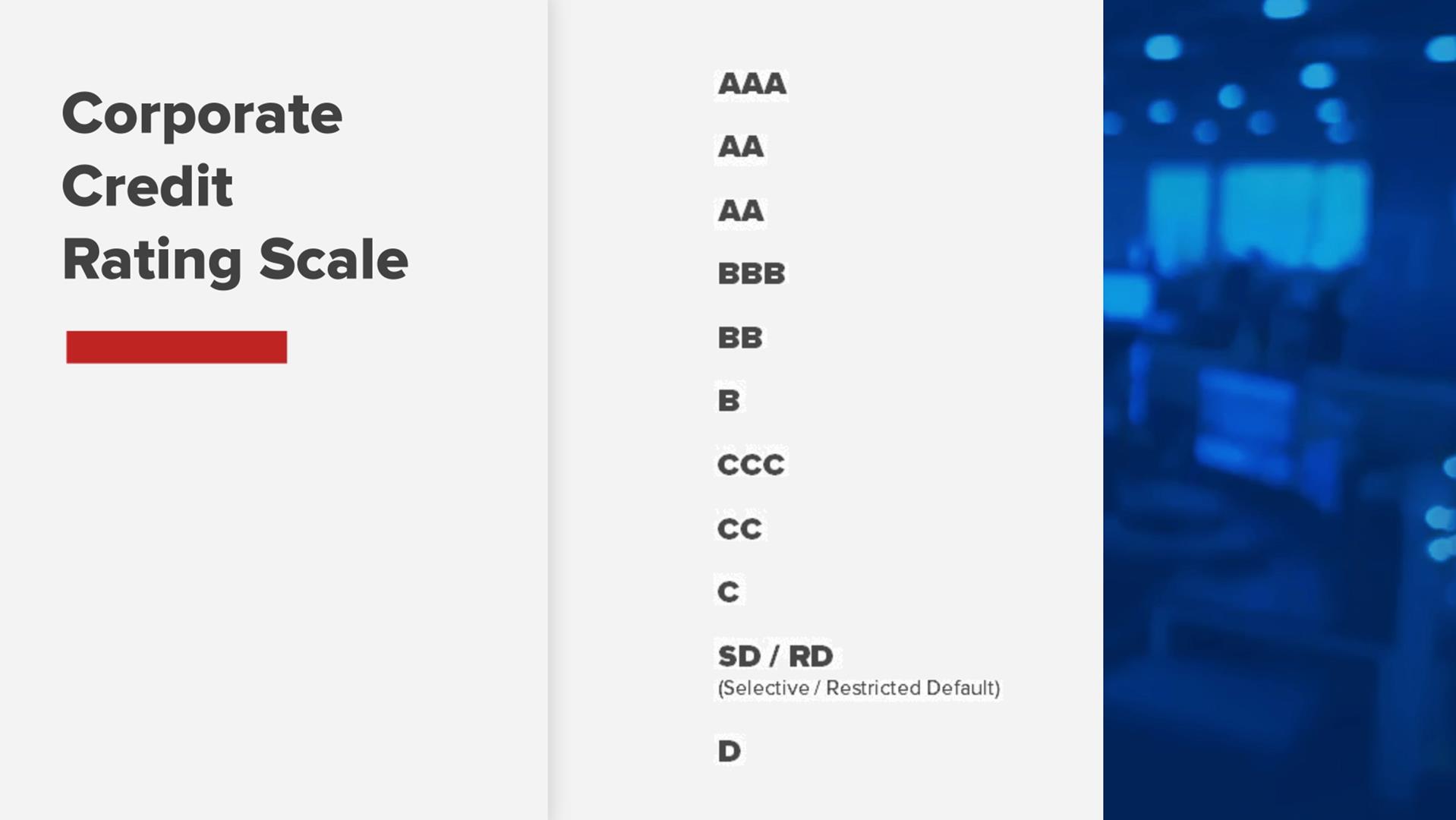
To rank this severity, credit ratings agencies typically use a scale. This scale categorizes the creditworthiness of most issuers of corporate debt, as well as their debt offerings, with designations usually divided into investment-grade (‘AAA’-‘BBB’) and lower-quality (‘BB’-‘C’) credits.
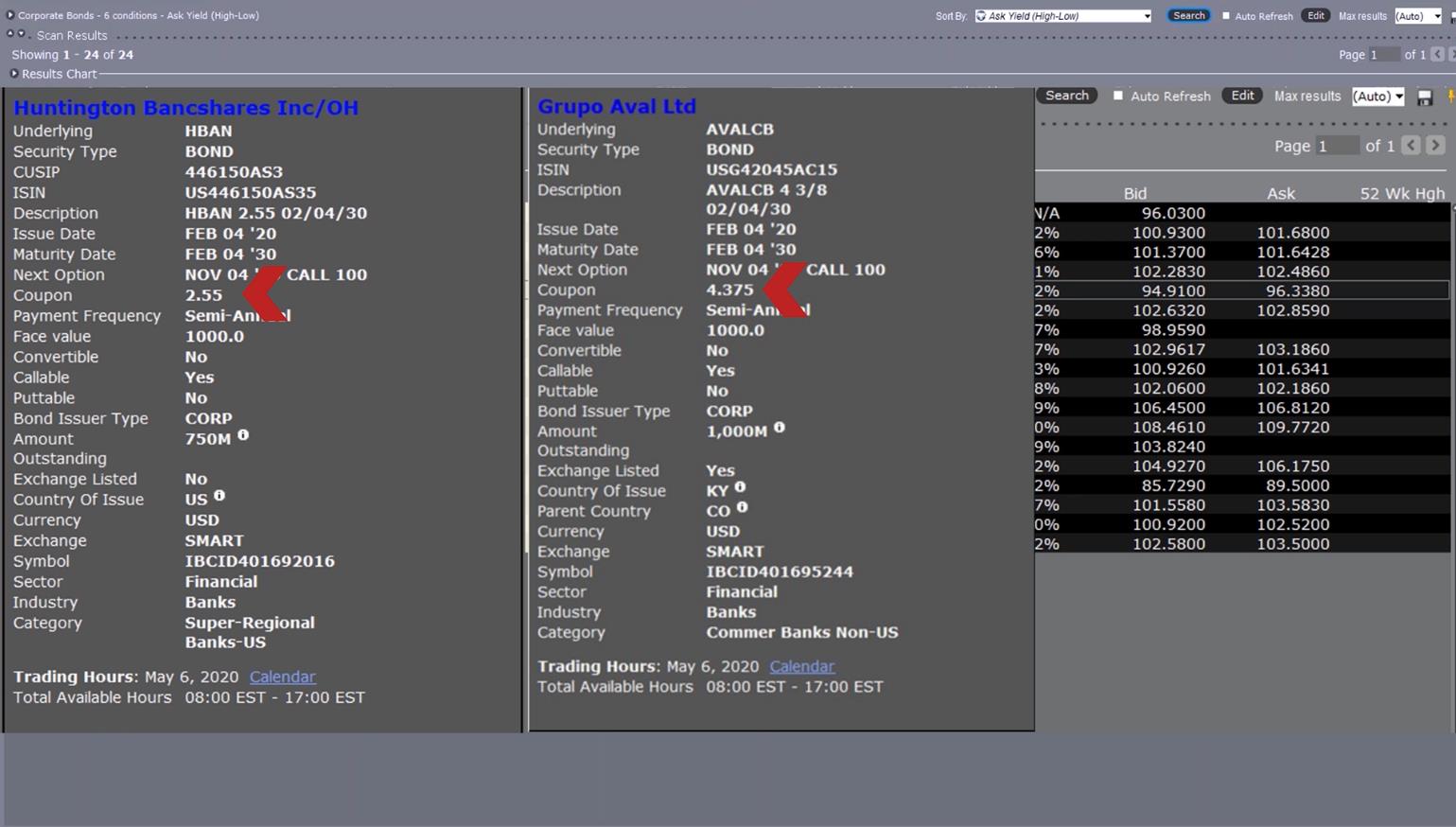
 A corporate bond issuer assigned an investment-grade credit rating is considered by that ratings agency to be more likely to make timely debt service payments than those deemed non-investment-grade – which are also referred to as ‘high-yield’, ‘speculative’ or ‘junk’ bond issuers. Corporate bond investors are generally compensated for higher degrees of credit risks in the form of higher interest rates. For example, using the Global Bond Scanner in the IBKR Trader Workstation, we’ll show how coupons on different grades of corporate bonds differ in value. For illustrative purposes, we’ll select a corporate bond with an investment-grade credit rating by both Moody’s and S&P, such as ‘A’-rated Huntington National Bank’s bond due February 4, 2030, which carries a 2.55% coupon. Meanwhile, a non-investment-grade, ‘BB’-rated bond by Colombian financial services firm Grupo Aval, which was issued on the same day as Huntington National’s sale, and which matures on exactly the same date, carries a much larger 4.375% coupon.
  Overall, credit ratings agencies generally aim to provide a well-detailed, fundamental assessment about a corporate bond issuer, and its debt offering, for investors to factor into their investment decisions. They may provide an analysis of:
The analysis in this material is provided for information only and is not and should not be construed as an offer to sell or the solicitation of an offer to buy any security. To the extent that this material discusses general market activity, industry or sector trends or other broad-based economic or political conditions, it should not be construed as research or investment advice. To the extent that it includes references to specific securities, commodities, currencies, or other instruments, those references do not constitute a recommendation by IBKR to buy, sell or hold such investments. This material does not and is not intended to take into account the particular financial conditions, investment objectives or requirements of individual customers. Before acting on this material, you should consider whether it is suitable for your particular circumstances and, as necessary, seek professional advice.
The views and opinions expressed herein are those of the author and do not necessarily reflect the views of Interactive Brokers, its affiliates, or its employees.










Join The Conversation
For specific platform feedback and suggestions, please submit it directly to our team using these instructions.
If you have an account-specific question or concern, please reach out to Client Services.
We encourage you to look through our FAQs before posting. Your question may already be covered!