
- Solve real problems with our hands-on interface
- Progress from basic puts and calls to advanced strategies
Interactive Options Course

Posted January 13, 2026 at 11:00 am
Labor market data show continued softness in the US and Canada, while Australia’s inflation eases. Next week, watch for steady US inflation and a potential rebound in EU industry.
US: Nonfarm Payrolls Change (Dec.): 50k
US: Labor Productivity (Q3, QoQ, saar): 4.9%
US: Unemployment Rate (Dec.): 4.4%
CA: Unemployment Rate (Dec.): 6.8%
UK: Mortgage Approvals (Nov., thousand): 64.5
UK: Services PMI (Dec., final):51.3
AU: CPI Inflation (Nov., YoY):3.4%
AU: Trimmed Mean CPI (Nov., YoY): 3.2%
JP: Household Spending (Nov., MoM): 6.2%
The dense data fog that had descended upon the US economy due to the prolonged government shutdown is finally starting to lift. New labor market updates this week confirm a backdrop of softness without acute weakness.
Nonfarm payroll employment rose a weaker-than-expected 50k in December, but the bigger story perhaps was the big downward revision to the October estimate, which now indicates a net loss of 173k jobs that month, compared with the 105k decline reported previously. While this is water under the bridge to some extent, it does better match our own estimates of the ultimate impact of the DOGE deferred layoffs announced in the spring but effective in October. The latest data point to job losses averaging 22k per month in Q4 2025.
Performance is poised to improve from here, if for no other reason that there is no DOGE 2.0 on the horizon, but the trend of soft labor demand is here to stay, as evidenced by another drop in job openings. Without a pickup in labor demand, there can be no pickup in hiring. Constraints to labor supply (mostly via immigration) will likely be the factor keeping the unemployment rate in check, although we believe risks are clearly to the upside. The unemployment rate ticked down a tenth to 4.4% in December (November was also revised down by a tenth to 4.5%) but hours worked remain weak and imply more vulnerability under the surface. Wage data was somewhat mixed, with overall average hourly earnings (AHE) inflation up two tenths to 3.8% YoY but AHE for production and non-supervisory employees down to 3.6% YoY, an almost four-year low.
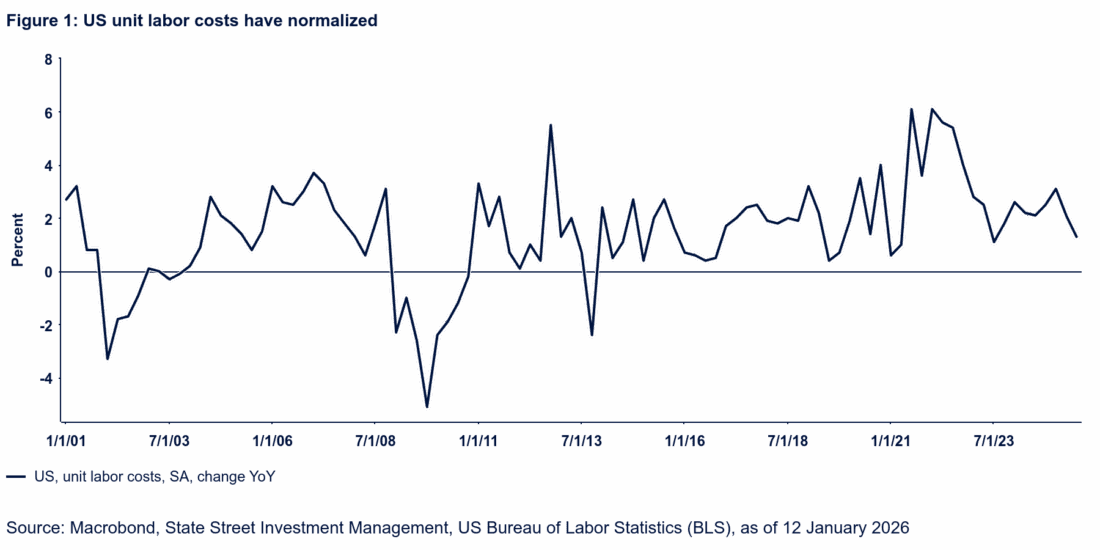
The takeaway here confirms Chair Powell’s assertion over the last few months that the labor market is not a source of meaningful inflationary pressures. If there was any lingering doubt about that, the Q3 update on productivity and labor costs should dispel it. In truth, we are somewhat perplexed by the strength of consumer spending in the Q3 GDP data, and any future downward revisions may alter things at the margin. But, based on current data, labor productivity surged at a 4.9% annualized rate in Q4, keeping unit labor costs growth into negative territory for the second consecutive quarter (‑1.9% QoQ SAAR). Still, these recent declines must be interpreted in the context of the Q1 surge. On a YoY basis, unit labor costs have normalized in a non-inflationary range but are by no means collapsing (Figure 1).
Following several months of positive surprises, the labor market experienced a modest reversal in December, as job creation stalled and the unemployment rate edged higher due to increased labor force participation. Given the inherent volatility in these data, such an outcome is not unexpected and aligns with our view that the labor market continues to face challenges.
In December, the unemployment rate rose from 6.5% to 6.8%, accompanied by an increase in labor force participation from 65.1% to 65.4%. Employment growth within public sectors such as educational services and health care was offset by reductions in other service industries, notably finance and insurance, as well as professional services including accounting, legal, and engineering. Meanwhile, trade-exposed sectors such as manufacturing and transport and warehousing have seen conditions stabilize toward the end of the year.
This development is unlikely to prompt a policy response from the Bank of Canada. Weak labor market, ongoing trade uncertainty, and potential inflation risks suggest that the policy rate will likely remain unchanged in the near term.

Headline CPI inflation came in at 3.4% YoY for November, two tenths below both our and consensus expectations—a positive start to the new year. Our updated forecasts had already penciled in a lower-than-consensus inflation rate of 3.2% YoY for 2026, as we expect the factors that recently pushed CPI higher to gradually fade. The latest print aligns with the Reserve Bank of Australia’s (RBA) projection of a 0.8% quarterly rise, reinforcing the case for a hold in February.
The key swing factor was electricity prices, which surged 7.0% MoM as rebate timing continued to distort pricing. We anticipate ongoing volatility in this segment, meaning occasional upside surprises are likely—but we caution against overreacting to these moves. Rental prices rose 0.4%, and new dwelling costs tracked expectations. Meanwhile, discretionary categories such as clothing (‑3.0%) and accommodation (‑2.7%) declined, likely due to seasonal effects. Goods inflation eased by five tenths to 3.3% YoY, while services remained firm at 3.7%. Importantly, the trimmed-mean measure landed at 3.2% YoY, edging closer to the RBA’s target band.
Looking ahead, we continue to expect the RBA to hold rates for an extended period. However, if policymakers remain patient through H1 and monitor labor market trends closely, they could gain critical space to ease later in the year.
—
Originally Posted on January 12, 2026 – Weekly Economic Perspectives: US labor soft, but no acute stress
Marketing Communication
State Street Global Advisors (SSGA) is now State Street Investment Management. Please go to statestreet.com/investment-management for more information.
State Street Global Advisors Worldwide Entities
The information provided does not constitute investment advice and it should not be relied on as such. It should not be considered a solicitation to buy or an offer to sell a security. It does not take into account any investor’s particular investment objectives, strategies, tax status or investment horizon. You should consult your tax and financial advisor.
The information contained in this communication is not a research recommendation or ‘investment research’ and is classified as a ‘Marketing Communication’ in accordance with the applicable regional regulation. This means that this marketing communication (a) has not been prepared in accordance with legal requirements designed to promote the independence of investment research (b) is not subject to any prohibition on dealing ahead of the dissemination of investment research.
This communication is directed at professional clients (this includes eligible counterparties as defined by the “appropriate EU regulator”) who are deemed both knowledgeable and experienced in matters relating to investments. The products and services to which this communication relates are only available to such persons and persons of any other description (including retail clients) should not rely on this communication.
The views expressed in this material are the views of SSGA Economics Team through the period ended 09 January 2026 and are subject to change based on market and other conditions. This document contains certain statements that may be deemed forward-looking statements. Please note that any such statements are not guarantees of any future performance and actual results or developments may differ materially from those projected.
The whole or any part of this work may not be reproduced, copied or transmitted or any of its contents disclosed to third parties without SSGA’s express written consent.
All information is from SSGA unless otherwise noted and has been obtained from sources believed to be reliable, but its accuracy is not guaranteed. There is no representation or warranty as to the current accuracy, reliability or completeness of, nor liability for, decisions based on such information and it should not be relied on as such.
© 2026 State Street Corporation. All Rights Reserved.
2537623.315.1.GBL.RTL
Exp. Date: 01/31/2027
Do not reproduce or reprint without the written permission of SSGA.
All information has been obtained from sources believed to be reliable, but its accuracy is not guaranteed. There is no representation or warranty as to the current accuracy, reliability or completeness of, nor liability for, decisions based on such information and it should not be relied on as such.
Important Risk Information
Investing involves risk including the risk of loss of principal.
This webcast is provided for informational purposes only and should not be considered investment advice or an offer for a particular security or securities. The views and opinions expressed by the speaker are those of his or her own, and do not necessarily represent the views of State Street or its affiliates. It does not take into account any investor’s particular investment objectives, strategies, tax status or investment horizon. You should consult your tax and financial advisor.
ETFs trade like stocks, are subject to investment risk, fluctuate in market value and may trade at prices above or below the ETFs net asset value. Brokerage commissions and ETF expenses will reduce returns.
State Street Global Advisors and its affiliates have not taken into consideration the circumstances of any particular investor in producing this material and are not making an investment recommendation or acting in fiduciary capacity in connection with the provision of the information contained herein.
© 2026 State Street Corporation – All Rights Reserved
State Street Global Advisors (SSGA) is now State Street Investment Management. Please go to statestreet.com/investment-management for more information.
9053339.1.1.AM.RTL
Exp. Date: 7/31/2027
Bonds generally present less short-term risk and volatility than stocks, but contain interest rate risk (as interest rates raise, bond prices usually fall); issuer default risk; issuer credit risk; liquidity risk; and inflation risk. These effects are usually pronounced for longer-term securities. Any fixed income security sold or redeemed prior to maturity may be subject to a substantial gain or loss.
Investing involves risk including the risk of loss of principal.
The whole or any part of this work may not be reproduced, copied or transmitted or any of its contents disclosed to third parties without SSGA’s express written consent.
Investing in high yield fixed income securities, otherwise known as “junk bonds”, is considered speculative and involves greater risk of loss of principal and interest than investing in investment grade fixed income securities. These Lower-quality debt securities involve greater risk of default or price changes due to potential changes in the credit quality of the issuer.
COPYRIGHT AND OTHER RIGHTS
Other third party content is the intellectual property of the respective third party and all rights are reserved to them. All rights reserved. No organization or individual is permitted to reproduce, distribute or otherwise use the statistics and information in this report without the written agreement of the copyright owners.
Entity Disclosures:
The trademarks and service marks referenced herein are the property of their respective owners. Third party data providers make no warranties or representations of any kind relating to the accuracy, completeness or timeliness of the data and have no liability for damages of any kind relating to the use of such data.
SSGA Funds Management, Inc. serves as the investment advisor to the SPDR ETFs that are registered with the United States Securities and Exchange Commission under the Investment Company Act of 1940. SSGA Funds Management, Inc. is an affiliate of State Street Global Advisors Limited.
Intellectual Property Disclosures:
Standard & Poor’s®, S&P® and SPDR® are registered trademarks of Standard & Poor’s® Financial Services LLC (S&P); Dow Jones is a registered trademark of Dow Jones Trademark Holdings LLC (Dow Jones); and these trademarks have been licensed for use by S&P Dow Jones Indices LLC (SPDJI) and sublicensed for certain purposes by State Street Corporation. State Street Corporation’s financial products are not sponsored, endorsed, sold or promoted by SPDJI, Dow Jones, S&P, their respective affiliates and third party licensors and none of such parties make any representation regarding the advisability of investing in such product(s) nor do they have any liability in relation thereto, including for any errors, omissions, or interruptions of any index.
BLOOMBERG®, a trademark and service mark of Bloomberg Finance, L.P. and its affiliates, and BARCLAYS®, a trademark and service mark of Barclays Bank Plc., have each been licensed for use in connection with the listing and trading of the SPDR Bloomberg Barclays ETFs.
Distributor: State Street Global Advisors Funds Distributors, LLC, member FINRA, SIPC, an indirect wholly owned subsidiary of State Street Corporation. References to State Street may include State Street Corporation and its affiliates. Certain State Street affiliates provide services and receive fees from the SPDR ETFs.
ALPS Distributors, Inc., member FINRA, is distributor for SPDR® S&P 500®, SPDR® S&P MidCap 400® and SPDR® Dow Jones Industrial Average, all unit investment trusts. ALPS Distributors, Inc. is not affiliated with State Street Global Advisors Funds Distributors, LLC.
Before investing, consider the funds’ investment objectives, risks, charges, and expenses. For SPDR funds, you may obtain a prospectus or summary prospectus containing this and other information by calling 1‐866‐787‐2257 or visiting www.spdrs.com. Please read the prospectus carefully before investing.
Information posted on IBKR Campus that is provided by third-parties does NOT constitute a recommendation that you should contract for the services of that third party. Third-party participants who contribute to IBKR Campus are independent of Interactive Brokers and Interactive Brokers does not make any representations or warranties concerning the services offered, their past or future performance, or the accuracy of the information provided by the third party. Past performance is no guarantee of future results.
This material is from State Street Global Advisors and is being posted with its permission. The views expressed in this material are solely those of the author and/or State Street Global Advisors and Interactive Brokers is not endorsing or recommending any investment or trading discussed in the material. This material is not and should not be construed as an offer to buy or sell any security. It should not be construed as research or investment advice or a recommendation to buy, sell or hold any security or commodity. This material does not and is not intended to take into account the particular financial conditions, investment objectives or requirements of individual customers. Before acting on this material, you should consider whether it is suitable for your particular circumstances and, as necessary, seek professional advice.
U.S. Spot Gold trading through IB LLC accounts is only available to legal residents of the United States that do not reside in Arizona, Montana, New Hampshire, and Rhode Island.
Related Articles

















Join The Conversation
For specific platform feedback and suggestions, please submit it directly to our team using these instructions.
If you have an account-specific question or concern, please reach out to Client Services.
We encourage you to look through our FAQs before posting. Your question may already be covered!