
- Solve real problems with our hands-on interface
- Progress from basic puts and calls to advanced strategies
Interactive Options Course

Posted November 6, 2026 at 10:45 am
A few years back, I compared two island-nations whose leaders came to power in 1959. At the time, Cuba was by far the wealthier of the two—rich in sugar, tobacco and tourism—while Singapore was a sleepy former colonial outpost with almost no natural resources.
Fifty-something years later, and the roles have completely reversed. Singapore’s Lee Kuan Yew bet on free markets, low taxes and the rule of law. Cuba’s Fidel Castro bet on central planning.
You know how that turned out.
I’ve wanted to write a follow-up for a while now, and today I’d like to look at two more countries—Poland and Venezuela—that teach the very same lesson, only from opposite directions.
Poland spent four decades under socialist rule and, in 1989, had the courage to walk away from it. Venezuela, on the other hand, was once among the richest nations in the Western Hemisphere, and they walked right into it.
It’s easy to forget how bad things used to be. Several years ago, I sat down with Joanna Sawicka, then a junior analyst on our team, after she returned from a trip to her native Poland. She remembered having to stand in line for hours as a child just to buy food and school supplies. Families were issued government cards that limited how much meat they could buy each month.
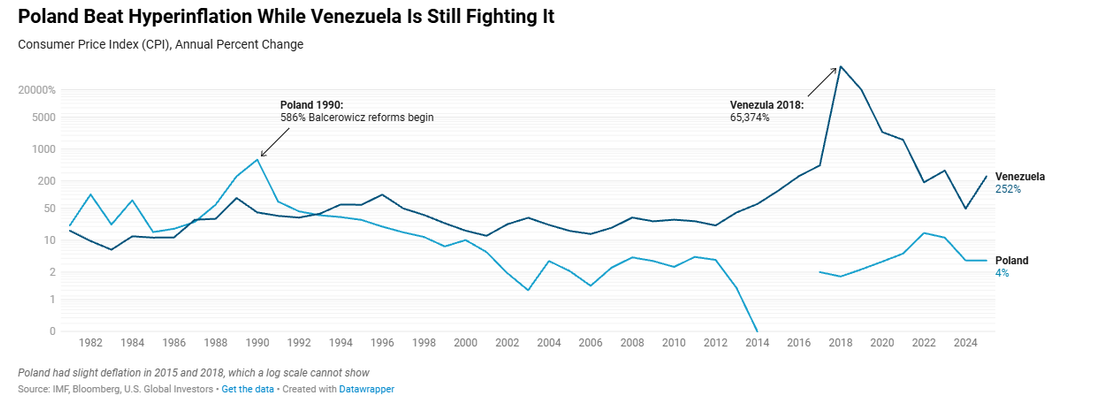
Joanna wasn’t exaggerating. In 1981, the communist government cut the meat ration to just three kilograms per person per month, according to an economic history of Poland published by the Fraser Institute. Real GDP per person fell 18% between 1980 and 1982. By 1990, inflation had hit 586%, and the country’s foreign debt would soon top $48 billion, money it had no way of repaying.
Then Poland did something remarkable. On January 1, 1990, Finance Minister Leszek Balcerowicz launched what became known as “shock therapy.” Roughly 90% of prices were freed, the money printing slowed dramatically and state-owned enterprises were sold off. Shortages that had plagued Poles for decades ended within weeks.
The results have been nothing short of a miracle. Poland’s GDP per capita on a purchasing power parity (PPP) basis grew from about $6,730 in 1990 to nearly $56,000 in 2025. The average Pole is now wealthier than roughly 85% of the world’s population, according to the Polish Economic Institute. After its transition recession, Poland grew for 28 straight years, and it was the only European Union (EU) member to dodge a recession during the global financial crisis.
Back in 2014, I wrote that economists believed Poland could join the world’s 20 largest economies by as early as 2030. Today it’s practically there. The latest International Monetary Fund (IMF) data puts Poland’s 2025 GDP at $1.036 trillion, a hair behind Switzerland, and the IMF projects Poland will pass Switzerland by 2028.
Not bad for a country whose economy was in ruins a little over three decades ago.

Critics like to say that the EU deserves the credit. Membership no doubt helped. But money alone doesn’t build an economy. If it did, Venezuela would be the richest nation in South America today.
That’s what makes Venezuela’s story so tragic. In the 1950s, by some measures, Venezuela’s income per person rivaled that of the U.S. As recently as 1990, a Library of Congress country study said Venezuela “enjoyed the highest standard of living in Latin America.” The country was so wealthy, it was “more frequently a donor than a recipient of foreign assistance.” The same year, the average Pole’s income was only about 70% of the average Venezuelan’s on a purchasing power basis.
To be fair, Venezuela had real problems before Hugo Chavez took office in 1999, including corruption and an overreliance on oil revenues. But Chavez took a flawed petro-state and supercharged its worst instincts. He expropriated private businesses, imposed price and currency controls and turned the state oil company, PDVSA, into a piggy bank for his political programs.
Just look at oil production. Venezuela pumped about 3.45 million barrels a day at its peak in 1998 and roughly 2.9 million when Chavez was sworn in. It never got back there, even when oil traded above $100 a barrel. By September 2020, output had collapsed to just 310,000 barrels a day, a jaw-dropping drop of about 91% from the peak.

The rest of the economy followed. Real GDP shrank more than 75% between 2014 and 2020. Inflation hit an unthinkable 65,374% in 2018, according to the IMF. Roughly 8 million Venezuelans, about a quarter of the population, have fled the country.
Compare that to Poland, where emigrants began returning home after 2015 to take advantage of new opportunities.
As I wrote in January, the U.S. capture of Nicolas Maduro on January 3 was a major turning point. Venezuela’s oil output has climbed from about 820,000 barrels a day in January to 1.24 million in September, an increase of roughly 50%. The country’s defaulted government bonds, which traded around 17 cents on the dollar at the start of 2025, jumped into the low 40s right after Maduro’s capture and changed hands near 51 cents today.
That tells you investors believe things are getting better. But it also tells you they still expect to lose about half their money. And that’s before you consider the human toll of the devastating earthquakes that struck the country in June.
I think the market has it about right. Venezuela hasn’t had its Balcerowicz moment yet. Inflation was still running at 252% last year, and the IMF expects it to get worse in 2026. Restoring oil production to 3 million barrels a day could require as much as $180 billion in capital, according to Berkeley Research Group. Serious investors are going to want sound money, secure property rights, the rule of law and free elections before they commit that kind of money.
The good news is that Poland proves it can be done. In 1989, Poland looked a lot like Venezuela does today, with empty shelves, runaway inflation and unpayable debts. Thirty-five years later, it’s one of the most dynamic economies in Europe.
Whether it’s Singapore and Cuba or Poland and Venezuela, the lesson is the same. Economic freedom creates prosperity, and central planning destroys it. As the authors of the Fraser Institute history warn, the temptation to return to socialism grows stronger as memories fade and fewer people remain who lived through it.
That’s a warning we here in the U.S. would do well to heed, especially with midterm elections coming up.
—
Originally Posted November 2, 2026 – Poland Escaped Socialism and Got Rich. Venezuela Embraced It and Went Broke
All opinions expressed and data provided are subject to change without notice. Some of these opinions may not be appropriate to every investor. By clicking the link(s) above, you will be directed to a third-party website(s). U.S. Global Investors does not endorse all information supplied by this/these website(s) and is not responsible for its/their content.
All opinions expressed and data provided are subject to change without notice. Holdings may change daily.
Some of these opinions may not be appropriate to every investor. By clicking the link(s) above, you will be directed to a third-party website(s). U.S. Global Investors does not endorse all information supplied by this/these website(s) and is not responsible for its/their content.
About U.S. Global Investors, Inc. – U.S. Global Investors, Inc. is an investment adviser registered with the Securities and Exchange Commission (“SEC”). This does not mean that we are sponsored, recommended, or approved by the SEC, or that our abilities or qualifications in any respect have been passed upon by the SEC or any officer of the SEC.
This commentary should not be considered a solicitation or offering of any investment product.
Certain materials in this commentary may contain dated information. The information provided was current at the time of publication.
Some links above may be directed to third-party websites. U.S. Global Investors does not endorse all information supplied by these websites and is not responsible for their content.
Please consider carefully a fund’s investment objectives, risks, charges and expenses. For this and other important information, obtain a fund prospectus by clicking here or by calling 1-800-US-FUNDS (1-800-873-8637). Read it carefully before investing. Foreside Fund Services, LLC, Distributor. U.S. Global Investors is the investment adviser.
Information posted on IBKR Campus that is provided by third-parties does NOT constitute a recommendation that you should contract for the services of that third party. Third-party participants who contribute to IBKR Campus are independent of Interactive Brokers and Interactive Brokers does not make any representations or warranties concerning the services offered, their past or future performance, or the accuracy of the information provided by the third party. Past performance is no guarantee of future results.
This material is from US Global Investors and is being posted with its permission. The views expressed in this material are solely those of the author and/or US Global Investors and Interactive Brokers is not endorsing or recommending any investment or trading discussed in the material. This material is not and should not be construed as an offer to buy or sell any security. It should not be construed as research or investment advice or a recommendation to buy, sell or hold any security or commodity. This material does not and is not intended to take into account the particular financial conditions, investment objectives or requirements of individual customers. Before acting on this material, you should consider whether it is suitable for your particular circumstances and, as necessary, seek professional advice.
Related Articles


















Join The Conversation
For specific platform feedback and suggestions, please submit it directly to our team using these instructions.
If you have an account-specific question or concern, please reach out to Client Services.
We encourage you to look through our FAQs before posting. Your question may already be covered!