
- Solve real problems with our hands-on interface
- Progress from basic puts and calls to advanced strategies
Interactive Options Course
Posted May 28, 2026 at 3:25 am
Investopedia is partnering with All Star Charts on this newsletter. The contents of this newsletter are for informational and educational purposes only.
There’s a chart we’ve been staring at for a few weeks, and it’s worth a closer look.
Groupon currently has roughly 60% of its tradable supply sold short. Days to cover, the metric that estimates how long it would take all those shorts to exit, is sitting around seven.
By most standards, those readings are not high. They’re extreme.
For context, GameStop’s short interest peaked above 100% of its float before the 2021 squeeze.
Volkswagen’s locked-up float in 2008 was in the same ballpark as Porsche’s stake when it was revealed, and the stock quadrupled in two days.
Groupon is not at those levels. But it is closer to them than 99% of the rest of the market.
Here’s the chart:
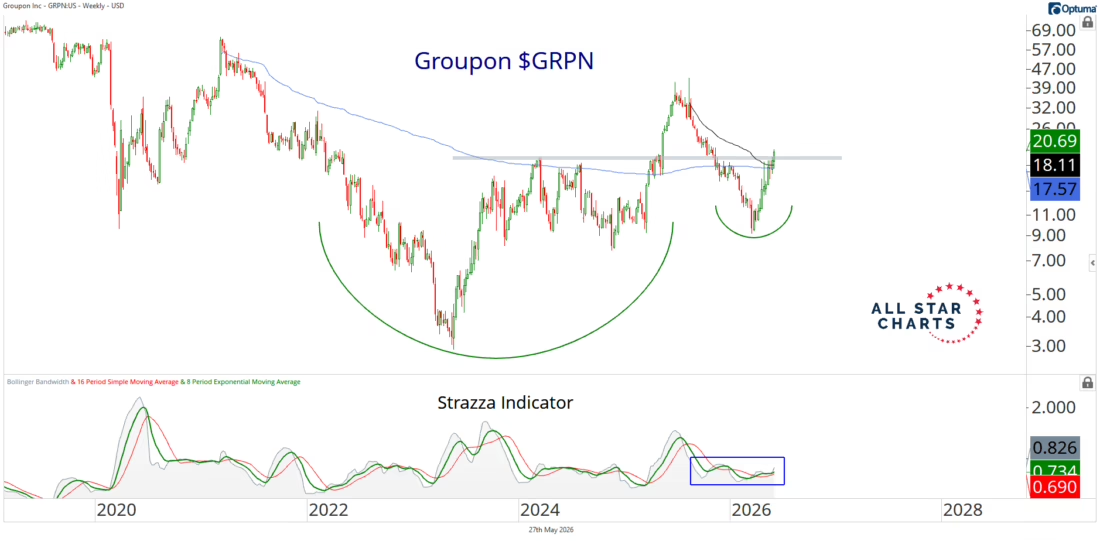
What you’re looking at is a stock that has been building a base for more than a year, repeatedly testing the same level near $19, and is now trying to break through. The $19 line matters because it’s a polarity zone, a price the stock has used as both ceiling and floor at different points in its history.
Multiple anchored measurements of average buyer cost basis, based on the 2021 and 2025 highs, fall within the same range.
In English, many independent measurements point to $19 as the line that matters.
Why Heavy Short Interest Creates a Tailwind
Most people think of short sellers as bears. They are, in the moment. But every open short is a future buy order.
When you short a stock, you borrow shares, sell them at the current price, and plan to buy them back later at a lower price. The shares have to be returned eventually. That return, the closing trade, is a purchase. Every short position is a buy that hasn’t happened yet, sitting in the book waiting for a reason to execute.
When a stock keeps falling, shorts can take their time. They’re profitable. They have no urgency.
When the stock starts rising, the math flips. Losses on a short are theoretically unlimited because a stock can keep going up forever. Brokers issue margin calls. Risk managers force exits. And the only way to close a short is to buy.
Each forced purchase pushes price higher, which forces more shorts to cover, which pushes price higher still. That feedback loop is what people mean when they say short squeeze.
It’s not magic. It’s just the math of forced buying compounding.
The reason squeezes look violent is that the fuel is finite. Once most of the shorts are out, the artificial buying pressure disappears, and the stock often retraces hard.
Volkswagen gave back most of its squeeze gains within months. GameStop is still trading well below its 2021 peak. Squeezes are events, not trends.
What Makes the Groupon Setup Different
You can’t squeeze a stock that no one is shorting, and you can’t squeeze one that nobody wants to buy. Groupon currently has both ingredients.
The short side is crowded.
Sixty percent of the float is the kind of number that gets attention. The long side has been quietly building a base for over a year, which means buyers have been showing up at the same price levels patiently, without panic, while the bears piled on.
That is the setup the team flags every time it shows up. It doesn’t guarantee anything. Plenty of heavily shorted stocks stay heavily shorted because the bears are right.
But if Groupon closes meaningfully above $19 and holds, the short interest data suggests there is real potential for forced covering to accelerate the move.
If it fails at that level and rolls over, the setup is invalidated, and the bears keep their thesis. The level itself tells you which side was right.
What to Do With This
A short squeeze isn’t a strategy. It’s a market event you can recognize in advance if you know what to look for.
The practical lesson is simpler than the mechanical.
When a stock has unusual short interest and is approaching a level it has repeatedly failed to clear, the question stops being whether the bears are right about the company.
It becomes: who is positioned for what comes next?
That question matters whether you ever trade Groupon or not. The same setup shows up across the market several times a year, and the investors who recognize the math early are the ones who don’t get caught on the wrong side when it resolves.
We’ll be watching $19.
Tomorrow at 5 PM ET, our Senior Crypto Analyst Louis Sykes is walking through what he calls the $100 Trillion Trade.
It’s a tokenization shift the SEC cleared in December that goes live in July. Louis covers digital assets full-time, and he’s laid out exactly which company he thinks is positioned to benefit and why he’s already invested.
Reserve your seat for tomorrow’s call
—
Originally posted 27th May 2026
Investopedia.com: The comments, opinions and analyses expressed herein are for informational purposes only and should not be considered individual investment advice or recommendations to invest in any security or to adopt any investment strategy. While we believe the information provided herein is reliable, we do not warrant its accuracy or completeness. The views and strategies described on our content may not be suitable for all investors. Because market and economic conditions are subject to rapid change, all comments, opinions and analyses contained within our content are rendered as of the date of the posting and may change without notice. The material is not intended as a complete analysis of every material fact regarding any country, region, market, industry, investment or strategy. This information is intended for US residents only.
Information posted on IBKR Campus that is provided by third-parties does NOT constitute a recommendation that you should contract for the services of that third party. Third-party participants who contribute to IBKR Campus are independent of Interactive Brokers and Interactive Brokers does not make any representations or warranties concerning the services offered, their past or future performance, or the accuracy of the information provided by the third party. Past performance is no guarantee of future results.
This material is from Investopedia and is being posted with its permission. The views expressed in this material are solely those of the author and/or Investopedia and Interactive Brokers is not endorsing or recommending any investment or trading discussed in the material. This material is not and should not be construed as an offer to buy or sell any security. It should not be construed as research or investment advice or a recommendation to buy, sell or hold any security or commodity. This material does not and is not intended to take into account the particular financial conditions, investment objectives or requirements of individual customers. Before acting on this material, you should consider whether it is suitable for your particular circumstances and, as necessary, seek professional advice.
Related Articles















Join The Conversation
For specific platform feedback and suggestions, please submit it directly to our team using these instructions.
If you have an account-specific question or concern, please reach out to Client Services.
We encourage you to look through our FAQs before posting. Your question may already be covered!