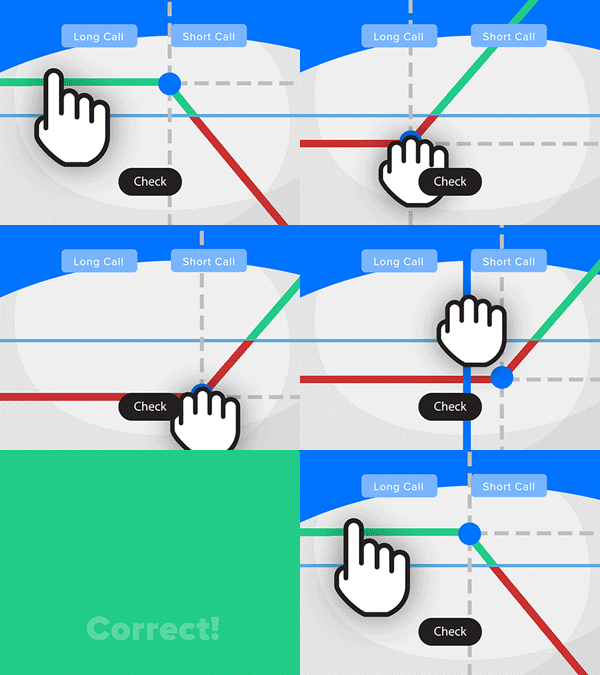
- Solve real problems with our hands-on interface
- Progress from basic puts and calls to advanced strategies
Interactive Options Course
Posted July 30, 2026 at 2:38 am
Investopedia is partnering with All Star Charts on this newsletter. The contents of this newsletter are for informational and educational purposes only.
The bond market has been quiet for years.
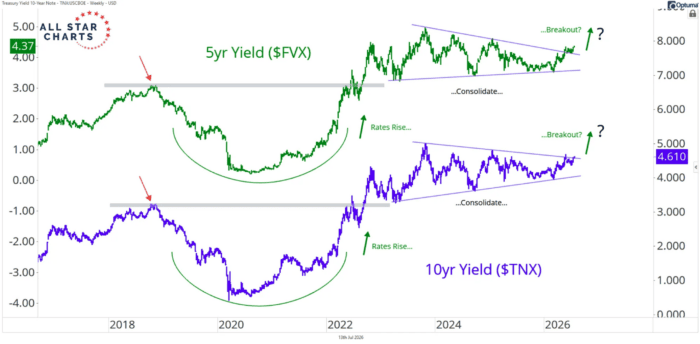
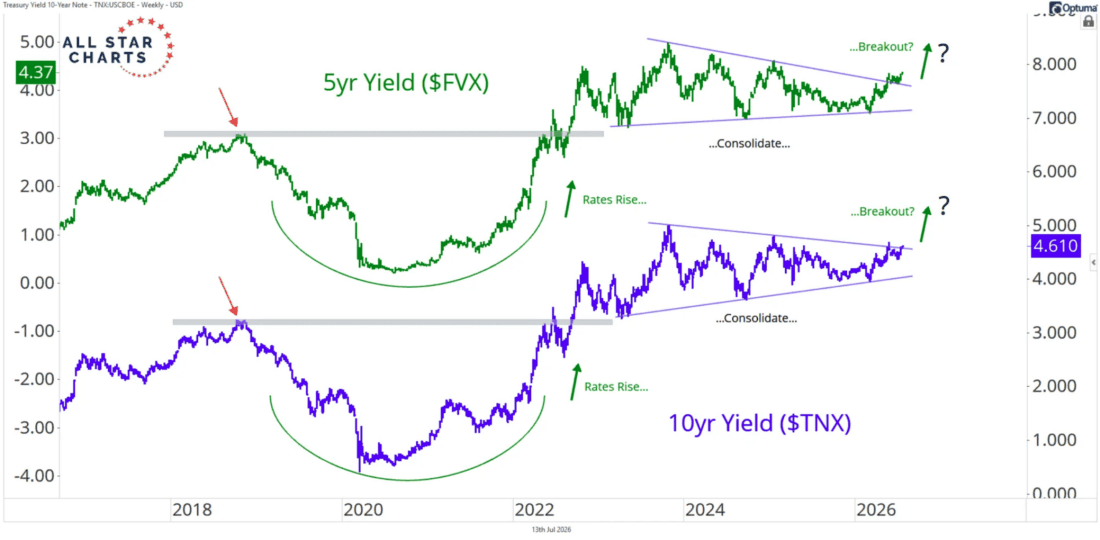
That quiet is a big reason stocks have been able to run, and it may not survive the afternoon. Both the 5-year and 10-year Treasury yields are now pressing against the top of consolidation ranges that have held since 2022, with the 10-year near 4.61% and the 5-year near 4.37%. Four years of grinding sideways inside a narrowing wedge, and both are at the ceiling at the same time.
Compression like that resolves eventually. One side of the range wins.
The Federal Reserve announces at 2:00 this afternoon, and this meeting is unusual. Going into most FOMC decisions over the past five years, markets priced a single outcome at 95% probability or better. This time the odds are genuinely split, with a meaningful share of the market pricing a hike that would have been unthinkable a few months ago.
A compressed range and a live binary event is why bonds deserve attention today even from investors who never buy one.
Why bonds set the tone
No market trades in a vacuum.
Treasury yields are the reference rate for nearly everything else. They determine the discount rate applied to future corporate earnings, which is the mechanical input behind equity valuations. They set the cost of corporate borrowing. They drive currencies through interest rate differentials, and through currencies they reach commodities.
When the reference rate moves violently, everything priced against it has to reprice.
Direction matters less than speed
This is the part most investors get backwards.
Whether rates rise or fall matters less than how fast they do it. Markets adapt to almost any rate level given time. What they cannot absorb is rapid, unpredictable movement, because that removes the ability to plan.
The instrument that measures it is the ICE BofA MOVE Index, often called the VIX of the bond market. It tracks implied volatility on Treasury options across the 2-, 5-, 10-, and 30-year tenors, expressed in basis points.
It typically ranges between roughly 50 and 250 in normal conditions and spikes above 150 under real stress. It peaked near 150 in late 2022 during the fastest hiking cycle in modern history. It broke above 180 in early March 2023, before Silicon Valley Bank failed.
Recently it has been sitting near 70, which reflects a calm Treasury market where options are cheap and no policy-shock premium is being priced.
That calm is not incidental to the equity rally. The S&P 500 held a correlation near 0.80 with the MOVE Index through 2025, because when bond volatility falls, discount rates stabilize and valuations expand. The relationship runs the other way too, and spikes in MOVE have historically arrived before spikes in the VIX rather than after.
The case against reading it this way
Consolidations persist far longer than they look capable of.
These ranges have held for four years, and patterns that size routinely produce false breakouts before resolving. One day through the top of a range is not a trend change.
The Fed also rarely delivers genuine surprises. Central banks telegraph intentions through speeches and projections specifically to avoid disorderly repricing, and the base case for any meeting is that markets absorb it within hours.
There’s a fair argument that the level matters more than this framing admits. A 10-year at 4.6% is a materially different cost of capital than one at 3.5%, regardless of how smoothly it got there.
The counterpoint is narrower than it sounds. Nobody claims the level is irrelevant. The claim is that markets price levels in advance and struggle with velocity, which is why the volatility measure has historically led the price measure.
What to actually watch
Not the yield by itself.
Watch whether the 5-year and 10-year clear their range highs together, because one tenor moving alone is noise while both moving together signals a shift in the whole curve. Then watch whether bond volatility expands with it. A breakout on stable volatility is a repricing, while a breakout on rising volatility is a regime change.
For four years that measure has stayed quiet. Today is the most likely day in months for that to change.
And the timing could not be worse for the most expensive part of the market.
Bond yields set the discount rate. Earnings tell you which companies can actually grow into it. This week delivers both at once, with Microsoft and Meta tonight and Apple and Amazon tomorrow.
Long-duration assets are the most sensitive to both inputs, and mega-cap technology is the longest-duration trade on the board.
Spencer is trading it live, right after the Morning Show on Wednesdays and Thursdays for the next three weeks.
Not a recap the following morning, not a walkthrough of what he would have done. Live, in the first 30 to 60 minutes after the open, with his own money on the line.
That first hour after a mega-cap print is where the opportunity is, and that’s exactly when he’ll be on.
—
Originally posted 29th July 2026
Investopedia.com: The comments, opinions and analyses expressed herein are for informational purposes only and should not be considered individual investment advice or recommendations to invest in any security or to adopt any investment strategy. While we believe the information provided herein is reliable, we do not warrant its accuracy or completeness. The views and strategies described on our content may not be suitable for all investors. Because market and economic conditions are subject to rapid change, all comments, opinions and analyses contained within our content are rendered as of the date of the posting and may change without notice. The material is not intended as a complete analysis of every material fact regarding any country, region, market, industry, investment or strategy. This information is intended for US residents only.
Information posted on IBKR Campus that is provided by third-parties does NOT constitute a recommendation that you should contract for the services of that third party. Third-party participants who contribute to IBKR Campus are independent of Interactive Brokers and Interactive Brokers does not make any representations or warranties concerning the services offered, their past or future performance, or the accuracy of the information provided by the third party. Past performance is no guarantee of future results.
This material is from Investopedia and is being posted with its permission. The views expressed in this material are solely those of the author and/or Investopedia and Interactive Brokers is not endorsing or recommending any investment or trading discussed in the material. This material is not and should not be construed as an offer to buy or sell any security. It should not be construed as research or investment advice or a recommendation to buy, sell or hold any security or commodity. This material does not and is not intended to take into account the particular financial conditions, investment objectives or requirements of individual customers. Before acting on this material, you should consider whether it is suitable for your particular circumstances and, as necessary, seek professional advice.
Municipal Bonds are only available from Interactive Brokers for IBKR LLC, IBKR Canada, IBKR Hong Kong, IBKR Australia and IBKR Singapore entities.
Related Articles















Join The Conversation
For specific platform feedback and suggestions, please submit it directly to our team using these instructions.
If you have an account-specific question or concern, please reach out to Client Services.
We encourage you to look through our FAQs before posting. Your question may already be covered!